skip to main |
skip to sidebar
 Film: Time
Release date: 23rd August 2010
Certificate: 15
Running time: 97 mins
Director: Kim Ki-duk
Starring: Ha Jung-woo, Park Ji-yeon, Jang Jun-yeong, Jung Gyu-woon, Kim Ji-heon
Genre: Drama/Romance
Studio: Palisades Tartan
Format: DVD
Country: South Korea
Award-winning (Berlin and Venice Film Festivals for Samaritan Girl and 3-Iron respectively) Korean director Kim Ki-duk flirts with controversy once more as he invites his audience to examine a world of unhealthy obsession, narcissistic tendencies and the violence of manufactured beauty, in a film only screened in his homeland after 10,000 South Koreans signed up to an online protest, thus forcing a limited art house release.
Film: Time
Release date: 23rd August 2010
Certificate: 15
Running time: 97 mins
Director: Kim Ki-duk
Starring: Ha Jung-woo, Park Ji-yeon, Jang Jun-yeong, Jung Gyu-woon, Kim Ji-heon
Genre: Drama/Romance
Studio: Palisades Tartan
Format: DVD
Country: South Korea
Award-winning (Berlin and Venice Film Festivals for Samaritan Girl and 3-Iron respectively) Korean director Kim Ki-duk flirts with controversy once more as he invites his audience to examine a world of unhealthy obsession, narcissistic tendencies and the violence of manufactured beauty, in a film only screened in his homeland after 10,000 South Koreans signed up to an online protest, thus forcing a limited art house release.
Sehie (Park Ji-yeon) is a beautiful, yet extremely insecure and jealous woman, who feels that her long term relationship with Jiwoo (Ha Jung-woo) is growing stale. With each passing day she believes that her beauty is fading while the other women Jiwoo comes into contact with during his normal mundane life are more interesting and considerably better looking than her.
Despite her relatively contented boyfriend’s protests, she persists with her paranoid thoughts and accusations, verbally abusing waitresses and cafe customers at the local cafe, the couple’s regular meeting spot. From a mind bordering on the psychotic, an idea is hatched as Sehie realises that something drastic needs be done to stop the situation escalating to such a degree that she will lose the love of her life forever.
After secretively consulting with a plastic surgeon, Sehie books herself into a clinic and begins the painful six month procedure that will completely reshape her face and, hopefully, achieve a higher level of beauty. Jiwoo is distraught at her sudden disappearance, he devotes time and effort searching high and low for his girlfriend, but, eventually, he admits defeat. Gradually, as his pain lessens, he begins to date other women, yet, in the back of his mind, he can never quite let his desire for Sehie go.
Several months later, a mysterious new waitress calling herself Saehie (Seong Hyeon-ah) begins to work at his local cafe. There is an instant attraction, a strange familiarity that Jiwoo cannot explain - he is compelled to be with her, yet Sehie still haunts his thoughts...
Time is an atypical and somewhat curious film from a director known for pushing the envelope with bizarre characters, often on the wrong side of the law, and left of centre situations. In this case, the leads are the epitome of middle class, law-abiding Asia - they hang out in coffee bars, have normal jobs, run of the mill hobbies and, on the surface at least, aspirations for a mediocre life. There are no fantastic monsters or ‘outsiders’ on the edge of society to invoke the audience’s attention, instead Kim Ki-duk utilises the desires and fixations that swim behind the eyes of these seemingly conventional citizens.
Ki-duk briefly begins his story at the halfway point, where we witness gruesome and detailed face surgery, before jumping back in time to the psychological lead up to Sehie’s extreme solution for solving her insecurities. Initially, the director draws us in by skilfully orchestrating his main actors - all well on top of their game - through a maze of raw emotions that he hopes will justify his severe story arc. Unfortunately, it is this intense story arc that is the weak link and, ultimately, the movie’s downfall. We are asked to suspend belief as each new emotional outburst grows in intensity and, like the story’s nervous bystanders, we begin to feel increasingly uncomfortable and somewhat alienated by a plot, now, punctured with too many unacceptable coincidences.
The cinematography is on a par with Kim Ki-duk’s usual work - in fact, it is particularly reminiscent of his earlier films The Coast Guard and The Isle, in style rather than the far removed content. The latter being his most controversial film, in the UK at least, after its release was delayed due to accusations of animal cruelty on set. The director later admitted, and voiced regret for slicing open a live frog and mutilating several fish for particular scenes within that film.
Other positives are that Ki-duk utilises the scenery and vistas to great effect, his use of colour is, at times, exquisite, and even the background music, often a weak point, is fine. The dialogue, for the most part, is believable, if not the motives and reasoning behind the characters’ words. If his idea was to make us question our identity, who we are, and if true beauty is more than skin deep then this movie does just that, albeit going too far in its search for answers to these raised questions. In fact, if we accept the plot’s weak points, as huge as they are, there is still much to be enjoyed by watching these occasionally mesmerising characters attempt to fulfil their passionate and seemingly unattainable desires.
Time is an engaging little film with a plot that is as compelling as it is frustrating, and a ‘love it’ or ‘hate it’ ending, yet easily worth 97 minutes of anyone’s time. MG
Series: Mobile Suit Gundam Wing – Complete Collection 1/2
Release date: 2nd August 2010
Certificate: PG
Running time: 625 mins
Director: Masashi Ikeda
Starring: Ai Orikasa, Akiko Yajima, Hikaru Midorikawa
Genre: Anime
Studio: Beez
Format: DVD
Country: Japan
This release includes the first 25 episodes (of 49) of this series of the Gundam franchise, originally shown in Japan in 1995. Falling into the mecha genre of anime, featuring gigantic fighting machines, it tells the story of five young warriors battling against aggressive military powers that are attempting to gain control of the colonies of outer space.
Following the assassination of a pacifist leader of the colonies, five pilots are trained by disaffected scientists to combat the sinister United Earth Sphere Alliance using the advanced technology of virtually indestructible ‘mobile suits’. Made of a resilient alloy known as Gundanium, and hence known as Gundams, these monumental fighting machines are controlled by a pilot who sits within each mobile suit, and are able to navigate space as well as earth’s atmosphere to battle their enemies.
The five pilots are sent to earth in order to rearm its inhabitants against the dominant power of the Alliance, and the military organisation known as OZ (the Organisation of the Zodiac), which possesses its own, inferior mobile suits together with specially trained forces to operate them. The five pilots – Heero Yuy, Chang Wufei, Quatre Raberba Winner, Trowa Barton and Duo Maxwell – are initially unaware of each other’s presence, and must find and learn to trust each other in order to maximise their strength against OZ and the Alliance.
The pilots receive help from surprising quarters in their journey. The crash landing of Heero’s mobile suit into the sea is witnessed by a schoolgirl, Relena Darlian, daughter of the Vice Foreign Minister of the Alliance. Despite the fact that her father represents the Alliance, it transpires that he sympathises with the pacifist philosophy of the colonies, and that Relena has a secret identity that unexpectedly aligns her with the cause of the Gundams.
The finest fighter among OZ’s mobile suit forces, Zechs Merquise, would seem to be the Gundams’ most daunting foe, but again the discovery of his true identity reveals that his mission is in fact allied to that of the Gundams. Even amongst the highest echelons of OZ, a distaste for the brutal destruction of mechanised warfare is expressed. OZ’s leader, Treize Kushrenada, has a strong philosophical ethos concerning the role of the warrior, displaying a spiritual rather than purely militaristic character.
Allegiances change during the series, and the Gundams’ eventual discovery that the colonies have accepted OZ and now denounce the Gundams as rebels causes a crisis among their ranks…
This shifting of loyalties between various factions lends some complexity to the plot. There is obviously an ambition to explore the nature of what it means to fight, how a soldier should honourably conduct himself, and the psychological consequences when characters trained purely for battle suddenly find that their sole purpose has become redundant.
The characterisation of the Gundam pilots seems intended to show the different ways this military quest impacts on different personalities. Heero’s apparent coldness masks a compassion for the plight of the oppressed colonies. Duo and Quatre’s warmer personalities demonstrate the importance of humour and kindness in forging bonds between the Gundams, while Wufei’s harsh judgement of weak opponents is linked to a strong sense of his spiritual duty as a warrior.
Despite this, there’s little here to distinguish the characterisation from standard bishounen fare. Gundam’s rabid fan base indicates that there’s a strong enough appeal to spark off a mass of fanfic, much of it falling into the yaoi category, using the strong bonds between the Gundam pilots as the inspiration for homoerotic fantasy. The angst of the Gundams’ semi-suicidal quest and lack of any clear romantic links to the female characters may well be the source of this. That, and their standard big-eyed, spikily coiffed, lean-hipped appearance – but like Jessica Rabbit, they can’t help that, they’re just drawn that way.
Far better design is shown in the mobile suits themselves, whose severe and angular faces suggest the stylisation of Samurai helmets, while their chunkiness, primary colours and completely unsubtle big-bang destruction techniques fully demonstrate why there’s a highly successful merchandising spinoff from the Gundam franchise. The animation of the series overall is poor, with many cels being reused while only small elements of foreground action are actually animated. There’s nothing visually striking about the series overall, but somehow the appealing mobile suit designs manage to give the frequent fight scenes an air of retro charm.
The dialogue can sometimes seem pitifully ill-matched to the visuals. When Treize meditates upon the nature of being a soldier in the last episode of this release (“the emotions of those who are thought to be beautiful are always full of sorrow”), the impact of this is completely undermined by the poor quality of the images and animation. And however much the characters may bang on about their belief in peace and their hatred for the evil militarism of the Alliance and OZ, this is contradicted by the fact that every one of them is busy blowing up military bases, blasting space stations, annihilating mobile suit pilots and, should all more advanced technology fail, taking a good old fashioned potshot at someone with a pistol. Dress it up how you like with some superficial hand wringing, the odd crisis of conscience and the occasional bout of insanity, it’s still just a bunch of unfeasibly young pretty boys, possessing wish-fulfilling levels of strength and indestructibility, in possession of mega cool toys enabling them to be really heroic on a universal stage.
The plot’s pleasingly twisty, the mobile suits are transformer-tastic, and there’s some good J-pop to sandwich each episode, but the animation’s rubbish and the characters aren’t distinctive enough. If you want Gundam, you’re better off with one of the classic 1980s series such as 08th MS Team or 0083: Stardust Memory. KR

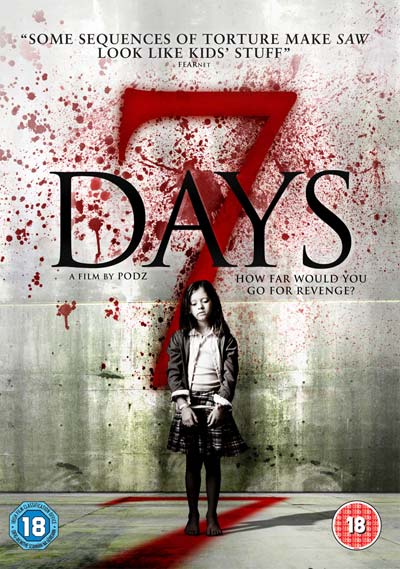
 Film: 7 Days
Release date: 23rd August 2010
Certificate: 18
Running time: 106 mins
Director: Daniel Grou
Starring: Rémy Girard, Claude Legault, Fanny Mallette, Martin Dubreuil, Rose-Marie Coallier
Genre: Drama/Horror/Thriller
Studio: E1
Format: DVD
Country: Canada
Daniel Drou plays Devil’s advocate as he directs the brutal, yet powerful French-Canadian film 7 Days (original title Les Sept Jours Du Talion, literally translated as 7 Days Of Retaliation), a story based on a novel by Patrick Senécal (who also wrote the screenplay) of a man who sinks deeper and deeper into despair as he takes the law into his own hands and comes face-to-face with the ‘monster’ who raped and murdered his only child.
Film: 7 Days
Release date: 23rd August 2010
Certificate: 18
Running time: 106 mins
Director: Daniel Grou
Starring: Rémy Girard, Claude Legault, Fanny Mallette, Martin Dubreuil, Rose-Marie Coallier
Genre: Drama/Horror/Thriller
Studio: E1
Format: DVD
Country: Canada
Daniel Drou plays Devil’s advocate as he directs the brutal, yet powerful French-Canadian film 7 Days (original title Les Sept Jours Du Talion, literally translated as 7 Days Of Retaliation), a story based on a novel by Patrick Senécal (who also wrote the screenplay) of a man who sinks deeper and deeper into despair as he takes the law into his own hands and comes face-to-face with the ‘monster’ who raped and murdered his only child.
Bruno Hemel (Claude Legault) is a well-mannered, highly respected and successful surgeon who lives with his wife Sylvie (Fanny Mallette) and their beloved daughter Jasmine (Rose-Marie Coallier) in a quiet suburban neighbourhood in Quebec, Canada.
The day starts with the happy family all enjoying breakfast together at the kitchen table. Jasmine wants her father to help her deliver birthday invitations to the homes of her friends before she goes to school. But after an all-night operation at the hospital, Bruno is too tired to escort her, and her mother doesn’t have the time to help either. Disappointed, Jasmine decides that she will deliver the invitations after lunch and is lovingly sent off to school.
As Jasmine heads off, Sylvie persuades an unenthusiastic and weary Bruno to partake in some morning lovemaking before she leaves for work. Sometime after, he awakes to an empty house and begins working on his laptop whilst drinking a bottle of beer, but a knock at the door brings the realisation that Jasmine never made it to school and has gone missing. The police are called, and with Bruno assisting them, a hunt for the young girl begins.
The discovery of her abused and murdered bloody body is the beginning of Bruno’s spiral into rage, darkness and misery which leads to the kidnapping of the murderer, Anthony Lemaire (Martin Dubreuil), and seven days of unimaginable torture which climaxes on, what would have been, his daughter’s ninth birthday…
7 Days is an intense, violent, thought-provoking film that forces us to question our beliefs on controversial matters such as vigilantism, human-rights and the criminal justice system. But it goes far deeper than that, it gets to the very soul of a man whose life has sunk to the dark depths of desolation, where he lives with the excruciating pain of guilt, which he has bestowed upon himself for failing to save the life of his daughter. Therefore, the question that is being implied is whether the punishment Bruno inflicts upon his daughter’s murderer is inhumane or justified?
The film is shot at a steady pace, allowing the tension to build gradually, drawing us further and further into Bruno’s darkened world. Drou is cautious and takes his time directing the soft, slow camera movements, deciding against fancy camera angles and quick editing. The lack of music throughout the film only adds to the overall realism - in fact, any composition used would only disturb the intense atmospheric scenes.
High praise must certainly go to Legault for his portrayal as the vengeful father, and Mallette, who plays his emotionally shattered grieving wife – two very strong and convincing performances. Respect should also be given to Dubreuil, not because he gave a powerful performance, because he didn’t, his character didn’t call for it, but for the fact that he had to play a pathetic paedophile fully naked strapped to a torture device for almost every scene he was in – a role that could easily be humiliating for many actors.
Keeping the dialogue to a minimum was a smart move, too, but there are moments, such as when Bruno gives his captive a plate of food, where it feels we are being spoon feed (no pun intended!). We know it’s not done out of compassion, we know the food is being given to him to keep him alive, so he can suffer more punishment, we don’t need to have Dubreuil’s character say it. And also, having Bruno kidnap the mother of another victim of the murderer, and forcing her to face him after she has proclaimed on TV that she has blanked him out of her mind – an announcement that disgusted Bruno – is unnecessary and even unrealistic.
To pigeonhole 7 Days solely in the horror genre would do it an injustice, and would remove the seriousness of the theme, and what Drou is trying to convey - and it may actually draw in the wrong crowd. And yet, some of the violence is so extreme it may turn many filmgoers, who don’t have the stomach for it, away.
Thus, sitting through 7 Days is no easy task; even the hardest of the hardened will find some of the graphic torture scenes a little challenging to sit through – if they don’t, they probably need to question themselves, which is the whole point of the film anyway. But no scene is more disturbing than that of the lifeless body of murdered Jasmine, an image that is all too real, and an image that no-one should ever have to see in real life.
7 Days is a gripping, hard-hitting, gut-wrenching film that will unapologetically have you questioning your moral values - and your endurance for ultra-violent scenes. SLP

 Film: A Day Of Violence
Release date: 9th August 2010
Certificate: 18
Running time: 101 mins
Director: Darren Ward
Starring: Christopher Fosh, Giovanni Lombardo Radice, Nick Rendell, Victor D Thorn, Peter Rnic
Genre: Crime/Thriller
Studio: 101
Format: DVD
Country: UK
This is an English-Language release.
Film: A Day Of Violence
Release date: 9th August 2010
Certificate: 18
Running time: 101 mins
Director: Darren Ward
Starring: Christopher Fosh, Giovanni Lombardo Radice, Nick Rendell, Victor D Thorn, Peter Rnic
Genre: Crime/Thriller
Studio: 101
Format: DVD
Country: UK
This is an English-Language release.
A film soaked in copious amounts of blood and sex, A Day Of Violence is a low-budget schlock shock fest for only the toughest and sturdiest of stomachs. A UK film, this features Italian veteran Giovanno Lombardo.
Between the bloody vignettes, this film’s flimsy plot follows the exploits of Mitchell (Rendell), a low-life debt collector. He steals £100,000 from the wrong people, a gang headed by Boswell (Thorn) who, of course, takes umbrage and chases Mitchell for retribution. Cue a cavalcade of quite sick blood sopping scenes that seem to stretch over much more than just the day promised in the title.
The chase is on through seedy underworld hotspots and alleys that seem to be empty of anyone other than our cast. As Mitchell does his best to evade these grimy bloodlust-fuelled enthusiasts, he makes a journey of his own, whilst pitching against some nasty characters to perhaps reach some kind of redemption in spite of the theme of violence…
The opening set of scenes shows that old hand of Italian exploitation Lombardo being knifed after a tacky sex scene that brings to mind the opening of Edward Norton’s American History X. This trick, the murder of our Italian veteran, is an old staple of the Grindhouse industry - to show a flicker of a mildly prestige name, only to slaughter them unapologetically. Setting out his stall extremely early, Ward pitches this as a movie for the crowd who enjoy the gratuitous side of cinema, the Grindhouse posse.
This mess of a movie is a real test, given the gratuitous events that unfold on screen, but the biggest issue, that seems to render the whole endeavour completely pointless, is that we already know the fate of Mitchell, as he is narrating the story whilst dead. The viewer is left to either enjoy or revile in the meaningless soft-core pornography, and overindulgent violence.
As for the acting; Susy, Mitchell’s paramour, has some chops, but Rendell, who plays Mitchell, tries embarrassingly to ape the efforts of acting luminaries who have blazed trails in British gangster flicks. In his attempts at Ray Winstone and Jason Statham in a trademark black leather jacket, he instead hits a tangled mix between completely amateur and totally talentless, recalling soap character Phil Mitchell, but with a more grating false London accent. Couple this with a script (written by Ward) devoid of any real coherence that stumbles along with expletives and clipped short sentences, and you literally have an episode of Eastenders on high strength hallucinogens being helmed by a serial killer with ADHD – like that popular BBC1 soap, it’s cliché ridden and cringe worthy at inopportune times, and the delivery of the lines flavoured with over-imitation.
Ward, as director takes his cue from the Guy Ritchie school of filmmaking, hoping that scampering editing and lots of, admittedly good, if derivative bloody effects will catapult him to the heights of respected Brit director. He has a long way to go.
There are plus points: core scenes aren’t allowed to stilt, the pace is kept tight as the film progresses, and the framing and tone of lighting in exposing the gritty, grotty London underworld shows some promise - and talent in the eye of Ward, who also knows who his desired audience are, and panders to them quite shamelessly - although his attempts to crowbar in some humanity is another failure. This movie is so imbued with the video nasty spirit - which it thrives on - that character redemption is pointless.
Without a plot, gratuitous and pointless, it will take a particular and worrying type of viewer to really enjoy A Day Of Violence, although with hefty dabs of sex and blood, it should offer them sufficient titillation. JM

Series: Naruto Shippuden Box Set 2
Release date: 9th August 2010
Certificate: 12
Running time: 325 mins
Director: Hayato Date
Starring: Chie Nakamura, Junko Takeuchi, Noriaki Sugiyama, Akira Ishida, Hideo Ishikawa
Genre: Anime
Studio: Manga
Format: DVD
Country: Japan
Taking us through episodes 14 to 26 of the series, Naruto and his ninja comrades in Team 7 and Team Guy are back facing ever more tricky and cunning foes, as the popular anime series continues.
We are thrown straight into the action as the Kazekage Rescue Arc continues. Naruto finds himself locked in a tight battle with one of Pains, of the criminal Akatsuki gang’s body doubles, in the form of Itachi Uchiha, who traps the young ninja in a tricky mind genjutsu. Meanwhile, Team Guy is equally in trouble as they struggle to defeat Kisame, and his mighty water techniques. However, both teams prevail, and, realising that these fights were a ruse by the Akatsuki to slow them, rush to try and rescue the captured Gaara, who is slowly having his life drained away as the Akatsuki attempt to steal his jinchuriku energy.
Arriving at the cave where the Gaara is being held, the two teams reunite only to find that the entrance is blocked with a special Chakra gate; requiring the team to split up again and remove the four paper seals of the gate. Team Guy are sent off to find the seals, however, they are soon then trapped in a deadly clash with a further security measure of the gate - clones of themselves, who share all their techniques.
In the meantime, Naruto, Kakashi, Sakura and Chiyo smash into the cave only to find their efforts were in vain, as they discover Akatsuki members Deidara and Sasori sitting on top of Gaara’s lifeless body. An enraged Naruto chases after Deidara, who leads him and Kakashi on a wild goose chase. This leaves Sakura and Chiyo facing down against Sasori, Chiyo’s grandson and an incredibly powerful human puppet master...
Naruto fans will not be disappointed with the battles that these DVDs cover, as we get the bulk of Naruto’s fight with the clone of Itachi Uchiha, as well as the major battle between Sasori, Chiyo and Sakura.
However, as there are only a limited numbers of episodes included in this box-set, the continuity can feel somewhat clunky, particularly as the first episode starts in the middle of a battle. This will make following the plot especially difficult to newcomers to the series, who are thrown straight in without any real clue of what’s going on. Additionally, after investing the time viewing the discs, the box set ends on a major cliff-hanger, which could make some fans feel a little cheated, as there is little resolution to what was a long and fraught battle.
However, some electrifying moments from this part of the series are present despite these problems. The battle between Sakura, Chiyo and Sasori is particularly intense. But Sasori himself (including his many puppets) is incredibly creepy. The creators have done well to make this fight seem extra atmospheric, as the fight is visually and aurally intense; especially thanks to a bone clattering sound effect used when the puppets fight. If you didn’t find puppets sinister before, you likely will after witnessing this fight.
Strangely, we do not see a great deal of the titular hero from the midway point of this box set. In the meantime, Sakura becomes the main focus, and definitely shows that she is a formidable ninja, with a strong resolve to win. These episodes really concentrate on how the characters have progressed, starting with Naruto himself, but then placing the emphasis more and more on Sakura. To be fair, it is nice to see a female character in an anime series not being marginalized for once.
For those unfamiliar with the style of Naruto Shippuden, the animation is generally of a good standard. It doesn’t contain the sometimes sketchy, almost draft like style, which some anime series’ utilise. The lines are well drawn, the scenery is colourful, and the animators make good use of CGI in some parts, which compliments, rather than clashes with the style of the drawing. Also, the animation can be particularly expressive on occasions - as good anime should be, especially when it comes to some of the more poignant and explosive moments of battle.
The second box set includes some great action from The Kazekage Rescue Arc of the show. However, it is probably not worth a look without having seen the first box set, or without being familiar with the series. Ultimately, however, Naruto: Shippuden fans will not be disappointed, as there are some gratifying moments to enjoy, as well as a fun all-round anime experience. DJ
 Film: Soldier Of Orange
Release date: 16th August 2010
Certificate: 15
Running time: 149 mins
Director: Paul Verhoeven
Starring: Rutger Hauer, Jeroen Krabbe, Susan Penhaligon, Edward Fox, Derek de Lint
Genre: Adventure/Drama/Thriller/War
Studio: Palisades Tartan
Format: DVD
Country: Netherlands
Paul Verhoeven has always been a cynic, teetering on just the right side of violent nihilist. Robocop was a vicious satire on the police. Starship Troopers a vicious satire on the military. Soldier Of Orange is set during the Second World War, it would be forgivable to call it a vicious satire on war, but it's not. It's a relatively gentle (for Verhoeven) satire on life and friendship that is no less devastating in its critiques for that.
Film: Soldier Of Orange
Release date: 16th August 2010
Certificate: 15
Running time: 149 mins
Director: Paul Verhoeven
Starring: Rutger Hauer, Jeroen Krabbe, Susan Penhaligon, Edward Fox, Derek de Lint
Genre: Adventure/Drama/Thriller/War
Studio: Palisades Tartan
Format: DVD
Country: Netherlands
Paul Verhoeven has always been a cynic, teetering on just the right side of violent nihilist. Robocop was a vicious satire on the police. Starship Troopers a vicious satire on the military. Soldier Of Orange is set during the Second World War, it would be forgivable to call it a vicious satire on war, but it's not. It's a relatively gentle (for Verhoeven) satire on life and friendship that is no less devastating in its critiques for that.
Eric Lanshof is attending a fresher party at university. During the ritual humiliation dished out by seniors, he is knocked unconscious by the union president Guus Lejeune. Later Guus apologises, and the two share digs and a group of friends - Robby, Nico, Alex, Jan and Jack. As war descends upon them unexpectedly, these seven men react in very different ways.
Robby sets up a secret transmitter. Nico becomes heavily involved in the Dutch Resistence. Eric and Guus both decide to escape to England. Jan and Jack try to sit out the war, while Alex, whose mother is German, becomes ever more seduced by the German army. After an aborted attempt to reach England, which leads to the capture and execution of the Jewish Jan, Eric and Guus finally escape, but Eric has been fed false information about a traitor, and almost shoots the wrong man.
As two of only a handful of Dutch escapees, Eric and Guus are introduced to the exiled queen Wilhelmina, and recruited into her plan to bring the leaders of the Dutch Resistance to England. The plan is complicated and the traitor strikes again. The resistance leaders, Nico and Robby are shot and killed and Guus executed.
Eric returns to England once more, and becomes a pilot in the RAF, before becoming the queen's aide. On her triumphant homecoming to a free Holland, Eric returns to his flat and finds Jack, the only other survivor of his friends…
Soldier Of Orange is a film that bears all the hallmarks of being unremarkable, and yet, by the end, has left you breathless. It has gained the tag ‘epic’ due to its sheer length, yet it does not deserve such a tag - epic films are those that deal in broad sweeps of history. The characters in Soldier Of Orange don't so much make history as stumble around events that they barely comprehend, and mostly end up getting killed for their trouble. Thus while the characters are at first unremarkable, the events small and every day, we are slowly brought into their world, bearing witness to their deaths and entrances, and most especially, their failures, until the end scene, which is understated, yet quite devastating. Eric, the hero, has returned home. As he opens the doors to a scene of mass jubilation of freedom, he is asked what he will do now. “I don't know,” he replies, instantly hollowing out the perception of heroism and forcing the viewer to face a reality of war, that warriors become defined by what they do, that they have no purpose other than to fight, and while the Nazi's needed to be fought, what then? That Verhoven can express so much with a single line, instantly smashing the perceptions of a broad sweep of history, of heroes and villains, of bravery and cowardice, indicates the full power inherent in this film.
Verhoven is painting in shades of grey, his camera is a pure eye of realism, and he doesn't falter when covering his characters mistakes and failures, which are many. Indeed, Eric's RAF career, where he is successful, is barely covered. Verhoven isn't interested in it. He knows that heroes are created by how they face their mistakes, not how they celebrate their successes. Eric and Guus run a disastrous mission that ends up with most of the group dead. As Eric realises the danger and tries to save the mission, he puts himself in greater and greater danger, until, in a staggering scene, he finally finds himself literally dancing with his old friend Alex, now a fully fledged Nazi, and having to bluff his way past someone who knows almost everything about him.
The image of Guus escaping across the beach is unforgettable cinema in a film filled with memorable moments. Guus later guns down the traitor in broad daylight, and is immediately caught and then executed. By this point, we have almost forgotten that Guus sadistically humiliated Eric on their first meeting. Verhoven does not judge, however, his camera is simply there to record journeys. We sympathise with Alex, Jack, Robby and Esther, his wife, because we know why they do the things they do.
But this film could not have succeeded without its cast, all of whom are outstanding, but, of course, Rutger Hauer as Eric gives one of the great film performances. Hauer is a very difficult actor to film because he has such a gigantic presence on screen that he can often be allowed to dominate the camera, without even intending to. When he is onscreen, it's difficult to remember that other actors are around him. Some directors exploit this; others aren't good enough to control it. Verhoven, perhaps uniquely, manages to keep Hauer as part of a talented ensemble, and, in so doing, brings out shining performances.
Every major character is unforgettable, filmed beautifully, acted perfectly, and with understatement. We watch them grow and flower, whether as heroes, cowards or Nazis. We understand their justification, whether or not we accept it. Esther, who has turned a blind eye to the obvious, says, “I survived.” Esther is Jewish. Jan, the other Jewish character, did not survive. The audience do not need telling the obvious. How many of us would make the same decisions? These are real people we are watching.
Soldier Of Orange is a film made by a director at the height of his powers. The script, cinematography, direction and acting are all beyond compare, and sent Hauer and Verhoven to Hollywood. A masterpiece of European and war cinema, this is essential viewing, not just to cineastes, but to everyone. Unflinching and real. PE

 Film: Silent Light
Release date: 23rd August 2010
Certificate: 15
Running time: 136 mins
Director: Carlos Reygadas
Starring: Elizabeth Fehr, Cornelio Wall, Miriam Toews, Maria Pankratz, Jacabo Klassen
Genre: Drama
Studio: Palisades Tartan
Format: DVD
Country: Mexico/France/Netherlands/Germany
Carlos Reygadas’ multi award-winning picture has found worldwide critical acclaim and can count Martin Scorsese, who described it as “a surprising picture, and a very moving one as well,” amongst its admirers. The film deals with immediate impact that an affair has on a family, as well as the deeper moral implications that choosing one partner over another can have.
Film: Silent Light
Release date: 23rd August 2010
Certificate: 15
Running time: 136 mins
Director: Carlos Reygadas
Starring: Elizabeth Fehr, Cornelio Wall, Miriam Toews, Maria Pankratz, Jacabo Klassen
Genre: Drama
Studio: Palisades Tartan
Format: DVD
Country: Mexico/France/Netherlands/Germany
Carlos Reygadas’ multi award-winning picture has found worldwide critical acclaim and can count Martin Scorsese, who described it as “a surprising picture, and a very moving one as well,” amongst its admirers. The film deals with immediate impact that an affair has on a family, as well as the deeper moral implications that choosing one partner over another can have.
Silent Light tells the story of Johan (Cornelio Wall), a Russian Mennonite living in Mexico with his wife Esther (Miriam Toews) and their children.
From the beginning of the film, it is apparent that there is a tension between Johan and Esther, and we soon learn that Johan has been conducting an affair with a woman named Marianne.
Johan is a deeply religious man, but his faith in God is called into question as he begins to wonder whether it is morally correct to stay with Esther and honour his wedding vows, or to follow his heart and be with Marianne, who is better suited for him, and for whom he has deeper feelings of love.
Torn between his love for his family and his love for Marianne, as the story develops, we discover that it is not only Johan who is so deeply affected by his dilemma…
What is initially so striking about Silent Light is its subtlety. In the opening moments, we see a sky gradually turn from night to morning, as the sun crawls up from beyond the horizon. These opening shots provide some insight into what makes Silent Light such a beautifully visual piece of cinema - Reygadas’ use of natural environments means every shot is rich with stunning Mexican countryside; its harsh, uncontrollable wildness mirroring the feelings that penetrate each of the main characters’ thoughts. The cinematography is stunning, with each shot carefully considered and effective.
To frame a film with such deliberate and apparent symmetry can often lead to the world of the film seeming unreal, but Reygades manages to create several shots in which the focal point is perfectly centred without seeming contrived, adding to the aesthetic beauty of his piece rather than detracting from it.
The camera is not used simply to create a visual work of art, however, as it also expresses feelings which the characters clearly struggle with, such as a conversation between Johan and his father in which neither man can look the other in the eye. In a film with so little dialogue, such moments are vital insights into what the characters are feeling.
The camera is also used to instil in the viewer the general feeling of awkwardness that surrounds the film, and shots will often last just slightly longer than we feel they should in order to make us feel uncomfortably voyeuristic. This can be seen at the beginning of the film, when a shot of Johan crying seems to go on for a very long time; or in a kiss between Johan and Marianne, which not only defies filmic conventions in the length of time it is afforded on screen, but in its strange passionlessness.
Subtlety is key not only to the success of Silent Light as a visual piece, but to its storyline as well. With subject matter such as this, the possibility of dialogue lapsing into the melodramatic always remains and this is something Reygadas is keenly aware of. In many scenes, characters say very little to one another, and the hurt that Johan causes his wife is felt, for the most part, as a haunting presence which affects her very soul, sapping any energy and rigour from her, and transforming her into a shell of a woman. This actually proves to be more affecting than if she reacted angrily or with violence.
The uniqueness of Esther’s reaction is suggestive of the uniqueness of their situation as, unlike most films which centre around an affair, Johan is completely open about his transgressions, letting his wife know each time he has been unfaithful. This leads to several heart rendering moments when the viewer cannot help but sympathise with Esther, such as a scene when they are giving one of their children a bath and Johan tells her that she is always good at making the soap that they use, which leads to Esther almost breaking into tears. It is in moments like this that Silent Light is at its most emotionally resonant, displaying how simple, everyday events become so irreversibly transformed when a wife’s faith in her husband is lost.
The only drawback of Reygadas’ refusal to ever allow his characters to raise their voices or express themselves emotionally is that this can occasionally lead to a detachment from what is happening, and cause us to feel strangely unaffected at what would seem to be critical moments in the film’s development. However, this possible stylistic flaw can be overlooked, as it is his avoidance of the sensational for the majority of the film that makes the ending one of the most surprising and powerful moments of any film in the last few years, one that immediately makes Silent Light demand to be seen again.
Beautifully shot and exquisitely framed, Silent Light is a visual masterpiece, one which is also ripe with subtle and touching displays of the pain and confusion of infidelity. The story may seem to drag towards the closing moments, but it is more than worth persevering with to feel the impact of its sensational ending. PK

Film: El Bola
Release date: 23rd August 2010
Certificate: 15
Running time: 84 mins
Director: Achero Mañas
Starring: Juan José Ballesta, Pablo Galán, Alberto Jimenez, Manuel Moran, Anna Wagener
Genre: Drama
Studio: Axiom
Format: DVD
Country: Spain
There are many films that deal with parental child abuse, but few match the poignancy or unflinching realism of El Bola, a multiple award-winning 2000 Spanish drama directed by Archero Manas.
Twelve-year-old Pablo, aka El Bola (Spanish for pellet, a nickname that may derive from a small wooden ball he carries around with him as a good luck charm), is a bit of a loner: a sensitive yet tough-minded boy who leads what at first appears to be a very ordinary existence; attending school and living in an unremarkable Madrid apartment with his stern father, tired looking mother and elderly, incontinent grandmother.
Pablo (Juan Jose Ballesta) has no close friends, though he does have limited interactions with some of his fellow school pupils. Out of school, their favourite pastime seems to be playing a dangerous game of ‘chicken’, which involves leaping across train tracks moments before speeding trains pass.
Pablo’s life, and what we know about it, begins to change, however, when he befriends Alfredo (Pablo Galan), a rebellious yet level-headed new boy at his school. Where Alfredo’s family background is comparatively unconventional yet loving, it becomes clear that beneath the seemingly ordinary surface of Pablo’s life lies a disturbing secret.
Pablo’s father doesn’t like the fact that his son is spending more and more time with Alfredo and his family, and we become increasingly aware that, far from just being taciturn, he is a violently abusive authoritarian who hides beneath a veneer of civility. The more Pablo starts to come out of his shell and stand up for himself, the more brutal his father’s responses to him become, and the film culminates in a harrowing sequence of events from which there is no turning back for either Pablo or those around him…
With El Bola, director Archero Manas has achieved a striking yet subtle balance between tenderness and the stark, brutal reality of Pablo’s treatment at the hands of his father. Lesser filmmakers would have ramped up the sentimentality, or revelled in the graphic violence, but Manas does neither. Instead, he is sparing in the access he allows us to Pablo’s moments of quiet joy, as well as his most terrifying experiences.
There is also a strong sense of frustration - conveyed through Alfredo’s family when they become aware of the abuse and try to act to stop it - at the cruel absurdities of a social system that seems to be designed to protect the abuser rather than the abused.
Juan Jose Ballesta puts in an astonishingly accomplished performance as the 12-year-old Pablo in his debut film role. The demands of playing such a character must have been enormous, but Ballesta conveys a wide range of emotions with natural, understated poise: from loneliness, shame and confusion to innocent curiosity and unfurling happiness; from bullish self-assertion to outright desperation.
Manas, who co-wrote the screenplay with Veronica Hernandez, ensures that there are also flashes of comic relief, black though they may be. In one pivotal scene that may point to the origins of Pablo’s father’s abusive behaviour, Pablo reveals to Alfredo that he had a brother who died in a car accident before he was born, and comments that “he must have been idiot” because his father “keeps comparing him to me.”
It is small details such as this that make El Bola such a touching and convincing film. The ending is abrupt, and the details Pablo reveals about the abuses his father inflicted on him are shocking, to say the least, but this is not a film without hope. In the form of Alfredo’s tattooist father Jose (Alberto Jiminez), Pablo has at least experienced the protective, fatherly love of a man who was prepared to do what was best for him, even if it was to his own disadvantage.
Director Archero Manas’s debut feature film is a powerful and intensely moving exploration of fathers and sons that tests commonly held perceptions of what is normal or healthy and what is not. JG

 Film: Daughters Of Darkness
Release date: 30th August 2010
Certificate: 18
Running time: 96 mins
Director: Harry Kuemel
Starring: Paul Esser, John Karlen, Delphine Seyrig, Daniele Quimet, George Jamin
Genre: Erotica/Horror
Studio: Optimum
Format: DVD
Country: Belgium/France/West Germany
Newlyweds Stefan and Valerie are celebrating their spontaneous marriage in Childen Manor, Ostend, Belgium, when things take a turn for the worse, and certainly for the bizarre. A plot thick with surreal and thrilling events; Harry Kümel screens a rather original (if not still a little predictable) take on a vampire horror surrounding a ghoulishly grim honeymoon with a difference!
Film: Daughters Of Darkness
Release date: 30th August 2010
Certificate: 18
Running time: 96 mins
Director: Harry Kuemel
Starring: Paul Esser, John Karlen, Delphine Seyrig, Daniele Quimet, George Jamin
Genre: Erotica/Horror
Studio: Optimum
Format: DVD
Country: Belgium/France/West Germany
Newlyweds Stefan and Valerie are celebrating their spontaneous marriage in Childen Manor, Ostend, Belgium, when things take a turn for the worse, and certainly for the bizarre. A plot thick with surreal and thrilling events; Harry Kümel screens a rather original (if not still a little predictable) take on a vampire horror surrounding a ghoulishly grim honeymoon with a difference!
Everything seems to be running smoothly, and in the normal post marital fashion for honeymooners Stefan and Valerie - even in the middle of winter, at a seaside resort, they appear perfectly happy as though nothing could spoil their joyous bliss. This is until they realise they are not the only guests staying in Childen Manor. The Hungarian Countess Elizabeth Bathory and her faithful assistant Ilona are also occupying a suite close by.
From here on in, strange episodes come to pass, arising suspicion between Stefan and Valerie, and the Concierge Pierre, who swears the Countess has not changed or aged one bit in the forty years since he last set eyes on her in the Manor as a young boy.
News reports of sadistic occurrences begin to emerge: three young girls, all virgins, and all patently beautiful, have been murdered by way of blood drainage in close by towns, leaving not a shred of evidence in order to begin looking for a perpetrator. Stefan, too, begins to act warily different, and even more so when the two mystifying women are present, expressing a deeper interest in the dead, and especially for those of the recent corpses.
It is increasingly obvious that the Countess and her assistant are up to no good, but are noticeably skilled in covering their tracks. However, when Elizabeth gets carried away one night in an oddly pleasurable description of her ancestors’ means of claiming eternal youth via killing and drinking the blood of copious virgins, there is no doubt who the true slayer is. The question is, will Stefan and Valerie live to enjoy a lengthy married life together, or will they be the next victims of the ferocious Countess and her partner in crime Ilona?
The performances are well delivered, despite one or two slightly over dramatic scenes from Valerie, and a few unclear audio moments, helping us feel a part of the action. It is possible to feel afraid for the fated couple, but, simultaneously, feel empowered at the idea of holding the control and beauty of Elizabeth.
An interesting element of cinematography is used between scenes, where the screen is filled with the colour red, whilst an accompaniment of horror harmonies is played before the next scene is quickly cut to - indicating the vast bloodshed to be expected. However, despite a couple of nice scenes in Bruges, there aren’t many interesting landscape shots or captivating screen fillers, as most of the film is shot inside the hotel or outside in the dark of night. Besides the pretty faces, there’s little beauty on screen.
The idea of sexual yearning is present throughout, and portrayed between Valerie and Stefan, as well as Ilona and Stefan, but there is an emphasis upon lesbianism, too, with a seemingly sexual relationship portrayed between the Countess and Ilona, and also amid Countess and Valerie nearing the end: “Did you see her skin, her lips?”
It must be said that although the film is a fine piece of cinema for its time, and would certainly have made an impact in the 1970s, it reveals its age in certain scenes with the predictable lines and plot developments - for example, a vampire’s struggle for eternal youth and what this leads them to do to mere humans, and the sexualisation of such characters and their prey. In saying this, the film does hold surprising plot twists, which are admirable and add to the intriguing quality Kümel has acquired and displayed. The ending, in particular, deserves credit for the way in which it is shot and revealed.
Vampires, virgins and violence: the perfect recipe for a fierce and haunting piece of terror fuelled cinema. For a 1970s horror film, Harry Kümel comes out on top, but in comparison to a horror film of today’s standards, Daughters Of Darkness simply doesn’t measures up. VMF

 Film: Storm
Release date: 2nd August 2010
Certificate: 15
Running time: 103 mins
Director: Hans-Christian Schmid
Starring: Kerry Fox, Anamaria Marinca, Stephen Dillane, Rolf Lassgard, Alexander Fehling
Genre: Drama/Thriller
Studio: Soda
Format: DVD
Country: Germany/Denmark/Netherlands
The inner workings of the European Union appear centre stage as Hans-Christian Schmid (director and co-writer) shines his critical spotlight upon an ostensibly expanding crevice of stark reality wedged between true justice and political expediency.
Film: Storm
Release date: 2nd August 2010
Certificate: 15
Running time: 103 mins
Director: Hans-Christian Schmid
Starring: Kerry Fox, Anamaria Marinca, Stephen Dillane, Rolf Lassgard, Alexander Fehling
Genre: Drama/Thriller
Studio: Soda
Format: DVD
Country: Germany/Denmark/Netherlands
The inner workings of the European Union appear centre stage as Hans-Christian Schmid (director and co-writer) shines his critical spotlight upon an ostensibly expanding crevice of stark reality wedged between true justice and political expediency.
Hannah Maynard (Kerry Fox), employed as a prosecutor for the International Criminal Tribunal in The Hague, is belatedly placed in charge of a three year old case against Serbian general Goran Duric (Drazen Kuhn) for war crimes perpetrated during his country’s conflict.
Stress levels, already high after losing out in the promotion stakes to a less dedicated colleague; go into overdrive when her star witness perjures himself as a precursor to a remorse fuelled suicide.
With the case seemingly doomed, Hannah pleads with the witness’ sister Mira (Anamaria Marinca) to place herself and her family in danger by taking her brother’s place on the witness stand. It is Mira who has suffered the true atrocities that her brother pretended to witness in his misguided quest, for not only justice, but also to protect his immediate family from persecution by the accused and his followers...
Hans-Christian Schmid knits his plot together with a slow stitch, wisely allowing each character to reveal flaws and traits at well paced intervals. His direction is adequate, by the book, never flashy or unnecessarily ostentatious, and somewhat akin to the procedural obsessed characters that fill The Hauge’s judicial courtrooms and hallways. There is an underlying feeling of resigned indignation, issues simmer without fully bubbling over, as all concerned allow outside factors to influence true justice - and a director shows his feelings for the state of the European Union.
Schmid counters his purposely drab use of colour, stale soundtrack and bland settings by telling his politically tense story from the emotive dual female perspective of Hannah and Mira. By giving us this sensitive slice of humanity, amongst the throng of grey suited mediocrity, we feel compelled to empathise with their plight, while simultaneously feeling frustrated as they come up against bureaucratic brick walls.
Both lead actresses are outstanding; one expertly portraying repressed, yet swelling emotional undercurrents as the put upon, somewhat paranoid, prosecutor striving for justice through the mire of thick nonsensical red tape, while the other is never less than proficient when displaying conflictive feelings caused by necessity verses integrity. The supporting cast are all adequate but it is when the two lead actresses are brought together, displaying their selfless acting abilities, while enhancing a suspenseful atmosphere crafted by a director on a mission, that the film springs to life.
The dialogue is well structured, while the script, which is occasionally laboured, gains credence by dealing with topical issues with an obvious knowledgeable insight. Yet, ironically, this is also the movies Achilles heel. Events and procedures are so close to the inner workings of a legal system governed by technicalities that Schmid occasionally abandons entertainment for frustrating boring reality. Points against the European Union are often well made, but, at times, lack balance, and his criticism is unconstructive in nature, yet he does soften slightly as the film approaches the credits, and so, in so doing, leaves his audience with the slimmest slither of hope.
Storm is a dark, thought provoking drama that, having the courage of its convictions, aims high only to fall short at the final hurdle. MG

 Series: Bleach: Series 05: Part 01
Release date: 30th August 2010
Certificate: 12
Running time: 199 mins
Director: Noriyuki Abe
Starring: Johnny Yong Bosch, Masakazu Morita, Fumiko Orikasa, Yuki Matsuoka
Genre: Anime
Studio: Manga
Format: DVD
Country: Japan
The first part of Bleach season five arrives on DVD, bringing with it more of the animated chaos, pseudo-spiritualism and complex mythology that has gained it an eager and ever-growing fan base.
Series: Bleach: Series 05: Part 01
Release date: 30th August 2010
Certificate: 12
Running time: 199 mins
Director: Noriyuki Abe
Starring: Johnny Yong Bosch, Masakazu Morita, Fumiko Orikasa, Yuki Matsuoka
Genre: Anime
Studio: Manga
Format: DVD
Country: Japan
The first part of Bleach season five arrives on DVD, bringing with it more of the animated chaos, pseudo-spiritualism and complex mythology that has gained it an eager and ever-growing fan base.
Ichigo continues his role of Soul Reaper, but this time an evil pack of renegades have broken into the Soul Societies’ inner sanctum, bringing with them a tidal-wave of violence . The ability of the group to hide their own ‘Soul-pressure’ renders them invisible to the high-ranking reapers detection making their presence all the more dangerous.
Soon after the initial breach of the cities walls, the renegades seriously injure one of our main protagonists. As the battle between good and evil mounts, vengeance becomes involved in the mix. But it soon becomes clear that the seemingly endless battles are actually a distraction for an impending terrorist attack.
Amongst all the ancient feuding and political friction, there is a magical race of stuffed animals who are used to detect ‘Soul Pressure’. As well as providing some of the comic relief of the series in season five, they start to become fully-fleshed characters of their own, with the protective bird creature, perverted lion and sarcastic green faced man each taking it in turns to help, distract and amuse our main group of heroes…
It is important whilst watching Bleach to note just how astonishingly popular the series is. In the United States, it is rated as one of the top ten most popular anime series’, and, in its native Japan, the manga, on which this is based, sold over sixty-one-million copies.
In the original season, Ichigo was thrown into battle with a horde of demons, giving its audience a new demented enemy every week. The popularity of the show was simple; it worked on the same level as a freak-show. People would tune in looking for the latest unsettling monstrosity and sit back as it was punished and contained by the forces of good. But that simple structure has now been replaced with an ever more complicated series of narrative arcs, which stem from the characters and their placing in the imagined hierarchy of the afterlife. This would be welcome if the characters provided were as fascinating as the demonic entities they faced. But the simple truth of the matter is they are not.
The plot is too familiar, too clichéd to engage. As the endless dialogue clunks on, it leaves you rolling your eyes and sighing loudly, wishing the writers had been brave enough to bestow us with something resembling originality.
But in fairness maybe what a crowd are really looking for here is kinetic battle sequences rather than a cerebral, or indeed comprehendible, plot. Baring in mind just how popular this show is, it still manages to looks amazingly cheap, visually unappealing and hugely uninteresting. The fight sequences consist of large light orbs firing randomly, characters moving very quickly, and not a lot else. They contain none of the spark or energy needed to keep you on the edge of your seat - it is, most of the time, difficult to figure out who you are meant to be rooting for, and when you do, it is even harder to care. In a seeming attempt to make sure the audience gain as little enjoyment from these events as is possible, they will grind to halt for some more clunky dialogue and failed attempts at wit. Which leads us to the subject of comic relief.
In a blatant attempt to create more merchandise, the heroes are all teamed with a set of annoying stuffed animal creations that, we are left to presume, are meant to be funny. But this attempt at humour is nothing more than an increasingly offensive assault. If the idea of a sexually-aggressive lion stalking woman and ogling their breasts is funny then so be it, but the rest of this ‘cute’ mob spend the rest of the show squawking loudly or just getting in the way. When they appear on the screen, usually in scenes that are quite separate from the larger storyline, they stop all plot-progression and just make for a show that is tonally messy, part ineffective drama, part un-amusing farce
This is for the converts only. Its huge cult-following masks a show that overindulges in cliché, leaving no space for originality, interesting characters or a drop of humanity. Cold, ineffective and wildly incomprehensible. AC
 Film: The Banquet
Release date: 2nd August 2010
Certificate: 15
Running time: 126 mins
Director: Xiaogang Feng
Starring: Ziyi Zhang, Daniel Wu, Sun Zhou, You Ge, Jingwu Ma
Genre: Action/Drama/History/War
Studio: Metrodome
Format: Blu-ray
Country: China
Loosely based on Shakespeare’s Hamlet The Banquet, directed by Feng Xiaogang, is a lavishly produced tale of incest, corruption and revenge during the fall of the Tang Dynasty, a period known as the 'Five Dynasties of Ten Kingdoms'. A web of intrigue has been woven within the walls of the Imperial Palace that ultimately leads to tragedy and bloodshed.
Film: The Banquet
Release date: 2nd August 2010
Certificate: 15
Running time: 126 mins
Director: Xiaogang Feng
Starring: Ziyi Zhang, Daniel Wu, Sun Zhou, You Ge, Jingwu Ma
Genre: Action/Drama/History/War
Studio: Metrodome
Format: Blu-ray
Country: China
Loosely based on Shakespeare’s Hamlet The Banquet, directed by Feng Xiaogang, is a lavishly produced tale of incest, corruption and revenge during the fall of the Tang Dynasty, a period known as the 'Five Dynasties of Ten Kingdoms'. A web of intrigue has been woven within the walls of the Imperial Palace that ultimately leads to tragedy and bloodshed.
China 907 BC: Prince Wuluan (Daniel Wu) has decided to study the performing arts in remote woodlands away from the Imperial Palace after his sweetheart, Little Wan, (Ziyi Zhang), marries his father the Emperor, and thus becoming Empress.
She sends word to Wuluan that his father has been killed, presumably by a black scorpion, and his Uncle Li (You Gi) has now taken the throne, taking her as his own Empress.
Unbeknown to Wan, Li orders a secret onslaught on Wuluan, but despite the slaughter of all Wuluan’s fellow performers, whose faces are hidden behind white impassive masks - making it difficult to know which one is the Prince - Wuluan makes a narrow escape. Convinced they have killed Wuluan, the steel-welding Imperial Guards return to notify the Emperor of their “success”.
Believing Wan to be responsible for his father’s death, Wuluan returns to the palace to confront her, but Wan reassures Wuluan that it was Emperor Li who killed his father.
Once the Emperor learns that Wuluan is still alive, another attempt on the young Prince’s life is made, only to be saved yet again by the Empress’ intervention.
The Emperor decides to hold a lavish banquet and orders all those that don’t attend to be put to death. The Empress sees the event of grandeur as the perfect opportunity to rid the world of the Emperor. But as with all Shakespearean tragedies, all does not end well…
The Banquet is a visually spectacular costume drama, which incorporates balletic fight scenes with lashings of blood and grandiose set pieces, as well as impressive crane shots used to good effect during scenes within the walls of the Imperial Palace.
The central figure in the story is the multi-faceted Empress Wan, played to great effect by the talented international superstar Ziyi Zhang. The Empress is a complex character with a multiple persona, which is subtly revealed by the adornment of her vibrant extravagant costumes that she wears at specific moments. Colours divulge her characteristics: gowns of reddish-purple are worn as she demonstrates her powerful malicious side; whilst yellow, her chosen colour of attire during intimate moments with the Prince, is worn at times when she can be gentle and most true to herself. The role of the Empress was originally intended for a more developed actress, someone of Gong Li’s calibre, for example. But once Zhang agreed to come on board, Xiaogang was enthusiastic towards her suggestions on how she should approach the role, which led to major changes in the script to suit her specifications.
Because of this alteration with the leading actress, the film has come under fire from some critics who deem the role of the Empress too demanding for someone, at that time, not yet fully developed. If Gong Li or even Maggie Cheung did fill the Empress’ shoes, this would indeed command an amendment with the other major players. Although this could have given the film more substance, Zhang’s portrayal of the Empress, as well as the visuals, is the film’s saving grace; being that the decision to make the Empress only four years younger than the Prince actually works, it’s just a shame that Wu couldn’t have played the Prince with a little more ardour.
High praise must also go to actress/singer Xun Zhou for her portrayal of the virtuous Qing, who is deeply in love with Wuluan, and is the only character we can warm to. She is the innocent one within this tragic entanglement of love and rivalry, and receives our full sympathy – a well-deserved winner of the Hong Kong Film Award for Best Supporting Actress for her role. She also sang the closing theme tune, which was nominated for a Golden Horse Award for Best Original Film Song.
The overall intellect and style of The Banquet is very theatrical, and is relatively in keeping with Shakespeare’s original vision. On the downside, the western-influenced soundtrack falls short of being appealing, and is quite unforgettable, only managing to be commanding on occasion.
There is also an over use of slow motion filming. This technique works well with certain scenes, such as those of galloping horses and the wirework fight sequences, but is over-applied at other times, especially during the torture and slaughter scene of General Yin Sun (Xiaoming Huang). What should have been a brutal and unsettling sight for us to witness, consequently became an exaggeratedly dramatic stage show, which diminished the overall effect.
The Banquet is by no means a masterpiece, but it is a gloriously spectacular work of visual art with some fine performances, mainly from two of China’s brightest stars - Zhang Ziyi and Xun Zhou. Sadly, it’s hard to feel any compassion for the three main characters, as they are often cold and callous, putting a distance between them and the viewer. SLP