skip to main |
skip to sidebar
This is an English-language release.
Superstar genetic engineers Clive (Adrien Brody) and Elsa (Sarah Polley) specialize in splicing DNA from different animals to create incredible new hybrids. Now they want to use human DNA in a hybrid that could revolutionize science and medicine. But when the pharmaceutical company that funds their research forbids it, Clive and Elsa secretly take their boldest experimentation underground - risking their careers by pushing the boundaries of science to serve their own curiosity and ambition.
The result is Dren, an amazing, strangely beautiful creature of uncommon intelligence, and an array of unexpected physical developments. At first, Dren exceeds their wildest dreams. But as she grows and learns at an accelerated rate, her existence threatens to become their worst nightmare.
Film: Splice
Release date: 29th November 2010
Certificate: 15
Running time: 104 mins
Director: Vincenzo Natali
Starring: Adrien Brody, Sarah Polley, Delphine Chaneac, Brandon McGibbon, Simona Maicanescu
Genre: Drama/Sci-Fi/Thriller
Studio: Optimum
Format: DVD & Blu-ray
Country: Canada/France/USA
Film: Last Train Home
Release date: 25th October 2010
Certificate: E
Running time: 85 mins
Director: Lixie Fan
Starring: Suqin Chen, Changhua Zhan, Qin Zhang, Yang Zhang
Genre: Documentary
Studio: Dogwoof
Format: DVD
Country: Canada/China/UK
Each New Year, China’s railway stations become teeming, seething compounds of thousands of commuters. Here, they queue for tickets at booths where demand far outstrips supply, or wait in the forlorn hope that the train will turn up on time – if at all. This anxious group are all aching to return to their villages to see the families they left behind as they sought employment in the cities.
Last Train Home focuses on one family caught up in this desperate situation. In the ‘90s, the Zhang family were forced to leave their young children with their grandparents as they left to find work. Eager to improve the prospects of their children, they work hard and live simple lives, sending as much money as possible to the family they left in their rural village. This cash, they hope, will provide the education they were denied in their own youth.
Sadly, their daughter cannot see beyond her perceived abandonment and rebels. Dropping out of school, she decides to earn her own money by becoming a migrant worker, too. It’s a huge blow to her family, and Last Train Home concerns itself with the Zhangs’ attempts to heal the family rifts, and guide their daughter back onto the path they chose for her.
Opening with scenes of workers sewing garments in a crowded factory, we are instantly introduced into the drudgery of life in the Guangzhou. Here, staff work in open-plan conditions producing clothing for the West. It seems that all aspects of life take place within the grey walls of the factory – food is eaten communally and bedrooms are little more than stalls. A montage of images quickly conveys the grimness, which is in direct contrast to the lush greenery of the life Changhua and Suqin left behind in Sichuan province.
In the country, their children, Qin and Yang, live on the family farm with their loving grandmother. They gather corn, eat as a family, and their life seems much happier than that of their parents. Beautifully framed shots of paddy fields with farmers slowly meandering across the screen confirm that the pace of life here is much more sedate.
Following their first arduous journey across the country, Changhua and Suqin are reunited with their children. The expectation is of a joyous coming together, but instead there is a sullen air about the kids. It quickly becomes apparent that gifts of mobile phones don’t cut the mustard, especially with their daughter, Qin. She’s resentful of an approach to parenting which casts her mother and father in the role of providers of money – but not love.
The relationship between the daughter and her parents deteriorates from this point on. Never judgemental, the film allows each character to get their point across, and it’s perfectly possible to sympathise with all parties. One scene in particular illustrates the strange dynamic between the three characters: waiting for a train to take them back to Sichuan, they encounter a heaving station caused by a power cut further up the tracks. In the midst of the crowded chaos, the characters bicker - Qin sniggers at her mother and Changhua attempts (not particularly effectively) to take control of the situation. It sums up the dynamics of their relationship perfectly - all the more dramatic for being set amidst the human debris and emotion of the angry mob.
Lixin Fan’s directorial approach is to offer as little interference as possible in proceedings - and this has really paid dividends. The access he has gained is incredibly personal, and grows more so as the film progresses – it’s clear that the relationship he has built with the family has grown stronger and more trusting over the three year period in which filming took place. This can be seen most clearly in Changhua – initially he is meek, mild and ineffectual. He seems wary of the camera and is usually in the shadow of his more vocal wife. Even during direct addresses to the camera, he is often almost eerily quiet – a man of few words. Yet the most explosive scene of documentary takes place when Qin swears in front of him. He explodes in a violent rage – the first time his self-control has been lost. It’s indicative of the tension which has been boiling within him, but also points to a comfort with the camera which was evidently missing earlier in the piece.
Last Train Home is sedately paced, yet utterly engaging. The neutrality adopted by the director ensures that a complicated situation is allowed to breathe on screen, and this allows the audience to decide where their sympathies lie – if anywhere. It’s a documentary which asks many questions about the role of parents, the way capitalism is impacting on China and the merits of self-sacrifice. Thankfully, Lixin Fan is not patronising enough to try and answer those questions himself. RW

Film: Last Train Home
Release date: 25th October 2010
Certificate: E
Running time: 85 mins
Director: Lixie Fan
Starring: Suqin Chen, Changhua Zhan, Qin Zhang, Yang Zhang
Genre: Documentary
Studio: Dogwoof
Format: DVD
Country: Canada/China/UK
Powerful documentary about migrant workers in China, Last Train Home is a moving depiction of a country in transition, struggling to reconcile old traditions with modern cultures.
Last Train Home is the first feature film from Chinese-Canadian director Lixin Fan, and follows the story of the Zhang family from rural Sichuan. Like the rest of the 130 million (and growing) other migrant workers in China, both mother and father work in Guangzhou, the third largest city in China, leaving behind their two children in the care of their elderly grandparents. The only real opportunity they have to see their children is during the annual public holiday at Chinese New Year, and we follow the couple on their cross-country journey, alongside the billions of other commuters at this time of year.
Although this documentary focuses on the phenomenon of Chunyun (the month long travel period around New Year), it uses the journey simply as a way in to investigate this new emerging migrant culture. For the Zhang family, and many others, the choice to work away from home is a bitter and painful decision, forcing themselves to leave their children in order to financially support them.
The irony in the separation between parent and offspring is that when the family is at last reunited, the parents can only anxiously enquire about report cards, lecturing their children to study harder at school. There is too much at stake here; how can the parents relax when everything they have sacrificed and worked for is to create a better future for their children? Yet for the children, it is this very burden, the knowledge that their parents must abandon them for their own benefit that drives a wedge between their relationships.
This problematic situation is further exasperated when the eldest sister, Qin, drops out of school in order follow in her parents’ footsteps and work in a factory in Guangzhou. The parents’ anger and despair is obvious. Why did they risk everything just so their daughter could end up with the same fate as themselves? It seems that financial support on its own is not enough to ensure that their children will have a better quality of life…
Some of the most striking moments in the film are the chaotic train station scenes, as the Zhangs embark on their journey home. Aerial shots of the endless throngs of people, pushing and queuing for days outside the station, convey the magnitude and logistical nightmare of a country trying to facilitate this mass migration. Hysterical women are pulled out from the crowds, clutching their belongings and screaming for their lost husbands and siblings. On-board the crowded train, migrant workers swap stories of their hardships in the city, all of them working for similar factories that export cheap goods to the West.
It is during these scenes that the reason why these people choose to live such gruelling lives is revealed. In a country of 1.3 billion people and no welfare system, the ability to spend time with your family is a luxury that many simply cannot afford to have. Having been deprived of the means to earn a living for so many decades, rural people are now capitalising on whatever opportunities they can find, even at the sake of their family. These people are all hungry for a slice of the wealth they have been denied for so long, because they know that there is simply not enough to go around.
It is a situation that is very much epitomised by the huge mobs of people at the train station. Although the commuters are all aware of the station guards’ pleas to stop pushing, every single individual knows they must shove their hardest to get to the front of the queue, because if they don’t, they will simply be left behind. In a country as big as China, there will never be enough spaces on trains or any other mode transport, never enough jobs to go around or places in schools for everyone. It is the most extreme example of survival of the fittest.
As we see the Zhangs emerge in a sea of faces at the station, we wonder what other personal stories of suffering and hardship do each of these millions of migrants have. How many other Qins are out there, and how many families are also struggling to piece back together their fragmented lives in this fast changing country? Although migration is a growing trend in many other countries around the world, China’s massive population means that everything is amplified, accelerated and intensified so many times over.
Last Train Home is a moving documentary that uses the personal and intimate story of one family in order to embody the countless experiences of the hundreds of millions of other migrant families in China. KW
 Film: 7 Days
Release date: 23rd August 2010
Certificate: 18
Running time: 106 mins
Director: Daniel Grou
Starring: Rémy Girard, Claude Legault, Fanny Mallette, Martin Dubreuil, Rose-Marie Coallier
Genre: Drama/Horror/Thriller
Studio: E1
Format: DVD
Country: Canada
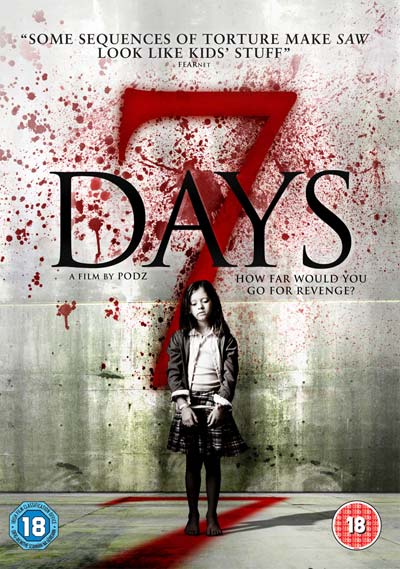
Daniel Drou plays Devil’s advocate as he directs the brutal, yet powerful French-Canadian film 7 Days (original title Les Sept Jours Du Talion, literally translated as 7 Days Of Retaliation), a story based on a novel by Patrick Senécal (who also wrote the screenplay) of a man who sinks deeper and deeper into despair as he takes the law into his own hands and comes face-to-face with the ‘monster’ who raped and murdered his only child.
Film: 7 Days
Release date: 23rd August 2010
Certificate: 18
Running time: 106 mins
Director: Daniel Grou
Starring: Rémy Girard, Claude Legault, Fanny Mallette, Martin Dubreuil, Rose-Marie Coallier
Genre: Drama/Horror/Thriller
Studio: E1
Format: DVD
Country: Canada
Daniel Drou plays Devil’s advocate as he directs the brutal, yet powerful French-Canadian film 7 Days (original title Les Sept Jours Du Talion, literally translated as 7 Days Of Retaliation), a story based on a novel by Patrick Senécal (who also wrote the screenplay) of a man who sinks deeper and deeper into despair as he takes the law into his own hands and comes face-to-face with the ‘monster’ who raped and murdered his only child.
Bruno Hemel (Claude Legault) is a well-mannered, highly respected and successful surgeon who lives with his wife Sylvie (Fanny Mallette) and their beloved daughter Jasmine (Rose-Marie Coallier) in a quiet suburban neighbourhood in Quebec, Canada.
The day starts with the happy family all enjoying breakfast together at the kitchen table. Jasmine wants her father to help her deliver birthday invitations to the homes of her friends before she goes to school. But after an all-night operation at the hospital, Bruno is too tired to escort her, and her mother doesn’t have the time to help either. Disappointed, Jasmine decides that she will deliver the invitations after lunch and is lovingly sent off to school.
As Jasmine heads off, Sylvie persuades an unenthusiastic and weary Bruno to partake in some morning lovemaking before she leaves for work. Sometime after, he awakes to an empty house and begins working on his laptop whilst drinking a bottle of beer, but a knock at the door brings the realisation that Jasmine never made it to school and has gone missing. The police are called, and with Bruno assisting them, a hunt for the young girl begins.
The discovery of her abused and murdered bloody body is the beginning of Bruno’s spiral into rage, darkness and misery which leads to the kidnapping of the murderer, Anthony Lemaire (Martin Dubreuil), and seven days of unimaginable torture which climaxes on, what would have been, his daughter’s ninth birthday…
7 Days is an intense, violent, thought-provoking film that forces us to question our beliefs on controversial matters such as vigilantism, human-rights and the criminal justice system. But it goes far deeper than that, it gets to the very soul of a man whose life has sunk to the dark depths of desolation, where he lives with the excruciating pain of guilt, which he has bestowed upon himself for failing to save the life of his daughter. Therefore, the question that is being implied is whether the punishment Bruno inflicts upon his daughter’s murderer is inhumane or justified?
The film is shot at a steady pace, allowing the tension to build gradually, drawing us further and further into Bruno’s darkened world. Drou is cautious and takes his time directing the soft, slow camera movements, deciding against fancy camera angles and quick editing. The lack of music throughout the film only adds to the overall realism - in fact, any composition used would only disturb the intense atmospheric scenes.
High praise must certainly go to Legault for his portrayal as the vengeful father, and Mallette, who plays his emotionally shattered grieving wife – two very strong and convincing performances. Respect should also be given to Dubreuil, not because he gave a powerful performance, because he didn’t, his character didn’t call for it, but for the fact that he had to play a pathetic paedophile fully naked strapped to a torture device for almost every scene he was in – a role that could easily be humiliating for many actors.
Keeping the dialogue to a minimum was a smart move, too, but there are moments, such as when Bruno gives his captive a plate of food, where it feels we are being spoon feed (no pun intended!). We know it’s not done out of compassion, we know the food is being given to him to keep him alive, so he can suffer more punishment, we don’t need to have Dubreuil’s character say it. And also, having Bruno kidnap the mother of another victim of the murderer, and forcing her to face him after she has proclaimed on TV that she has blanked him out of her mind – an announcement that disgusted Bruno – is unnecessary and even unrealistic.
To pigeonhole 7 Days solely in the horror genre would do it an injustice, and would remove the seriousness of the theme, and what Drou is trying to convey - and it may actually draw in the wrong crowd. And yet, some of the violence is so extreme it may turn many filmgoers, who don’t have the stomach for it, away.
Thus, sitting through 7 Days is no easy task; even the hardest of the hardened will find some of the graphic torture scenes a little challenging to sit through – if they don’t, they probably need to question themselves, which is the whole point of the film anyway. But no scene is more disturbing than that of the lifeless body of murdered Jasmine, an image that is all too real, and an image that no-one should ever have to see in real life.
7 Days is a gripping, hard-hitting, gut-wrenching film that will unapologetically have you questioning your moral values - and your endurance for ultra-violent scenes. SLP

 This is an English-language release.
What if there was no tomorrow? What if you knew the world was coming to an end? How – and with whom – would you spend your last hours on earth? These are the questions facing a number of very different individuals ahead of the millennium in this beautifully shot drama.
Don McKellar plays an architect who plans to meet his maker alone, while others party, or pray, in groups. A recently married couple make a suicide pact, but are caught apart and struggle to get back together. One man pursues final sexual conquests, and a weak woman strives to gain courage.
As the end of the world approaches, these strangers’ lives end up interacting.
Film: Last Night
Release date: 20th September 2010
Certificate: 15
Running time: 92 mins
Director: Don McKellar
Starring: Don McKellar, Sandra Oh, David Cronenberg, Roberta Maxwell, Robin Gammell
Genre: Drama
Studio: Park Circus
Format: DVD
Country: Canada/France
DVD Special Features:
•
Theatrical trailer
•
Stills gallery
 Film: Sweet Karma
Release date: 13th September 2010
Certificate: 18
Running time: 85 mins
Director: Andrew Thomas Hunt
Starring: Shera Bechard, John Tokatlidis, Frank J. Zupancic, Christian Bako
Genre: Action/Crime/Drama/Thriller
Studio: Anchor Bay
Format: DVD
Country: Canada
This is an English-Language release.
Film: Sweet Karma
Release date: 13th September 2010
Certificate: 18
Running time: 85 mins
Director: Andrew Thomas Hunt
Starring: Shera Bechard, John Tokatlidis, Frank J. Zupancic, Christian Bako
Genre: Action/Crime/Drama/Thriller
Studio: Anchor Bay
Format: DVD
Country: Canada
This is an English-Language release.
Rape and revenge movies have rarely offered anything new to the mix since they gate-crashed the movie scene during the seventies. So far, so brutal. But the genre has developed more pleasingly away from Hollywood, using torture as a shocking last resort, dabbling only occasionally, calming us with arty visuals, characterization and story. Now it’s Canada’s turn. Sweet Karma, written and directed by newcomer Andrew Thomas Hunt, better known for his music videos and photography, introduces us to Shera Bechard, a model with no previous acting credentials playing the lead – a mute. Hollywood must be shaking in its blood-stained boots.
Karma (Shera Bechard), a young, mute Russian woman follows in her dead sister’s footsteps by signing up to become a housemaid in Toronto, with hopes of discovering the truth about Anna’s demise.
Keen to exact revenge on those responsible, Karma follows her sister’s trail, soon realising that her employers’ ideas of a spit and polish are completely different to her own. From sleazy strip joints to dirty motel rooms, her journey to retribution forces her to confront some of the most vicious thugs out there, using and abusing girls simply to make cold hard cash.
Befriended by a gang-member and a friend of Anna’s, Karma must put their hidden agendas to one side as she’ll need all the help she can get if she is to retaliate, let alone survive…
Shera Bechard moved to Toronto to pursue a modeling career, during which she worked with photographers Marcus Klinko, George Whiteside and music director Andrew Thomas Hunt, who was clearly taken by her, seeing as he took a huge risk by casting her as the lead for his feature debut. Picking up the New Wave Best Actress Award at Austin’s annual international Fantastic Fest 2009, he wasn’t the only one.
While her performance is commendable, filling the role with endearing warmth and looks to die for, the latter allowing her character to get away with murder time and time again, it’s only when she is mistreated that we question Hunt’s decision. Lacking the power of articulate speech is a powerful plot device, not only in using imagery to provide essential back-story, but to create suspense otherwise impossible if our protagonist is able to scream for help.
Sadly, Hunt lazily uses a flashback to provide us with what he considers key information regarding Anna’s escape to a better life in Canada. It’s unnecessary to say the least. As for tension, Bechard’s character is rarely put in too much danger, and when she is, during the standout scene of the movie, it’s behind closed doors, and in a place nobody would come to her aid even if she demanded it. A chase scene leading to her predicament also wastes the opportunity to play out some much-needed suspense – it wouldn’t hurt to watch Anthony Waller’s Mute Witness (1994) for a lesson in how it should be done.
Therefore, it stands to reason that even though Hunt knew that Bechard’s looks would provide a justifiable amount of empathy, as well as giving her a believable device to seduce her enemies, it still doesn’t explain why her character had to be mute. Considering her lack of desire to act any further, and a script not playing on the strengths of her disorder, it’s disappointingly safe to say we already know the answer.
Bechard is supported by a strong cast of relative unknowns. While nobody really stands out from the crowd of thugs and gangsters, they all keep it believable, and with the inclusion of a few one-liners, Sweet Karma maintains its gritty realism throughout by injecting a bit of humour and some much welcomed fear into its characters.
Of course, there is also gore and titillation on offer here: a pole-dance to rival any seen on screen before, a shootout in a motel room, a stab in the dark, and a lesson in why you shouldn’t snort cocaine from a hooker’s chest all deliver the required thrills to satisfy any horror fan. However, a slightly bland confrontation in the final act is frustratingly sped-up to hide the two female characters’ lack of fighting abilities, while others, notably the chase scenes, are hurried and lack drama.
Plot-wise, this rivals most of the new wave, with an intriguing twist on the hour mark that gives the movie a welcome boost, even if William (played by John Tokatlidis) lacks enough back-story to gain the viewer’s trust - merely a tool to enable Karma to take that final step forward. The final scene is a tad confusing and does little but add to the short running time, whilst the choice of location could frustratingly be anywhere. In fact, only some forced dialogue about ice hockey halfway through proceedings suggests the drama is unfolding in picturesque Canada and not Russia itself.
Bestowing upon it a gritty authenticity, the absence of a star name works in Sweet Karma’s favour, and while it offers little new to the rape-revenge genre, Shera Bechard’s performance will certainly taunt the hairs on the back of your neck, whilst her killer looks will tease other parts. DW