Showing posts with label Genre: Anime. Show all posts
REVIEW: DVD Release: The Slayers Revolution: Season 4 Part 1
Series: The Slayers Revolution: Season 4 Part 1
Release date: 8th November 2010
Certificate: PG
Running time: 325 mins
Director: Takashi Watanabe
Starring: N/a
Genre: Anime
Studio: MVM
Format: DVD
Country: Japan
Taking inspiration from Dungeons & Dragons, and based on Hajime Kanzaka’s manga series, Slayers Revolution returns for a fourth season, blending action with fantasy and comedy as Lina and her gang face insurmountable odds to face off against the evil Duclis.
The sorceress Lina Inverse and her gang are searching for the Sword of Light after losing it in an earlier battle when they happen across Pokota, who is in possession of one Lina’s most powerful spells.
On the way, they meet a marauding gang of pirates, who have kidnapped a mermaid; emergency aid for Pokota’s kingdom of Taforashia is vindictively intercepted by the evil Gioconda; and a rich lady’s pets have gone missing. As the crew deal with these problems, they must bring the final battle to Duclis’ newly created Zanaffar, who can only be damaged by the missing Sword of Light…
The most striking element in season four of Slayers Revolution is the poor animation and characterisation. The style forgoes the obvious potential of similar series’ in favour of a simplistic, poorly designed approach, with uninteresting clichéd character models and a lack of consistency throughout the production. Clichéd is a notion which is synonymous with the whole series, as the attempted aesthetic and function of the show has been done before so many times, and done so much better (see D.Gray Man et al).
The lead character, Lina Inverse, is presented as an anti-hero of sorts, with the producers aiming to squeeze some comedy out of her arrogance and defiance. All they succeed in doing is making her possibly the single most un-relatable and unlikeable protagonist in anime. Of course, not all heroes have to be pure and innocent, and these flaws normally succeed in driving the narrative - and offering the audience anchor for the adventure, but it seems they have set out to make the most repugnant, annoying character ever, helped in no small part by the irritating voice acting from Megumi Hayashibara. The voice acting is a mixed bag, with a notable turn from Yasunori Matsumoto as the hapless Gourry who brings most of the comic beats as he struggles with his clumsiness and constantly breaking sword - much to the dismay and anger of Lina.
The relationship between Lina and the rest of the gang consists mainly of them lamenting her bad attitude or (rather bizarrely for a PG rated show) relentlessly bullying her for her flat chest (a sentiment echoed by many of the enemies they come across, even the live stuffed animal Pokota). This shift in tone from action and adventure into infantile, repetitive references to an 18-year-old girl’s breasts (or lack thereof) is somewhat unsettling, and lends an element of unsuited crudity to the show.
The aforementioned stuffed animal antagonist, Pokota, is also a redundant, infuriating character, despite featuring heavily in the earlier episodes. This is largely down to his simplistic and uninspired characterisation, leading the gang on a fruitless and dangerous journey before becoming an annoying sidekick of sorts once he realises that the evil Gioconda is involved in a plot to destroy Pokota’s kingdom, Taforashia. Pokota’s appearance is reminiscent of a bargain bin Pokémon, lacking any of their charm and harbouring a massive chip on his tiny shoulder, which, when combined with Lina’s constant arrogance, presents a truly lamentable proposition.
The juxtaposition of highly stylised, overly cartoony characters (Lina and Pokota) with much more human, relatable designs (specifically in Wizer Freon, the inspector of Ruvignald) creates a sense of disjointedness which does not lend itself well to the show’s overall aesthetic. Secondary and background characters are very poorly animated, with seemingly only a couple of frames of animation to share between them, becoming the only focal point as they spasmodically jig behind the action in a relentless loop of lazy production..
These moments of laughable shoddiness are only exacerbated when shown alongside the rather impressive action scenes. The characters cry out the names of their attacks - in typical anime fashion - and use creative combat and spells to offer a real sense of pace to these scenes, and present a pleasant distraction from the rest of the episode.
The plot is rather typical fantasy fare, with the clichéd set up of an overarching narrative beset with smaller sub-plots to appease the casual viewer. The main narrative is a convoluted affair, with Lina and Gourry reconvening with her separated friends before Wizer attempts to arrest her for apparently “being herself” (which would have been a blessing). And so begins a cat and mouse chase between Wizer, Lina and Pokota which results in an epic final battle against the Zanaffar. The confusing main narrative is made more so by the simplicity of the events of individual episodes. New characters are constantly introduced and long-winded names of far off lands are dropped with a misguided familiarity while the gang search for missing pets - and take part in a ball rolling festival.
Slayers Revolution is a poorly produced, confusing and unappealing anime with substandard design and a lead character who is one of the most unlikeable and annoying in recent memory. There are much stronger examples of similarly themed anime available, and fleeting moments of exciting combat and comedic lines cannot save this from being difficult to recommend. RB
REVIEW: DVD Release: Eden Of The East
Series: Eden Of The East
Release date: 29th November 2010
Certificate: 15
Running time: 333 mins
Director: Kenji Kamiyama
Starring: Ryohei Takizawa, Saori Hayami, Rei Igarashi, Atsushi Miyauchi, Sakiko Tamagawa
Genre: Anime
Studio: Manga
Format: DVD & Blu-ray
Country: Japan
Director Kenji Kamiyama (Ghost in the Shell) is joined by respected character designer Chika Umino (Honey & Clover) for his latest creation, Eden Of The East, an original, gripping, intelligent animation series with a progressively unravelling plot that takes place over eleven intensifying twenty-minute episodes.
On 22 November 2010, ten missiles strike Japan. Because they were targeted at isolated areas, the apparent terrorist attack, referred to as ‘Careless Monday’, claimed no victims, and the incident was soon forgotten by most people.
Three months later, Saki Morimi is on her graduation trip from Japan, and is standing outside the White House. As she tosses some coins onto the lawn, two police officers come charging over, demanding to know what she is doing. Just then, a young man by the name of Akira Takizawa, who is stark naked, distracts them and leads them away from the scene. He shortly returns and informs Morimi that he has no memory, and can’t explain why he isn’t wearing any clothes and why he is carrying a gun and a mobile phone with credit of 8.5 Billion Yen. After giving Takizawa her coat, Morimi, intrigued by the whole affair, decides to help him find out the meaning behind it all, and so they head back to Japan together.
With the mystery concerning Takizawa’s identity, and the news of another attack being planned, Morimi and Takizawa seek the help of the Eden of the East Project, a group of computer boffins of which Morimi is a member.
Takizawa is told by Mr. Mononobe, the main antagonist, that he is one of twelve Selecao’s taking part in a “game” devised by Mr. Outside, a mysterious figure who is never seen. The rules are simple: each of the selected twelve has a special phone containing credit of 8.5 Billion Yen, and must use it to help bring stability back to Japan in any way they see fit. Whoever achieves this aim is the winner. But whoever breaks the rules, such as using the credit for personal gain or deciding to do nothing at all, will be exterminated. So, who is responsible for ‘Careless Monday’? Is it possible Takizawa is a terrorist?
Kamiyama dangles a carrot in front of us, cleverly feeding us enough information in each episode to make us eager to continue watching. This is also facilitated by the talent of the two main voice artists, Ryohei Takizawa and Saori Hayami, who deliver commanding performances, making the rapport between Takizawa and Morimi all the more convincing, allowing us to warm to their characters naturally. The American police officers, on the other hand, seen in the opening episode, are portrayed as dim-wits – perhaps Kamiyama meant this as a humorous implication in response to the opinion by many that America is the centre of the world. The script is complex, at times, but always mature and compelling, and one of the main aspects for the series’ success, as well as focusing on a theme that is still very much close to our hearts.
With 9/11 still fresh in the minds of most people around the world, it’s easy to see how the terrorist attacks in East Of The Eden can be seen as distressing for some, and why it makes a worthwhile premise for a TV series. It’s these feelings of insecurity that resonates so well with us, and makes the subject matter all the more real - even if it is being presented in the form of animation. With such believable characters, the threat of a terrorist attack is very much realised.
Terrorism has been the central theme of many forms of storytelling, and is much of a potential danger to society today than it’s ever been. Kamiyama intelligently uses this worldwide fear to make comment on the changing attitudes of the Japanese people, which have been evolving more radically since the end of the Second World War. From Mr. Outside’s perspective, the nation has lost a part of its identity, whilst the economic struggle has caused a malfunction within the country’s structure.
Individualism is threatening the collective mindset once employed by the social order. His opinion of the younger generation is irrational; he views them as “deadweight,” who contribute to, what he perceives to be, a “slacker culture,” and his measures for putting Japan back to her former glory are extreme. The “game” he has developed is a retaliation against the fact that once the wheels of change are put in motion, it’s inevitable that they will keep on turning. However, no matter how isolated and detached we may feel within this change, there will always be hope. Ironically, the threat of Mr. Outside’s neurotic ideology is what brings the people of Japan together as they aim to fight against it. And where modern technology is blamed as the cause of creating isolation among the younger generation, as well as the crumble of community spirit, it actually serves as a positive tool which unites the people as they oppose stale beliefs.
Eden Of The East is a riveting series and makes an excellent first choice for those of you new to this genre – although established fans will not be disappointed either. With strong, likable characters, and a well thought out plot, its appeal stretches beyond anime, crossing over into mainstream quarters worldwide – a rare achievement indeed for a production within this category. SLP
NEWS: DVD Release: Fullmetal Alchemist Brotherhood: Part Two – Episodes 14-26
Alchemy - the mystic science of transmutation. Gifted alchemists can break down and reconstruct matter using the Law of Equivalent Exchange, creating miraculous things. But one taboo can never be broken - human transmutation.
The Elric brothers Edward and Alphonse broke the taboo in an attempt to resurrect their late mother and, as a result, lost everything. Al's soul was transferred to a suit of living armour, and Ed lost two limbs, confining him to mechanical auto-mail.
To recover what they've lost, they embarked on a journey to find the fabled Philosopher's Stone. The closer they get to the hidden truth of the Philosopher's Stone, the deeper they fall under shadowy schemes and the perils of unnatural creatures.
The military nation of Amestris, the grudges and hatreds of a persecuted people, and the countless tragedies caused by alchemy all form a dark vortex that will draw people and countries into its void. The Elric brothers forge ahead in their quest to transmute despair into hope...
Series: Fullmetal Alchemist Brotherhood: Part Two – Episodes 14-26
Release date: 6th December 2010
Certificate: 15
Running time: 304 mins
Director: Yasuhiro Irie
Starring: Rie Kugimiya, Romi Park, Iemasa Kayumi, Megumi Takamoto, Shinichiro Miki
Genre: Anime
Studio: Manga
Format: DVD & Blu-ray
Country: Japan
NEWS: DVD Release: Mobile Suit Gundam 00: Season 2 - Volume 1
The first half of the second season of the Japanese anime series set in the 24th century.
It is now 2312 AD, and four years have passed since the final battle between Celestial Being and the UN Forces. Humankind has formed an elite peace-keeping force known as the A-Laws. But this new world is still riddled with corruption and conflict, and the Gundam Meisters now prepare to make their second advent which aims to do away with global oppression once and for all.
Series: Mobile Suit Gundam 00: Season 2 - Volume 1
Release date: 29th November 2010
Certificate: 15
Running time: 220 mins
Director: Seiji Mizushima
Starring: Setsuna Efu Seiei, Rokkuon Sutoratosu, Areruya Haputizumu, Tieria Āde
Genre: Anime
Studio: Beez
Format: DVD
Country: Japan
It is now 2312 AD, and four years have passed since the final battle between Celestial Being and the UN Forces. Humankind has formed an elite peace-keeping force known as the A-Laws. But this new world is still riddled with corruption and conflict, and the Gundam Meisters now prepare to make their second advent which aims to do away with global oppression once and for all.
Series: Mobile Suit Gundam 00: Season 2 - Volume 1
Release date: 29th November 2010
Certificate: 15
Running time: 220 mins
Director: Seiji Mizushima
Starring: Setsuna Efu Seiei, Rokkuon Sutoratosu, Areruya Haputizumu, Tieria Āde
Genre: Anime
Studio: Beez
Format: DVD
Country: Japan
NEWS: DVD Release: Durarara!!: Volume 1
The first instalment of the Japanese anime show adapted from the light novel series by Ryohgo Narita.
Fed up with his uneventful life, Mikado Ryuugamine (voice of Toshiyuki Toyonaga) jumps at the opportunity to move to a new school in the city of Ikebukuro. While there, he is re-acquainted with his friend Masaomi Kida (Mamoru Miyano), who warns him about some strange characters that live in the city, who would be best avoided.
Soon Mikado sees one of these characters, the Headless Rider, travelling on his black motorcycle, and thereafter further supernatural happenings plague the city.
Series: Durarara!!: Volume 1
Release date: 29th November 2010
Certificate: 15
Running time: 220 mins
Director: Shinya Kawatsura & Takahiro Omori
Starring: Toshiyuki Toyonaga, Mamoru Miyano
Genre: Anime
Studio: Beez
Format: DVD
Country: Japan
Fed up with his uneventful life, Mikado Ryuugamine (voice of Toshiyuki Toyonaga) jumps at the opportunity to move to a new school in the city of Ikebukuro. While there, he is re-acquainted with his friend Masaomi Kida (Mamoru Miyano), who warns him about some strange characters that live in the city, who would be best avoided.
Soon Mikado sees one of these characters, the Headless Rider, travelling on his black motorcycle, and thereafter further supernatural happenings plague the city.
Series: Durarara!!: Volume 1
Release date: 29th November 2010
Certificate: 15
Running time: 220 mins
Director: Shinya Kawatsura & Takahiro Omori
Starring: Toshiyuki Toyonaga, Mamoru Miyano
Genre: Anime
Studio: Beez
Format: DVD
Country: Japan
REVIEW: DVD Release: Bamboo Blade: Series 1 - Part 1
Series: Bamboo Blade: Series 1 - Part 1
Release date: 22nd November 2010
Certificate: PG
Running time: 316 mins
Director: Hisashi Saito
Starring: N/a
Genre: Anime
Studio: Manga
Format: DVD
Country: Japan
Adapted from the manga of the same name, Bamboo Blade is an anime that follows the trials and tribulations of a high school female kendo team as they train and prepare themselves for a range of competitions. This box set is comprised of the first half of the twenty-six episode first season.
Toraji Ishida is a politics teacher at Menro High School, but, more importantly, the kendo sensei. Unfortunately, he's down on his luck, with very little reward or success in his everyday life, and an increasingly despondent disposition.
Toraji is struggling as he finds his home devoid of food, his belly rumbling and no sign of a paycheck for at least another week. However, the coach of the rival school’s kendo team, Kenzaburo Ishibashi, offers a potential solution to his woes, challenging Toraji to have a 5-on-5 all-girl match-up, with the prize being a year's supply of all-you-can-eat food from Kenzaburo’s father’s restaurant.
Spurred on by the prospect of a year's supply of free sushi, Toraji develops a new found determination, and sets about assembling his femme fatale fighting force. But can the five girls that have come together by determination or chance work as a team, deal with the troubles in their private lives, and improve their skills sufficiently to compete against the top schools in the region (this initial one-off match-up leads to a high school tournament, and talk of future inter-school competitions)?
As with many Seinen manga adaptations of this kind, the initial reaction to such a seemingly sparse and potentially sluggish plotline may to some prove off putting, but, as with many, the development of the individual characters proves engrossing. Bamboo Blade manages to create, introduce and flesh out a substantial quantity of individuals without ever reducing them to mere clichés, presenting each with enough screen time and emotional context to justify their actions. Not simply this, but every character is unique, from their personality through to their reasons for joining the kendo dojo and their interactions with each other, giving the audience characters to associate with and cheer for. From the unbound enthusiasm of the blonde haired team captain, Kirino Chiba, who has to instill discipline into her teammates, to the distanced personality of the immensely talented Tamaki Kawazoe and the psychologically troubled mind of Miyako Miyazaki, and her micro-sized boyfriend, there are plenty of sub plots that intertwine and escalate the tension as we build to the upcoming conflict.
The anime, while essentially a teenage drama, allows itself plenty of opportunity and time to escape the rigours of seriousness - flexing its comedic muscles. From the opening scene, highlighting the ridiculous reason as to why Toraji is spurred onto kendo success to his lack of social graces, the animators use all the traditional anime hallmarks to alleviate any tension. From characters falling flat on their backs when someone says or engages in something utterly nonsensical to the over-exaggerated facial expressions to show disdain or affection, the animators endow Bamboo Blade with an undeniable sense of warmth and charm. They also find time to poke fun at themselves, and other writers of similar series', by having one of their main characters, who is obsessed with animation, create a show within the show, “Blade Braver”. The self-referencing is particularly apparent when the cheerful Yuji Nakata, one of the few male members of the high school’s kendo club (and the only member of the squad that knows the real reason for Toraji’s determination to win), makes one of a number of his overly dramatic or emotional monologues, much in keeping with many anime, to the amusement of his peers.
In terms of animation, Bamboo Blade is at the cutting edge of contemporary anime, highlighting the immensely crisp, creative and colourful details that we may take for granted now in the West. There is an unimaginable amount of delicacy and depth to the handwork, which is very pleasing on the eye - coupled by a very sparsely used and sympathetically implemented amount of computer generated imagery.
In such a relatively short space of time, Bamboo Blade creates a great affinity and understanding of the characters within the Menro High School, while never feeling derivative or replicated from another source. Each individual slowly develops throughout the course of the thirteen episodes, whether that is through a softening or toughening of their stance, but always through promoting and understanding the values of teamwork and friendship.
Bamboo Blade proves that there is more to an anime that is ostensibly centred around fighting than the actual encounters themselves. It's the humanisation and authentic feel of the characters that that provides the driving force of a series less concerned with the bashing of bamboo than the lives and emotions of the individuals that frequent the dojo. However, by taking the time to nurture each of the students, the matches themselves take on a greater meaning and importance.
Bamboo Blade is a well-constructed, enjoyable series, which, while bracketed as a Seinen (manga targeted towards males between the ages of 18-30) reaches far beyond that demographics thanks to the strong female character presence and tendency to veer towards the emotional and interpersonal relations between the characters. BL
REVIEW: DVD Release: Spirited Away
Film: Spirited Away
Release date: 29th March 2004
Certificate: PG
Running time: 116 mins
Director: Hayao Miyazaki
Starring: Rumi Hîragi, Miyu Irino, Mari Natsuki, Takashi Naitô, Yasuko Sawaguchi
Genre: Anime
Studio: Optimum
Format: DVD
Country: Japan
Studio Ghibli is a name to be reckoned with in animation. Their back catalogue is sizeable, from 1984 up until the present day it numbers seventeen films without including shorts and museum releases. The Japanese animation studio has attained a high standard of excellence and awards throughout its productions - Spirited Away is no exception. It is a film that reveals at its heart a message that love can be stronger than magic.
Chihiro is a 10-year-old girl, moving to a new home with her parents, looking sadly on a bunch of flowers given to her by the friends she is leaving. On their journey, they encounter a long tunnel, at the end of which is a mysterious town. As events unfold, the mysterious town is not all that it seems. Whilst looking around, her parents are turned into pigs after gorging themselves on the available food which has appeared despite Chihiro’s warnings.
Her situation finds her alone in the town, trapped in a spirit world with darkness approaching. A young boy Haku comes to her aid, sneaking her into the large bathhouse for spirits and gods, telling her that if she is willing to make herself useful the witch Yubaba will have to tolerate her. He takes her down to the furnaces to the six armed Kijami to work. As Chihiro goes on to explore upstairs, following a young woman she is curious about, she finds work on the upper levels preparing the baths for the customers.
During this employment, where Yubaba works her staff hard through the night, Chihiro, with Haku’s help, must somehow work out where her parents are, and how to turn them back from the pigs they have become - a somewhat notable aside from Miyazaki on capitalism.
Magic and intrigue conspire to make sure that Chihiro is always tested. In a world she is unfamiliar with, Chihiro’s core values are on trial…
Ghibli’s animation is always breathtaking, and this is no exception. The clear, identifiable style of the animation studio means that the viewer is able to tell its pedigree from the outset. To top it off, it is written and directed by Miyazaki after his pseudo retirement.
The impending sense of loneliness, which comes from a little girl alone and forced to try and survive, is filled with the sort of tenderness and stillness not often found in animation. One particularly notable scene comes from the coal creatures and Kijami. An exhausted Chihiro comes to sleep in the boiler room, where she feels comfortable, deep in the furnaces of Yubaba’s bathhouse. The six armed Kijami, in a moment of kindness, place a blanket over her, and the coal creatures remove her shoes to make her more comfortable. Even though this is such a short moment in the film, it encapsulates so much of the tenderness that the audience feels toward the character. Chihiro is in a strange land and is now having to work to stay safe. The need to feel the soothing sense of familiarity - however odd - is clearly pertinent for her.
An underlying message becomes clear as the film progresses - like many of the Ghibli films, and is encapsulated by the state of the land Yubaba inhabits. Miyazaki seems to be making a comment on pollution and the global warming occurring in the world. The customer at the bathhouse, which turns out to be a river spirit - not the stink demon they had envisaged - has become so laden with filth and garbage from river pollution that he has become unrecognisable. The cleansing process of Chihiro, removing the thorn stuck in his side, becomes somewhat illustrative of the pain and peril of the natural resources of the earth. This is shown again with the water overlapping onto the train track which leaves the bathhouse. It is inferred that much has been submerged; the train no longer comes back.
Even though there is the ability to read into the narrative issues of environmental destruction, at its heart, the film is a touching tale of a little girl trying to survive in an unfamiliar world, and finding that kindness, love and truth are universally held in high esteem. The innocence of Chihiro and the goodness and compassion which she tries to uphold sees the character able to deal with everything the spirit world throws at her.
The animation is stunning, and the visual landscape created is absolutely wondrous. For an audience who are used to animated films saturating the market with 3D and other trends, Spirited Away provides a burst of freshness. The film has so many things happening at once that it keeps the audience fully engaged in the world it has created. From thunderously large babies who must be appeased, faceless spirits and dangerous paper birds, Spirited Away is one of the most creative pieces of animation around, and richly deserving of the many awards it has acquired.
Ghibli have provided what is arguably one of their best films to date. This is a classic which seems to force Pixar and Disney’s fare to take a step back. It’s a great movie to introduce newcomers to the world of Ghibli, and an absolute essential in any film collection. DHA
REVIEW: DVD Release: Vampire Knight – Part 1: Episodes 1-4
Series: Vampire Knight – Part 1: Episodes 1-4
Release date: 22nd November 2010
Certificate: 12
Running time: 100 mins
Director: Kiyoko Sayama
Starring: Daisuke Kishio, Mamoru Miyano, Yui Horie, Fumiko Orikasa, Hiroki Yasumoto
Genre: Anime
Studio: Manga
Format: DVD
Country: Japan
The popular Vampire Knight, a shōjo manga and anime series written by Matsuri Hino, premiered in the January 2005 issue of LaLa magazine and is still on-going. The television series was quick to follow, airing in Japan in April 2008, and it is finally released in the UK on DVD this month, beginning with volume one and the first four episodes. So, was it worth the wait?
The earliest thing Yuki remembers is being attacked on a snowy night by a vampire, and being rescued by Kaname, another vampire. Ten years later, still haunted by those memories, Yuki is now the adopted daughter of the headmaster of Cross Academy.
Keeping peace at the academy with her friend Zero, her main duties are to ensure no problems arise between the freshmen that attend Day Class and those that seek out new blood, quite literally, as they vamp it up at Night Class.
Hindered by her hormones, Yuki is soon torn between Kaname, a pureblood who saved her life, and Zero, once bitten by a pureblood, now struggling to halt his slow transformation into the creature he loathes most - a vampire.
Sounds familiar, doesn't it? You could argue that this release is jumping on the Twilight bandwagon, if it wasn't for the fact that it came first. A twisted love triangle then, if ever there wasn't one, and the first volume struggles just as much to deliver a plot as the fore-mentioned slayer of vampire movies.
Yet, it goes one better, because the little storyline on show here is rammed down the viewer's throat so forcibly, time and time again, it's like painting by numbers, with only one colour needed - a very dull grey.
Instead of using the medium it was created for, back-story is created by non-stop dialogue, saving the audience the trouble of thinking. This would be okay, and welcome in parts, if the plot was as audacious as Ghost In The Shell (1995), but, quite frankly, it isn't, and is an embarrassment for all those concerned. Worst of all, Episode four, 'Trigger Of Conviction', dares to include flashbacks, just incase something blatantly obvious was missed. Thanks for that.
So, director Kiyoko Sayama manages with ease the ridiculous feat of making the three protagonists' affections simultaneously obvious; and handling Yuki's discovery of Zero's ailment, supposedly the volume's solitary peak, with clumsy precision. In fact, not one of the three main characters comes away from this scenario with any dignity. Zero, at one stage threatening to do the viewer a favour by blowing his brains out, lacks empathy because he's so miserable; Kaname's obsession with Yuki is never explored, therefore bordering on psychotic; and Yuki's failure to grasp the bigger picture suggests she's a bit stupid.
When Sayama does finally move away from the hideous forbidden-love-that-isn't plot she actually shows some promise. Episode three hints at better things to come when a freaky Gollum-like vampire stalks Yuki in the series' best moments; but, even then, the tension is almost ruined by Yuki talking aloud, realising that this beast must be naughty because it isn't as beautiful as all the other vampires at Night Class.
The goofy humour is enjoyable at first, yet quickly becomes repetitive, insulting the otherwise impressive gothic visuals on offer (a shame more time wasn't spent on the screenplay), while the opening score is almost as long as the episode itself - an intro that offers much but delivers so very little. So very little, in fact, that episode two revolves around the Day Class students offering chocolates to their beloved night-school comrades, blissfully unaware that they are actually vampires - and that's it. Seriously, it would be nice if just one of the students actually questioned a need for Night Class - it's not like they think they're all insomniacs, or something.
You could argue that Vampire Knight sticks faithfully to the manga series, concentrating more on romance rather than action, and while the love triangle is nothing new, especially post-twilight, it does carry with it some potential, certainly pleasing fans of the original material. Having said that, the few moments of real inspiration are pushed to one side, in favour of that romance, so much so that it's questionable whether Sayama will be able to introduce the students of Cross Academy to a wider audience.
While the basic premise of Vampire Knight might sound like a rehash of Twilight, watching it unfold is something else far less exciting; lacking in plot, humour or bite, the only thing on offer here worthy of praise is its short running time. Volume two should never be exposed to daylight. DW
NEWS: DVD Release: Eden Of The East
Kenji Kamiyama, the director of Ghost In The Shell: Stand Alone Complex and Solid State Society, and the writer of Blood: The Last Vampire, brings his latest vision to the screen in the eleven-part anime TV series Eden Of The East. The DVD and Blu-ray features the complete series over two discs.
Created, written and directed by Kamiyama, the series has won numerous awards, including the TV Feature Award at the 2009 Animation Kobe Festival and the Best Television Series of the Year Award at the Ninth Annual Tokyo International Anime Fair.
On 22nd November 2010 Japan is struck by ten missiles, which incredibly land only in uninhabited areas and claim no victims. An apparent terrorist attack, the event is dubbed ‘Careless Monday’ by the media, and is quickly disregarded by most of Japan’s populace.
Three months later, Saki Morimi, a Japanese student visiting Washington D.C. as part of a graduation trip, is almost arrested during a misunderstanding outside the White House but is rescued by a mysterious and completely naked young man, Akira Takizawa, who shows up out of nowhere with no memory, and carrying a gun and a cell phone credited with 8.2 billion yen to its account.
Returning home to Japan together, Saki and Takizawa learn that a new missile has hit their country, and Taki discovers that his phone is a tool in a complex political game in which he is a participant. The game involves twelve participants, each of whom possesses a cell phone that was originally credited with 10 billion yen to be spent however the respective players see fit. The object of the game is for one of them to ‘save Japan’. However, if the money is used up completely, or for purely selfish purposes, the player responsible will be eliminated.
As the game progresses, it is revealed to Taki that it was one of the game’s participants who ordered the missile strike on Japan, and that it was the events of ‘Careless Monday’ that led him to have his own memories deliberately erased.
Series: Eden Of The East
Release date: 29th November 2010
Certificate: 15
Running time: 333 mins
Director: Kenji Kamiyama
Starring: Ryohei Takizawa, Saori Hayami, Rei Igarashi, Atsushi Miyauchi, Sakiko Tamagawa
Genre: Anime
Studio: Manga
Format: DVD & Blu-ray
Country: Japan
Special Features:
• Interview with director Kenji Kamiyama and character designer Chika Umino
• Interview with Ryohei Kimura (Takizawa) and Saori Hayami (Saki)
• TV spot
• Promotion video
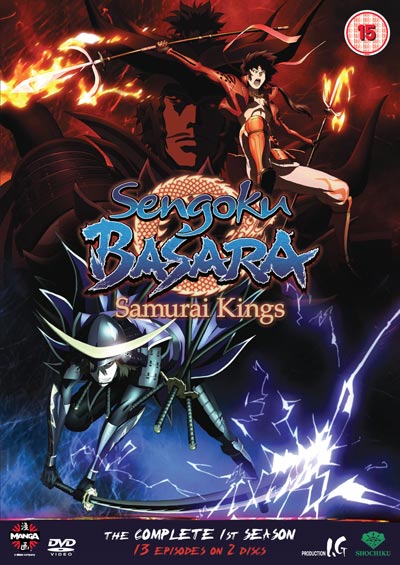
REVIEW: DVD Release: Sengoku Basara: Samurai Kings
Series: Sengoku Basara: Samurai Kings
Release date: 15th November 2010
Certificate: 15
Running time: 296 mins
Director: Itsuro Kawasaki
Starring: Kazuya Nakai, Norio Wakamoto, Souichiro Hoshi, Hiroki Shimowada, Kouji Tsujitani
Genre: Anime
Studio: Manga
Format: DVD & Blu-ray
Country: Japan
Those who have encountered the series of ‘hack and slash’ video games that shares the name of Itsuro Kawasaki’s anime will know exactly what to expect. Demigod heroes engaged in do or die battle for the future of a war-torn feudal Japan. That the game series has been created by Capcom (who gave the world the Street Fighter franchise) offers some clue to the uninitiated.
There will be fights aplenty but the tone is set by the introductory credits in which a military line up dances eccentrically to the Jrock theme tune, conveying a series which does not take itself too seriously.
Sengoku Basara lives up to this reputation, though the story is undoubtedly more vivid and complicated than expectation might suggest. We follow our two contrasting heroes: Date Masamune, the one-eyed dragon who wields six katanas at the same time; and Sandana Yukimura, fiercely loyal young spear fighter and servant of the rival Takeda clan. Our two heroes cross swords right from the word go and forge a bond of mutual respect, one that must culminate in them facing each other in honourable single combat.
Unfortunately for them, fate seems to have other ideas, as the many warring factions enter a shifting series of battles and allegiances as the fight for the country, based in part on actual Japanese history, intensifies.
Soon the warring clans, led by their samurai lords, are forced to try and unite in the face of a new and even greater threat – that of the titular Devil King Nobunaga whose ambition for ‘warrior rule’ of the country can be equated to covering the lands in darkness and indiscriminately butchering their inhabitants.
Masamune and Yukimura are forced to set aside their personal struggle and unite behind their lords as they try to push back Nobunaga’s marauders…
Whilst the many different clans and protagonists may leave some struggling to keep up, the series follows simple rules. Each clan is headed by a samurai hero of superhuman power. Each lord has his almost as powerful second, who is sworn to protect the life of their leader and offer candid counsel. Each clan also seems to enlist the services of a ninja - stealthy mercenaries who hurry through the shadows at the bidding of their masters, stopping long enough to shake their heads wryly in amusement at the antics of their lords.
As anyone familiar with the genre might imagine, there are indeed plenty of battles, from huge army set pieces to deadly single combat between fighters of superhuman strength. What is surprising about Sengoku Basara is the intensity of character definition, and, for lack of a better word, the amount of love on display. Aside from the complicated, touching romances woven through the series, the loyalty the characters display for one another is touching and, in places, moving - rarely more so than in the relationship between Yukimura and his master Takeda, who good naturedly pummel each other whilst debating strategy and philosophy. Or that of impossibly attired female ninja Kosuga and her unrequited love for her master, Uesugi Kenshin, whom she was sent to kill. Similarly, the loyalties of the common soldiers, whom one always felt for as they are eliminated fifty at a time by the superhuman commanders of their opponents.
A scene between the one-eyed dragon Masamune and his second-in-command Kojuro is particularly poignant. Kojuro must fight his own master to stop him going into battle in his weakened state, and uses Masamune’s blind spot to defeat him.
There are some interesting touches in the series. The evil enemies are conspicuously armed with Western weapons, and sentimentalisation of the sword is in evidence, echoing the forced opening of Japan to the West in the 1850s. The series places its emphasis on bonds of loyalty, honour, duty and love but is never simplified for doing so.
Whilst the final battle and ultimate confrontation are over rather quickly, there is plenty to see as a basis for a follow up series due next year. Arguably it might prove even more interesting as the complicated rivalries between characters were put on hold to defeat the self-evidently evil Nobunaga. It is reasonable to assume, therefore, that series two might contain rather more shades of grey.
The DVD does not contain special features as such, save for the bonus episode further explaining maverick Maida Keiji’s travels with his monkey. The visuals are what you would expect, colourfully rendered in good detail. The sound configuration on the Japanese version is such that the ambient noise and music can drown out the dialogue, though the subtitles are clear and consistent, if not terribly elegant in their translation.
This series is addictively watchable, funny and packs an emotional punch every bit as powerful as the many physical ones doled out through the thirteen short episodes that pass in a flurry of battles, betrayals and seductions that belay Sengoku Basara’s video game roots. NB
NEWS: DVD Release: Trinity Blood: Complete Collection
All 24 episodes of the Japanese anime series.
Many centuries ago, man's Armageddon gave birth to the vampires' wrath. As man and immortal clash, a reality-shattering threat looms.
Hope resides solely in a new breed of hunter operating under the Vatican's authority. The true battle between holiness and evil has begun.
Series: Trinity Blood: Complete Collection
Release date: 15th November 2010
Certificate: 15
Running time: 600 mins
Director: Tomohiro Hirata
Starring: N/a
Genre: Anime
Studio: MVM
Format: DVD
Country: Japan
Many centuries ago, man's Armageddon gave birth to the vampires' wrath. As man and immortal clash, a reality-shattering threat looms.
Hope resides solely in a new breed of hunter operating under the Vatican's authority. The true battle between holiness and evil has begun.
Series: Trinity Blood: Complete Collection
Release date: 15th November 2010
Certificate: 15
Running time: 600 mins
Director: Tomohiro Hirata
Starring: N/a
Genre: Anime
Studio: MVM
Format: DVD
Country: Japan
NEWS: DVD Release: Love Hina: The Complete Series
Attempting to fulfil a promise to his childhood sweetheart, Keitaro Urashima is determined to enter Tokyo University!
After being rejected twice, he decides to leave home and stay at his grandmother’s apartment complex to study. But when he arrives, his grandmother is gone, and he finds himself under attack by the all-female residents.
Will the girls accept him as their new apartment manager? Will his bones ever knit? More importantly, can he concentrate on his studies when he discovers that one of his tenants might be the promised girl from so long ago?
This complete series box set also includes the Christmas and Spring specials.
Series: Love Hina: The Complete Collection
Release date: 15th November 2010
Certificate: 12
Running time: TBC
Director: Yoshiaki Iwasaki
Starring: N/a
Genre: Anime
Studio: MVM
Format: DVD
Country: Japan
NEWS: DVD Release: Black Cat: Complete Collection
A happy ending takes more than just good luck!
Sven is your run-of-the-mill sweeper (a.k.a. bounty hunter): down on his luck, haunted by the perpetual grumbling of his stomach, and looking to make enough cash just to get by.
When a damsel in distress enlists his aid, Sven crosses paths with the worst possible luck: Black Cat (a.k.a. Train Heartnet, a.k.a. Number 13).
At odds now with the branded assassin, Sven seeks to save a young girl before the unlucky Number can carry out his mission.
Series: Black Cat: Complete Collection
Release date: 15th November 2010
Certificate: 15
Running time: 600 mins
Director: Shin Itagaki
Starring: Takashi Kondô, E. Jason Liebrecht, Keiji Fujiwara, Misato Fukuen
Genre: Anime
Studio: MVM
Format: DVD
Country: Japan
A happy ending takes more than just good luck!
Sven is your run-of-the-mill sweeper (a.k.a. bounty hunter): down on his luck, haunted by the perpetual grumbling of his stomach, and looking to make enough cash just to get by.
When a damsel in distress enlists his aid, Sven crosses paths with the worst possible luck: Black Cat (a.k.a. Train Heartnet, a.k.a. Number 13).
At odds now with the branded assassin, Sven seeks to save a young girl before the unlucky Number can carry out his mission.
Series: Black Cat: Complete Collection
Release date: 15th November 2010
Certificate: 15
Running time: 600 mins
Director: Shin Itagaki
Starring: Takashi Kondô, E. Jason Liebrecht, Keiji Fujiwara, Misato Fukuen
Genre: Anime
Studio: MVM
Format: DVD
Country: Japan
REVIEW: DVD Release: Moribito - Guardian of the Spirit: Volume 2
Series: Moribito: Guardian Of The Spirit - Part 2
Release date: 4th October 2010
Certificate: 12
Running time: 150 mins
Director: Kenji Kamiyama
Starring: Mabuki Andou, Naoto Adachi, Kouji Tsujitani, Ako Mayama, Rintarou Nishi
Genre: Anime
Studio: MVM
Format: DVD
Country: Japan
Something of a multimedia phenomenon in its native Japan, the Moribito (“guardian”) series is a sprawling, ten novel saga which has proliferated in other formats, notably radio, manga and TV. Conceived by author Nahoko Uehashi, the fantasy franchise recounts the derring-do of warriors, wizards and kings in the mystical kingdom of Yogo. This anime adaptation of the premier instalment in the series introduces the epic’s key players, translating the novel into a meaty twenty-seven episodes. MVM’s second 2DVD set contains the latter thirteen chapters - allowing fans left on tenterhooks midway through the series to conclude this engrossing yarn. Comprehensively visualising a mythic world of yore, Moriboto is an anachronistic fable that powerfully resonates with the present – and into the future.
Resuming where episode thirteen, ‘Neither Human Nor Tiger’, halted, we find our motley band of heroes in flight from the imperial army.
Heir to the Shin Yogo throne, Prince Chagum has been mysteriously possessed by the spirit of an ancient water demon, the Nyung Rochanga. Fearing the reincarnation of this mysterious beast, the emperor orders his liquidation. But before the assassination occurs, Chagum’s mother, the empress, intervenes, enabling his escape. Balsa, a lethally proficient female bodyguard – a yojimbo – is enlisted as his mother-protector, pledging to save the young prince.
Banding together with mystic weaver Mistress Torogai and her apprentice, Tanda, this quirky duo must evade the emperor’s minions, whilst divining the truth behind Chagum’s affliction.
As episode fourteen commences, a palace scholar, Shuga, begins an illicit probe into the official archives. To his horror, he learns that the nation’s founding myth – the slaying of a Nyung Rochanga by its founding monarch – is a lie. The fabled monster is actually a sacred water spirit; integral to the well-being of the land. Realising that the prince’s curse may be an obscure blessing, he investigates his assumed demise – ultimately proving that Chagum lives. Aided by the king’s elite guard, Shuga is promptly dispatched with orders to scour the kingdom and return with the youthful aristocrat – and kill his would-be benefactors if necessary…
Director Kenji Kamiyama’s ability to skilfully develop a chimerical premise is convincing. An anime veteran who scripted the much admired Blood: The Last Vampire before graduating to direct cyberpunk opus Ghost In The Shell: Stand Alone Complex for television, his restrained, conventional style comfortably embeds the phantastic in a familiar framework.
Easily intelligible, Kamiyama’s two-strand narrative mainly intercuts between pursuers and pursued - rarely extending beyond these nuclei. There’s little technical flamboyance on show, though later incidents where Chagum drifts between two dimensions are pleasingly surreal, composed with uncanny juxtaposition. Action scenes, when they do materialise, are tense and (perhaps due to their rarity) thrilling, particularly a climactic battle against the egg-eating hordes of Rarunga. Such spectacular intermissions are, however, secondary to the inexorable momentum of the plot. Thus relegated, visual flair becomes secondary to strong characterisation – which is where the series truly excels.
This is a powerful ensemble piece, significantly enhanced by its expressive voice cast. Cohering around the possessed Chagum, alpha female Balsa and demure partner Tanda are the ‘parents’ in an improvised, skewed nuclear family. As the series progresses, their backgrounds and convictions are incrementally revealed – resulting in a moving finale. Tanda’s love for Balsa, her soul saving conviction, and Chagum’s rendezvous with destiny are deftly interwoven, retaining a crucially humanistic emphasis amidst a beguiling backdrop of magic and intrigue.
Moriboto’s world is elemental: split between the trinity of fire, earth and water. But, behind this atavistic conceit lurk contemporary concerns which imbue it with modern relevance. Conflicts between duty and desire. and the erosion of cultural traditions are but two of several quintessentially Japanese topics explored. Infused with more than a hint of the nostalgic remorse that is a leitmotif in the works of Studio Ghibli, the series also offers a pensive mediation on man and his relationship with the environment.
Nhaji birds, regrets Torogai, have become much rarer since civilization started “working steel.” Even in its pre-industrial epoch, Moribito’s characters are conscious of environmental decay; a sentiment particularly profound in a Japanese context. Transcending feudalism, industrialising and entering the hi-tech vanguard within a mere 150 years, Japan’s dizzying evolution has irrevocably changed its cultural and material landscape. In Hayao Miyazaki’s Princess Mononoke, the ecology is sustained by a fragile equilibrium between man, nature and the spirit world. Kamiyama’s cosmos is similarly governed by a delicate balance of forces, which man, in his myopic ignorance, imperils. For all their knowledge and expertise, it is clear that his characters are subject to larger forces – environmental and magical – which they cannot comprehend. There is clearly an underlying system, a prophecy and pattern, to its divine machinations – but this remains elusive. Even the most erudite of our protagonists, Torogai and Shuga, are privy to only fragments of the puzzle.
The solution, it seems, may be buried in our past. In a subtle critique of cultural imperialism, the true nature of the water spirit is divulged through the lore of the Yakoo, a people whose traditions are in a terminal state of decay, supplanted by official history. Excavating lost archives, star reader Shuga discovers the orthodox legend to be a cynical manipulation. It is only through archaeology, and the hidden wisdom of folklore, that vital knowledge is gleaned, and redemption delivered. Cultural heterogeneity is vital if we are truly to know – and perhaps redeem – ourselves.
Moriboto is a meticulously paced epic that creeps up on the viewer before enwrapping them in its boa-like grip. Eschewing tawdry cliff hangers, Kenji Kamiyama’s rock-solid direction and moving characterisation ultimately proves compelling. A classical, linear narrative shrewdly counterpoints the exotic backdrop of Shin Yogo – an understatement that renders this touching parable all the more tangible. Whilst lacking the bravura style of visceral classics such as Ninja Scroll, the instantly likeable cast of spirit-guardians rouse an affection that amply compensates. Heroically tackling big – some might suggest timeless - themes, this stimulating, accessible package should enthral die-hards and dilettantes alike. DJO
REVIEW: DVD Release: Blade Of The Immortal - Volume 1
Series: Blade Of The Immortal - Volume 1
Release date: 4th October 2010
Certificate: 15
Running time: 125 mins
Director: Koichi Mashimo
Starring: N/a
Genre: Anime
Studio: MVM
Format: DVD
Country: Japan
Blade Of The Immortal - Volume 1 consists of the first five episodes in the thirteen-part Japanese anime-style television series. Each episode focuses on different aspects and themes, with the titles: Sinner, Conquest, Love Song, Genius and Prisoner.
Manji (Tomokazu Seki) was a samurai warrior serving an evil master. When Manji decided to rebel against and ultimately kill his master, however, he also killed 100 fellow warriors who remained committed in their servitude.
Looked upon as a beast and a monster for his actions, Manji is haunted by his deed, and is referred to as Manji “with the 100 killings” wherever he goes. Blessed (or cursed) by an ancient mystic woman with immortality, Manji protects his fragile sister Machi from harm, even while dealing with the dilemma that he killed her husband as one of the 100 killings.
However, in a confrontation between Manji and another bitter rival, Machi dies at the hand of her brother’s vicious foe. In his grief, and as a way of penance for his murderous acts, the unconventional samurai warrior vows to redeem himself by killing 1000 evil men, whilst seeking an end to his curse of perpetual life in order to die an honourable death.
On his travels, Manji meets Rin (Mela Lee), a girl who seeks revenge for her father’s murder at the hands of the notorious Itto-ryu dojo group. Together, Manji and Rin strike out against the dojo and its followers in a trail of blood and brutality, as they seek the members of the group responsible for the reprehensible crime committed against Rin’s family…
The anime style of Blade Of The Immortal is hugely effective in evoking a sense of Japan in the time of the samurai, in addition to the levels of bloodletting and violence that comes with the territory of being a warrior. Indeed, there is a level of detail and often macabre beauty in the animation that brings a strange sense of hard-hitting realism to events, even in the midst of ultraviolent deaths and fight scenes. In many ways, the pain of the characters – even the immortal Manji suffers – can be felt in the brutality of the visuals. Splashes of blood red are common throughout the episodic series, in some cases highly contrasting with dark, almost black-and-white backgrounds to create a semi-chiaroscuro effect. For instance, this is used to startling effect in Rin’s flashback sequences in recalling her father’s death, and in the opening blood-spraying sequence of episode four.
The interaction of Manji and Rin is central to the story of Blade Of The Immortal, and the continuing theme of Manji acting as Rin’s protector in the wake of his sister’s death is an engaging and often touching element. There is a clear story arc for Manji as the story progresses, and he grows to truly care for Rin, such as in episode five where he fights a shockingly formidable opponent to win back the stolen sword of Rin’s father. However, the interaction between Manji and Rin is also prone to cliché, where some elements of the dialogue (“will Manji save the girl, or will the girl save him?”) and Rin’s seemingly constant flashbacks to her past can occasionally grate when viewed as a whole.
Yet there are many hugely intriguing and engaging moral questions raised by the characters in Blade Of The Immortal, and a sense of spirituality that is again wonderfully evocative of Japan in the era of the samurai. Manji as the ‘immortal’ of the show’s title is a complex hero, who bears the weight of a dark past filled with regrets and bad deeds. He is a man immersed in his search of spiritual enlightenment and atonement for his sins, where he even wears the sign of a swastika (a symbol with a deep spiritual meaning in Eastern culture) on his back. At one stage, Manji says to Rin that he must know who is ‘good’ or ‘bad’ before striking out at evil, when Manji himself is equally capable of morally murky powers of destruction, also used by those he deems to be ‘bad’.
Of course, the main antagonists in the members of the Itto-ryu are overtly evil, where Manji has no qualms in setting about creating their destruction in honour of his pledge to himself and Rin. In one of the standout sequences of the series, in episode three, Rin comes across the man responsible for killing her father. This is a hulking warrior in full fearsome samurai regalia, and when he is unmasked, it is revealed that he is wearing the heads of his ex-wife and another person who was close to Rin - both stapled to his shoulders as sadistic mementoes of death. The killer has fallen for Rin to the extent that he wants to kill her as an ultimate “expression of love” (even going as far as to promise to remove his former wife’s head and replace it with Rin’s on his shoulder); an example which highlights the sheer darkness of this tale of emotional anguish and retribution in an effectively gruesome way.
Blade Of The Immortal - Volume 1 is an anime series well worth following. In spite of some clunky dialogue and clichéd elements (and, as a sidenote, quite frankly irritating title and end credit theme songs), the show also raises a great deal of intriguing moral and spiritual questions. It is also a visually superior production, bringing to life the brutality of the ways of the samurai as well as highlighting the moral dilemmas of one who is capable of destruction whilst on a path to enlightenment. DB
Subscribe to:
Posts (Atom)