skip to main |
skip to sidebar
Film: Involuntary
Release date: 29th October 2010
Certificate: 15
Running time: 98 mins
Director: Ruben Östlund
Starring: Villmar Björkman, Linnea Cart-Lamy, Leif Edlund, Sara Eriksson, Lola Ewerlund
Genre: Comedy/Drama
Studio: Trinity
Format: Cinema
Country: Sweden
Sweden’s entry for the 2010 Academy Awards, and a multi-award winner/festival favourite besides, Ruben Ostlund’s Involuntary takes familiar situations from everyday life to look at how a group dynamic can influence the choice and actions of an individual.
The film sees us following five unrelated stories intermittently.
An accident with a firework upsets the celebrations at a birthday party, with the injured, elderly host unwilling to attend hospital or receive medical examination, fearing he will upset the shindig for the attendees.
A bus trip goes off track when the driver refuses to continue the journey after discovering the curtain rail in the vehicle’s toilet has been damaged, and nobody is willing to take responsibility – although he suspects the group of foul-mouthed teenagers who have been fooling around at the back.
Two young girls, who love to pose together for sexy photos on their web cam, get wasted with their friends. However, one of them is left lying unconscious and alone when the group scarper having been confronted by a motorist whose car has been damaged by their immature antics.
A virtuous school teacher takes umbrage with the teaching methods and attitudes of her fellow educators, and takes her complaints against one even further after he physically reprimands a pupil.
A drunken all-male reunion takes an uncomfortable turn when a misbehaving prankster urges his fellow revellers to hold down one of their ‘friends’ as he performs a sexual act on him….
Ruben Ostlund’s concept, running across a number of unrelated stories - which we cut in and out of throughout – may have allowed him more possibilities to make his point, but the lack of one clear narrative, or a protagonist to follow is its biggest failing. Wanting the viewer to work is one thing, but you have to give them something to work with (unfortunately, his less is more approach to filming didn’t apply across the board).
Some of the best comedy derives from the humdrum/over familiarity of our everyday lives – and the director creates a number of identifiable scenarios within scenarios, and awkward situations that should be primed to have viewers squirming and chuckling with embarrassment and guilt (how often have you kept silent rather than admit your guilt over a trivial matter, for example?). The Office, and its star Ricky Gervais, became huge for doing just that. Unfortunately, we are never able to get to know any of the key characters here, no empathy built before we are thrown straight into their own personal disaster or events that already nark us in our own lives - and we’d rather not relive – before we are taken back out of the situation just as quickly.
It is hampered further by the director’s filming technique. It’s rare the camera will focus on a person’s face as they deliver dialogue, and once we cut to one of the stories, the camera stays fixed throughout, either at a distance, obstructed or focussed away from the where the action is taking place. It’s an interesting idea, as if we are voyeuristically listening in, but any initial intrigue soon gives way to annoyance – like being forced to listen in to a loud, inane conversation, or subjected to the behaviour of drunken youths on public transport (one of the scenarios in fact played out in this film).
It’s a shame because there was potential to provoke – the woman who is ostracised for reporting the abusive techniques employed by a fellow teacher, or the coach driver finally losing patience with his disrespectful travellers - but the director’s two key techniques, intended to disorientate the viewer and give us a distant, non-judgemental take on these events ultimately leaves us not caring as we deal with the aftermath of the five key events, and what are clever developments and reveals.
You can’t criticise the performances of those involved – although we barely see the party host or the bus driver – especially the two girls, Linnea (Linnea Cart-Lamy) and Sara (Sara Eriksson – all actors retain their real first name), who are believable as the conceited teenagers pushing their luck. The scene where the mother berates them after they are fortunate Linnea wasn’t picked up by a “sicko or paedophile” will resonate with many - both sit glumly, clearly holding back a smirk as the mother’s words go over their heads.
Had the director given more time to fleshing out the characters and stories (definitely achievable given the running length – though, he should have cut one or two of the stories out completely) and less on patting himself on the back for his unconventional framing method, this would have been a worthwhile exercise. Unfortunately, it’s an arduous task to sit through until the end despite the universally excellent performances. DH

Film: The Karate Kid
Release date: 15th November 2010
Certificate: 12A
Running time: 130 mins
Director: Harald Zwart
Starring: Jaden Smith, Jackie Chan, Taraji P. Henson, Wenwen Han, Rongguang Yu
Genre: Action/Drama/Family/Martial Arts
Studio: Sony
Format: DVD & Blu-ray
Country: USA/China
This is an English-Language release.
It may now be set in China, with an Afro-American child lead, but there are plenty of similarities for nostalgic fans of the original, as The Karate Kid becomes the latest ‘victim’ of the Hollywood reboot.
Dre Parker’s mother shows zero responsibility and care for her child by uprooting him from his home and friends in Detroit, USA and taking him across to Beijing, China, with minimal notice or preparation, for a standard employment opportunity.
Now alone and feeling lost in a foreign land, Dre takes a shine to young Chinese musician Mei Ying, but this does not impress the local kung fu kid, who, displaying superman-esque strength, gives Dre a thorough ass whooping.
With even less friends now, and a mother too busy to spend any time with him let alone address his ill-manners properly, Dre becomes increasingly isolated and depressed, as the bullying continues.
Looking to get his own back on these young brutes only lands Dre in even hotter water, and it’s left to handyman Mr. Han to save him from a precarious situation - by beating up a group of children.
This angers the children’s sensei, and the only way Mr. Han can think of avoiding more blood spill on the streets of Beijing is to enter Dre into an upcoming martial arts competition. Mr. Han will train him, but he has some unusual methods that will test the patience of the already testy Dre…
Of course, a remake, where so much of the original’s story has been retained (bar a completely new country), of such an iconic 80s children’s favourite will struggle for much goodwill amongst fans of the original, but, given its PG-certificate, this is being targeted at a whole new generation, who have likely never seen the original, and will no doubt relate to the petulant Dre character, and be thoroughly engrossed by its flashy, over-the-top fight scenes and loud soundtrack – they don’t need any emotional weight, moral aspect, or character relation. In fact, had they seen the original they’d no doubt find it tame in comparison, where Ralph Macchio in the role of Daniel Larusso was asked to get off his butt and do a bit of work (we’ll get to this later), whilst holding an elderly fellow in reverence as he passed on words of wisdom.
Unfortunately, for an adult viewing, The Karate Kid raises some serious questions mostly about the desensitisation of children today, who are growing up with intense, and at times fairly violent and aggressive video games and television – and nothing else. Here, in one of the film’s earliest scenes, where Dre is first confronted by his nemesis, we have a character presented as demonic, with power and strength well beyond his years, beating seven bells out of a small child with the slightest frame in a fairly graphic and bone crunching manner – this should be terrifying viewing for any child. For any adult, it makes for uncomfortable viewing, because it’s outright wrong (let’s forget all the racial stereotyping in this critique).
We’ll overlook the fact that the film is called Karate Kid, even though nobody is trained in that discipline, and that they’ve set the film in China, when, had they lived up to the film’s billing, Karate originates from Japan. This is being pedantic, and, of course, makes very little difference to the ‘boy trains to beat up bully’ premise. The biggest question has to be why they opted for such a young lead (perhaps not such a big question when you consider his father’s clout within the industry – Will Smith has a production credit here), which not only raises the aforementioned concerns, but takes the film into the realms of extreme fantasy – how does this compute in a child’s mind. In the original, Ralph was a twenty-something playing the role of a 16-year-old. He was at an age where hormones are raging and romantic interests and conflicts are commonplace; he was fighting against fellow older actors of a sizeable stature, in realistic scenarios; and everything was grounded in moral messages that ultimately fighting is wrong. Here we are expected to believe that someone who looks barely 10 is really going to be all that concerned with the fairer sex – let alone displaying the depth of emotional understanding we are shown during many of the film’s laborious moments – and that the bullies of the piece can fly around the screen with the strength to give Jackie Chan of all actors – still in decent shape - a tough time. The only message coming across is violence is good, and forget respecting anyone else – let alone an elder – unless you quite fancy them.
In fairness, Jackie Chan puts in a solid performance – a far better dramatic display than his much-hyped role in The Shinjuku Incident. But again, all the fun has been taken away. Part of the joy of the original was seeing the podgy, diminutive, elder Mr. Miyagi turning out to be an agile martial arts expert, and alongside his principles that vitally grounded the film’s events, he brought a humour to the part that was so enjoyable for a child viewer (he also disposed of these older, larger adversaries quickly – it wouldn’t have been half as cool if he spent half-an-hour knocking about infants). In this film, we have a dark, breakdown scene where Jackie completely loses it and bears his soul. Apparently, we are now expecting children to take on board such heavy issues - and amongst the fierce carnage that would leave any fully developed mind a little rattled.
As mentioned at the start of this review, fans of the original are going to pick holes, particularly in the initial training, where instead of the pupil being asked to clean and polish his trainer’s car (the infamous wax on, wax off scenes) and paint his fence - and the subsequent joyful enlightenment for both the viewer and the character when the big reveal shows all these menial tasks were actually grounding him in the basics of good karate skills - here the writers thought it would be enough to have him just hang his coat up, put it down, drop it on the floor, on repeat, for what seemed like an eternity. This is before it goes completely over-the-top as he quickly becomes the new Bruce Lee, if compensated for by some spectacular scenery.
That brings us to the running time. Unfortunately, the filmmakers got sidetracked with an unnecessaryily long romantic sub plot, which adds nothing – it certainly won’t impress child viewers where the thought of making out repulses, and who are waiting for their next fix of CGI enhanced kick ass, and neither Jaden Smith in the role of Dre or Wenwen Han in the role of Mei Ying have the acting chops to pull it off. In fact, the only commendable aspect of Jaden’s performance is in his physicality, although it’s uneasy that a child actor so young would be expected to develop in such a way – yet another unhealthy message for its target audience. Also clocking up the minutes is the big ‘visit China’ sell – all the key visitor attractions are enhanced and displayed on the grandest of scales. Whilst it may have helped with the production costs, and no doubt younger viewers will be in awe, it hampers progress of what, ignoring the moral concerns any right minded adult would have watching, is a decent, standard, big budget Hollywood action flick.
There’s nothing here for adults, the characters are too young for older teenagers, who have progressed to blowing people up on X-Box for their amusement, so this is definitely targeted at young children. Given its PG-rating, the choice should (although probably not) be with the parents as to whether they feel their child is ready to be exposed to such levels of emotional and physical distress – if they haven’t been already.
Kids today will lap it up. Fresh from smashing someone through a wall on their latest video game, they can now watch an actual person do it. For fans of the original, all the basic story elements are in place, it just lacks any of that film’s warmth, humour or soul. However, the biggest crime is the complete lack of responsibility Hollywood has again shown as those involved focus solely on boosting their bank balances. DH

Film: The Stoning Of Soraya M.
Release date: 22nd October 2010
Certificate: 18
Running time: 116 mins
Director: Cyrus Nowrasteh
Starring: Shohreh Aghdashloo, Mozhan Marnò, Jim Caviezel, Navid Negahban, David Diann
Genre: Crime/Drama
Studio: High Fliers
Format: Cinema
Country: USA
The Stoning Of Soraya M. is based on the account of French-Iranian journalist Freidoune Sahebjam, who, passing through an Iranian village, was told of the atrocious stoning of one of its female residents just 24 hours earlier. Its remake comes nearly twenty years after the release of Sahabjam’s book, but human rights activists claim up to fifty women were still in danger of stoning in 2010, despite Iranian officials asserting that stoning has been dropped by the penal code and these claims are simply being used as propaganda against their country.
After fathering four children with his wife Soraya, Ali now wants to marry the 14-year-old daughter of a condemned rich prisoner. However, his wife isn’t overly keen on the idea – knowing that without her husband, who is set to take their two boys away with him to the city, she would struggle to provide for their two young daughters.
With his wife unwilling to grant him a divorce – despite regular beatings and the pressure of religious figures within the village - Ali plots to set his wife up for “whispering and smiling” with another man, bribing and threatening villagers as he seeks to avoid having to pay support by ensuring his wife is sentenced to death by stoning, the punishment issued by Sharia Law for adultery…
The cinematography that opens the film, showing beautiful Iranian landscape, belies the terrors that lie within this country (even if it highlights how isolated women in this village are), and director Cyrus Nowrasteh wastes no time in arousing our emotions as we see a clearly upset elderly lady washing human bones in a stream, before being dismissed by the village’s men as “insane,” despite her distress.
The woman is Zahra, and she wants to tell a passing journalist about the horrors that took place in her village only the day previously. Her coarse voice only adding to the feeling of unease already stirred during the previous scenes.
Cyrus then allows the story to play itself out in its simplest terms – for the most part. There is no shift in tone after we’ve grown fond of characters through a contrived opening; instead we are immediately shown the unsavoury nature of the men who control this village and their intentions: Ali threatening the village’s Mullah (a fraudulent, in this case, religious cleric) so he will force his wife to agree to the divorce he desires. Few of the men show any conscience, and arguably the only one who does is the key witness in condemning Soraya to death. Here, women do their duty and step out of line at their peril.
Despite such a heavy-handed approach, the documentary-style approach to filming provides a sense of realism so vital to the retelling of a true story. Still, Cyrus cannot help but resort to a few Hollywood-esque techniques to force our emotions. Suddenly, in the midst of the melancholy, the director shifts to a scene showing Soraya happily playing with her daughters in a lush, almost CGI-like green, flowery field, completely contrasting the otherwise dusty, depressing village, or we see Ali watching over his wife from a high as he sets his plan into action – his intense eyes staring into the camera.
The performances are outstanding, particularly Navid Nagahban as Ali, whose menacing actions - turning his sons against their mother, with whom he’s quick to strike out against if she dares to vocalise her concerns – paint him as the archetypal villain, in a village of many (the village’s Mullah not above making sexual advances to a married woman). Mozhan Marno’s performance as Soraya is subtler, but no less affecting - particularly in the scenes where she prepares for her punishment. Her virtuous looks and restrained actions garner our sympathy as Ali plots and snarls, and her helpless situation is heart-wrenching. Shohreh Aghdashloo as Zahra, Soraya’s aunt, puts plenty of energy into her role as the voice of reason, but her character lacks merit given she’s allowed to confront and provoke the village’s men without reprimand when Soraya’s being subjected to such unfair punishment and the other women scurry around in silence cocooned in their black chadors.
The finale seems to build for an eternity, with the director keen to play on our knowledge of what is about to happen, and offering many false dawns of reprieve. When it finally arrives, the anxiety is palpable, and the scenes unflinchingly brutal – although the unexpected arrival of a colourful performance group, who subsequently provide an ominous drum build up to the stoning was unnecessary, and in all honesty distasteful, especially given we’d already bared witness to countless scenes of preparation, including the observation of very young boys collecting stones in wheelbarrows, which was far more powerful.
The picture makes some questionable assertions on men and Muslim religion as a whole in the Middle East, but given these heinous crimes do happen, and this is based on an actual event, you can forgive the filmmakers’ desires to paint this one black and white. However, whilst it’s undoubtedly moving, drawing attention to an important issue, a greater trust should have been afforded to viewers to understand the severity and potency of the facts without the uncomfortably superficial filmmaking tricks. DH

 Film: Budrus
Release date: 24th September 2010
Certificate: PG
Running time: 78 mins
Director: Julia Bacha
Starring: N/a
Genre: Documentary
Studio: Dogwoof
Format: Cinema
Country: Israel/Occupied Palestinian Territory/USA
The tagline which accompanies this award-winning documentary states that between Israel and Palestine you have “the most divided people on earth,” but whilst governments and certain groups are content for violence and animosity to continue breeding between their countries, Julia Bacha’s film shows that it’s the everyman that is ultimately affected – an everyman who can unite with other nationalities, and show the sort of leadership skills his country has been severely lacking for so long.
Film: Budrus
Release date: 24th September 2010
Certificate: PG
Running time: 78 mins
Director: Julia Bacha
Starring: N/a
Genre: Documentary
Studio: Dogwoof
Format: Cinema
Country: Israel/Occupied Palestinian Territory/USA
The tagline which accompanies this award-winning documentary states that between Israel and Palestine you have “the most divided people on earth,” but whilst governments and certain groups are content for violence and animosity to continue breeding between their countries, Julia Bacha’s film shows that it’s the everyman that is ultimately affected – an everyman who can unite with other nationalities, and show the sort of leadership skills his country has been severely lacking for so long.
Budrus is a small village of 1500 people in Occupied Palestine Territory; an agricultural village which cultivates olives.
When the Israeli government decided to build a Separation Barrier inside Palestine in response to suicide bombings, villages like Budrus were being cut off from hundreds of acres of their land (as one Israeli army captain interviewed says, “less fortunate than the death of an Israeli civilian”).
As CAT diggers begin uprooting trees in Budrus, Ayed Morrar brings together the village’s communities (of both Fatah and Hamas members) who are incensed by the confiscation of 300 acres of their land, the uprooting of 3,000 olive trees, and the impact on their cemetery. These villagers form an alliance to stop Israel destroying land which is “not their own” through peaceful/non-violent demonstrations.
But with operations being delayed, Israel becomes aggravated, sending in unsympathetic and trigger itchy border police, and declaring the village a closed military zone. Of course, Ayed and his comrades will not be deterred, creating strategic operations and gaining international support, including citizens from the neighbouring country they’ve been at loggerheads with for so long.
However, with government figures being left red-faced on Israeli TV by the disruptions caused by a small, poor village in Budrus, this fallout is soon escalating out of control…
In many ways, the biggest fault you could pick with this documentary is ultimately its great success, and what makes it such a riveting watch. The film takes a longstanding and complicated conflict, and largely ignores it to milk as much drama and therefore entertainment out of one by-product of two countries at war. It’s also unarguably biased, less about offering a balanced account of the issues that are affecting the two neighbouring countries, or offering any historical context – the reasoning behind this operation, which is ultimately many heinous and inhumane crimes against Israeli civilians, which cannot be acceptable in any circumstance - but creating a soap opera of sorts where the good and the bad guys are painted with very broad brush strokes.
It is, of course, not to say this issue was not vitally important to the communities affected, and wholly unfair, and with the Israeli’s playing up to the part as villains of the piece, both in the violent actions which are caught on film, and the interviews given to protagonists involved in the incidents captured at a later date (border police officer Yasmine is particularly cold and unrepentant), you are soon engaged with the villagers, and empathetic to their plight – slanted, of course, but enlightening still that for all the news we receive of suicide bombers, that this is not the mindset of a country on the whole.
As is the case throughout the world, many communities and religions are pillared for the actions of a small group of extremists, and so the filmmakers cleverly allow us to get close to the Morrar family, in particular, and gain a real sense of community, which they share with people who are equally downtrodden, but still show great love and respect for one another, and with no motivations to upset the status quo or harm others. Shockingly content in many ways, and although the Israeli’s are the bad guys we see on screen, the Palestinian government provoke even more anger, given little mention or screen time, but seemingly weak and unfitting to lead a people who deserve better, and at the very least support.
With the bigger picture largely forgotten, and our attachment to such likeable characters – who humour with deadpan comments such as “not normal if no-one is injured” - momentum builds throughout the documentary, as the women (led by Ayed’s 15-year-old daughter, Iltezam, who has a “duty to perform”) become empowered, minor victories, which are cleverly thought out, and marches/rallies lift as dramatically as we are sent crashing down to mourn olive trees, their livelihoods, being uprooted without care. The voice of a man, clearly cracking as the emotion gets to him is heartbreaking (the filmmakers don’t miss a trick, adding gentle piano to heighten the viewer’s sensations when the opportunities arise), the camera panning across a now barren land, and a child wandering a dusty street in their mother’s shoes.
As tensions increase, the military/police become progressively more heavy-handed, and having been influenced to such an extent by the filmmakers, it becomes the sort of edge of your seat fare that big-budget blockbusters seem incapable of delivering any more. As shots fire, and the anxiety and panic is caught on camera, the cries of “oh my god” are simply chilling. But it’s running this whole gamut of emotions that ensures you appreciate the ultimate ‘feel good’.
Undeniably manipulative, and, without a better grip on the history, it’s an imbalanced piece of documentary making, but it’s probably a story that needed to be told, and given the emotional charge that runs throughout, it’s absorbing stuff. DH

 Series: Desert Punk Collection
Release date: 19th July 2010
Certificate: 15
Running time: 600mins
Director: Takayuki Inagaki
Starring: Chihiro Suzuki, Tomoko Kotani, Chiwa Saito, Jiro Saito, Norio Wakamoto
Genre: Anime
Studio: MVM
Format: DVD
Country: Japan
Set in post-apocalyptic Japan, Desert Punk finds the title character and the few remaining survivors of a major, unexplained catastrophe trying to survive and prosper despite the hopelessness of their surroundings. Serialised since 1997, the manga was adapted into a 24-episode anime series, first aired in Japan in 2004, with the six volumes previously released by MVM in the UK now gathered together for this box set release.
Series: Desert Punk Collection
Release date: 19th July 2010
Certificate: 15
Running time: 600mins
Director: Takayuki Inagaki
Starring: Chihiro Suzuki, Tomoko Kotani, Chiwa Saito, Jiro Saito, Norio Wakamoto
Genre: Anime
Studio: MVM
Format: DVD
Country: Japan
Set in post-apocalyptic Japan, Desert Punk finds the title character and the few remaining survivors of a major, unexplained catastrophe trying to survive and prosper despite the hopelessness of their surroundings. Serialised since 1997, the manga was adapted into a 24-episode anime series, first aired in Japan in 2004, with the six volumes previously released by MVM in the UK now gathered together for this box set release.
Desert Punk is the “baddest stack of awesome” in the Great Kanto Desert. Where other mercenaries are too fearful to venture, or fail badly in doing so, Punk always, somehow comes through, even when the odds are firmly stacked against him – even when it’s a giant, spirit-possessed rock!
All Punk dreams of is building a “booby amusement park,” and he’ll do anything to ensure he gets his end away, and that means he needs money. He has no interest in politics – although he can’t avoid them forever once the writers have padded out enough for a 24-episode run - and he doesn’t care who he hurts, or how many lives he ruins in achieving his goal, if he even notices.
However, despite his seemingly limitless fighting and survival skills, he continuously finds himself out of pocket, and with a young girl in toe who is eager to learn from this “demon of the sand,” despite possessing moral scruples herself (Punk more than willing to auction off his fellow man to slavery), matters eventually become far too complex for the boy with a one-track mind…
What initially attracts with Desert Punk are the same characteristics that start to repel after a few episodes, especially when the writers become lazy with nothing of consequence really happening. Desert Punk is loud and offensive; refreshingly he is not your stereotypical hero/moralistic central character, and this is underlined early on when he shows seeming invincibility in disposing of unscrupulous foes only to take the family he saved for all they are worth (which wasn’t much at all); and he has an unhealthy obsession with “milk mounds” (just one of a number of childish terms he uses throughout to describe the assets of the fairer sex). This provides enough guilty giggles early on, especially as his desperation for the opposite sex finds him out of pocket (any inkling of Punk showing good sense is followed be a line such as “those jugs were huge though”), and with a gung ho attitude to the action (Punk showing his worth in outsmarting hulk-like creatures), it’s a riotous opening salvo.
Unfortunately, these adolescent jokes and close ups of, in particular, fellow mercenary Junko Asagiri’s gravity defying, size and shape shifting breasts (seemingly growing by the episode) are used far too often, with the addition of fantasy sequences that see him crawling between her breasts, for example. The joke has already worn thin by episode 3, and it’s surely no coincidence that this element of the series dominates episodes which could quite easily have been cut without missing anything from the overall story arc. It also becomes far more sinister, with Punk trying to force women he takes a shine to into becoming his sex slave, and resorting to kidnap.
It’s a shame that the series had to resort to such cheap tactics, as on the whole, whilst Desert Punk clearly has no respect for women (in his defence, he doesn’t seem to take a liking to any human, his motivation is purely monetary), and his grooming of child apprentice Taiko Koizumi is disturbing ( given his underlying motive to use her as his sex slave as she develops her charms), women are on the whole shown in a very strong light, not often the case in anime. His put upon apprentice ultimately shows her worth, whilst Punk is never able to get one over on the women he chases (and attempts to blackmail into having sex with him), who hold high ranking or powerful positions.
The animation is stunning. With the inhabited landscape desolate, the bareness of the background and the simplicity of the surrounding elements (usually cliffs or rocks), allows the crispness and detail of the characters to really standout, whilst the action scenes are handled faultlessly, capturing the zing as Punk flies across the screen and takes out much larger (in both collective numbers and physical stature) enemies than his diminutive stature, and otherwise irrational behaviour would suggest he has no place in even comprehending a challenge to. Even with the introduction of more characters, and grander set pieces as the series progresses, the visual aspect continues to wow, including the cut screens/intertitles.
It takes a little time for the main story to kick in, or any light to be shed on why the inhabitants find themselves in such a harsh environment fighting each other for what little there is to go around, but what is in fairness a fairly grown up, if not totally original concept is continually undermined, particularly in the middle episodes, by Punk’s perverse mind, and comments about his “boner” and “tittie ramming” – it’s a shame viewers will lose patience as the later episodes, with a significant shift in tone showing unexpected maturity (if coinciding with the introduction of one of the worst title songs ever used for an anime series – the early episodes’ song was fairly diabolical yet great fun), are tremendous, with a bold move from the writers, and plenty of twists to arouse viewers far more than incomprehensible animated breasts ever could.
Despite a fun opening, the series soon finds itself without direction or devoid of storylines strong enough to forgive the annoying and, at times, unsettling nature of the central character, with who the writers become far too obsessed with trying to milk cheap, churlish laughs. But stick with it, content yourself with the beautiful animation, and the series improves impenetrably before the end, with an audacious twist that will leave many viewers agasp. DH

 Film: Dinner For Schmucks
Release date: 3rd September 2010
Certificate: 12A
Running time: 114 mins
Director: Jay Roach
Starring: Steve Carell, Paul Rudd, Zach Galifianakis, Jemaine Clement, Stephanie Szostak
Genre: Comedy
Studio: Paramount
Format: Cinema
Country: USA
This is an English-language release.
Film: Dinner For Schmucks
Release date: 3rd September 2010
Certificate: 12A
Running time: 114 mins
Director: Jay Roach
Starring: Steve Carell, Paul Rudd, Zach Galifianakis, Jemaine Clement, Stephanie Szostak
Genre: Comedy
Studio: Paramount
Format: Cinema
Country: USA
This is an English-language release.
Le Dîner De Cons: intelligent, raucous and thought provoking - words you don’t tend to associate with the majority of Hollywood’s output. But they do insist on highlighting their failings.
Everything is going well for Tim. He has an easy, well paid job, a stunning girlfriend, and a flash apartment - but he wants more. He desires promotion to the next level of the firm he works for, a chance to gain more income, and impress his girlfriend who has thus far refused to bow to his relentless marriage proposals – he also becomes increasingly insecure she will find herself in the bed of the charismatic artist she’s working with.
Despite impressing at a board meeting, Tim must attend his boss’ annual dinner to ensure his promotion goes through – the catch: each attendee must bring a fool, who will provide the boss and his guests (including an orange David Walliams as Swiss royalty set to invest millions into their company) with entertainment.
Despite the protests of his girlfriend, Tim sees an opportunity too good to pass up when he mows down the slow minded Barry whilst distracted on his cell phone. Barry shows excitement that he’s been hit by a Porsche, and even offers to payoff Tim, despite being the victim – he’s the perfect candidate.
However, Tim will soon regret extending his dinner invite to Barry, as his presence soon sends his life into chaos…
It’s hardly going to be a surprise to read a website purveying in foreign-language filmmaking slate an American remake of one of France’s golden comedic achievements, Le Dîner De Cons. But we never wanted much. We always knew this was going to be a dumbed down version, but with the likes of Steve Carell, Paul Rudd and director Jay Roach at the helm, who have been involved in many of America’s more palatable releases in recent years, we would have forgiven the sledgehammer approach for ninety minutes of mindless, throwaway entertainment. It never comes close to such modest expectations.
Steve Carell has always struggled when moving into Jim Carrey territory – most obviously in his follow-up to Bruce Almighty – and whilst his ‘fool act’ was tolerable in the likes of Anchorman, where he had a much smaller role within an ensemble, here he comes painfully unstuck. Unlike Carrey who had such success playing dim-wits in the likes of Dumb & Dumber, Carell doesn’t have the physique, the facial elasticity or persona to carry off goofy behaviour whilst retaining the audience’s empathy (even if he sports the same haircut as Carrey’s Lloyd Christmas character in Peter Farrelly laugh-out-loud original). He simply becomes infuriating. More so, when he’s given such inconsistent and barrel scraping material to work with.
The early premise made by Rudd’s over reactive partner is that laughing at people who are odd is wrong, yet all attempts at humour stem from mocking Carell’s Barry character, whose OTT appearance and behaviour is an attempt at milking as many laughs as possible from somebody who surely has a mental disability. Yet despite these tasteless sets up, where, for example, Barry is given a telephone number containing a series of 1’s and doesn’t understand the strange noise from the handset informing him he’s misdialled, he’s managed to retain a long-term job working for the IRS (perhaps a dig from clearly overpaid scriptwriters bemoaning their tax bill); has previously been married (although he had to look under the sofa and still couldn’t find the cliterous); and can create intricate and detailed dioramas, populated by dead mice he preserves, makes up and dresses in custom made costumes – yet you are supposed to believe he would find it impossible to get himself dressed in the morning.
Carrel has proven when he plays it straight – Dan In Real Life, Little Miss Sunshine – he’s a competent actor, but he comes unstuck when asked to absurdly destroy a stranger’s flat play fighting with a leather clad stalker. Although, in fairness, he never comes to Rudd’s do-gooder love interest for exasperating viewers.
As with Carrel, Rudd is another actor whose limitations were easily overlooked within Farrell’s star-vehicle Anchorman, and whilst he’s become the unfunny ‘go to’ comedy actor for Hollywood within recent years, he serves no purpose when the lead fails so miserably. He’s clearly type-cast as the ‘well off’, career type with a beautiful partner, who jeopardises it all once he makes acquaintance with a dysfunctional male. He’s diminutive and plain in a stereotypically good looking way, so he’ll never distract from the star turn of a Seth Rogen (Knocked Up) or Jason Segel (I Love You, Man), and, with no obvious failings, he’s perfectly credible when it comes to the requisite Hollywood schmaltzy ending, but the more Carrel floundered, the more dislikeable he became. His vacant expression throughout the film’s running time was the only appropriate inclusion, as we were asked to root for a selfish character who displayed only monetary greed and dishonesty throughout. No story or character arc prepared us for the clichéd ending, which is swiftly tagged on despite ample time to build up to such predictability.
That brings us to the film’s running time. Two hours is too long for most films, particularly comedies, and when you are throwing out so many misses, it’s arduous to say the least. Roach has form with the Meet The Parents and Austin Powers franchises, but there were enough original set pieces – and two confirmed comedy actors in Ben Stiller and Mike Myers respectably – to maintain interest in those earlier hits.
Producer Sacha Baron Cohen has proven with characters Ali G, Borat and Bruno that he has little shame, but hopefully he’ll show some red-faced humility in apologising to the likes of David Walliams, Zach Galifianakis and Kristen Schaal who provide the only guilty chuckles, although Lucy Punch (recently enjoying success in BBC 2’s Vexed) is made to look ridiculous as the crazed stalker that wants Carell to spank her like a school girl (“You’re a little old to be a school girl, aren’t you?”). Let’s also hope this isn’t a sign of things to come for Jermaine Clement, whose cult television hit Flight Of The Conchords is in a completely different league to this offering.
Dinner For Schmucks has somehow managed to be worse than any fan of the original could possibly have feared when the remake was announced. ‘Nuff said. DH

 Film: Mother
Release date: 20th August 2010
Certificate: 15
Running time: 129 mins
Director: Bong Joon-ho
Starring: Kim Hey-ja, Won Bin, Ku Jin, Yoon Jae-moon, Jun Mi-sun
Genre: Crime/Drama/Mystery/Thriller
Studio: Optimum
Format: Cinema
Country: South Korea
Having enjoyed box office success with the throwaway if fun monster flick The Host, director Bong Joon-ho returns to tackling the sort of heavy subject matter he excelled on with the likes of Memories Of Murder early in his career.
Film: Mother
Release date: 20th August 2010
Certificate: 15
Running time: 129 mins
Director: Bong Joon-ho
Starring: Kim Hey-ja, Won Bin, Ku Jin, Yoon Jae-moon, Jun Mi-sun
Genre: Crime/Drama/Mystery/Thriller
Studio: Optimum
Format: Cinema
Country: South Korea
Having enjoyed box office success with the throwaway if fun monster flick The Host, director Bong Joon-ho returns to tackling the sort of heavy subject matter he excelled on with the likes of Memories Of Murder early in his career.
Yoon Do-joon is an impressionable, mentally-impaired twenty-something, led astray by his friend Jin-tae (which sees him rolling around, fighting in the sand pit of a local golf course), and suffocated and frustrated by his overprotective mother, who wants to feed him at the dinner table and sleeps next to him half-naked at night
After a night out where he creates a scene after Jim-tae doesn’t turn up, an inebriated Yoon Do-joon calls out and follows a school girl to a derelict building. Yoon is apparently scared off by a large rock that is thrown from the shadows, but the next day the girl is found bludgeoned to death, and he is arrested by the police and quickly manipulated to sign a confession.
His mother cannot believe her son is capable of such a heinous crime, and believing the police are taking the easy route and fitting him up, she sets out to find the real killer…
The out of context, quirky tone which permeates throughout is set straight away, as we follow the ‘mother’ of the piece serenely walking through a field’s long grass, before she begins an initially amusing yet soon uneasy slow, rhythmic dance in time with the title music. The next scene sees the mother (played by Kim Hye-ja) cutting herbs, the sound of which is crisp and intense, as the camera cuts between her fingers getting ever closer to the blade and her son outside with his friend by whom she’s distracted, then WHAM!, a car ploughs into her son and she heads out in hysterics. These two key scenes are indicative of the director’s joy in leading the viewer in one direction only to throw a curveball, and to quickly jolt the viewer as long periods of calm and sobriety suddenly turn extreme. You never know quite what to expect next and the director succeeds in creating a feeling of uncertainty, so important to a mystery, and more necessary here when needing to distract from several flimsy plot twists and developments.
The director, as we know from success stories like The Host, has a penchant for humour, and this combined with some wonderfully inventive cinematography and unnecessary surprise additions provides occasional treats - for example, when the boy urinates against the wall outside, the camera pans out to show his mother slowly approaching before closer inspection of her offspring’s uncivilized activity. She then begins to feed him as the camera now hoisted above shows his urine trickling behind. Suddenly the bus we were unaware he was waiting for turns up and he runs on.
Given the film’s sinister subject matter, and the overall sombre mood (darkly lit, with heavy storms for the most part), these moments of humour make more of an impression, but are also cheap tricks for a director seemingly unwilling to truly confront or examine the underlying darkness – suggesting an almost incestuous relationship between the pair who sleep together, later becomes a throwaway line for outsiders, although this would have been very important in explaining the mother’s behaviour. We are shown Yoon as odd at best because he’s played too comically, with never a missed opportunity to laugh at his expense (when his friend kicks a rear view mirror off a Mercedes Benz his efforts at emulating said activity only sees him land on his rear). His time in incarceration (where inmates revel in his reaction to being called a “retard”), away from the mother he was apparently so reliant upon, isn’t shown to be difficult for him, and he’s never in any serious anguish, occasionally rubbing his “temples of doom” when he wants to remember events that enter intermittently, and with many inaccuracies.
Given the role isn’t fully fleshed out, and there’s little drama (even his arrest becomes a jokey aside, with a car accident seeing a dazed police officer cuffing and reading him his rights, whilst a large gathering of civilians gawp through the police car’s window – later a police officer kicks an apple from his mouth), you have little understanding or sympathy for the son’s predicament. Your investment in this key character diminished further because of such a powerhouse performance from Kim Hye-ja, stealing every scene the pair share.
As with other key South Korean successes, such as Thirst and Ms. Vengeance, the film is carried by an outstanding female lead performance. The mother’s facial expressions say everything we need to know at times, and she stirs the audience with the role demanding she run the whole gamut of emotions, gaining the strength and courage to investigate given the police’s lazy ineptitude, yet clearly desperate and tormented by her need to protect her son. Her adaptability in the role is indicative of the film’s approach to storytelling, and even if we aren’t emotionally tied to developments, and there’s a criminal lack of tension (even during a scene where she has to creep past a sleeping suspect) as we reach the final scenes, both her performance and the director’s invention are to be marvelled at.
Cleverly crafted, with an old-timey feel (the Hitchcock-style score certainly lends weight to that feeling) and an outstanding lead performance (which has earned an extra star for this review), Mother is another classy South Korean offering, but the director’s unwillingness to explore the characters’ psychosis and some convenient plot developments prevent it being considered a classic. DH

Film: Home
Release date: 23rd August 2010
Certificate: 15
Running time: 98 mins
Director: Ursula Meier
Starring: Isabelle Huppert, Olivier Gourmet, Adelaide Leroux, Madeleine Budd, Kacey Mottet Klein
Genre: Drama/Comedy
Studio: Soda
Format: DVD
Country: Switzerland/France/Belgium
Setting up home is the aspiration for most people – a place to unwind with a sense of personal security, and privacy from the outside world. But what happens when this peaceful haven is taken away after ten years of happiness?
Marthe & Michel, and their three children, live a fairly idyllic lifestyle, with their home situated next to an abandoned highway that they’ve converted into their personal playground (son Julien uses it as a bicycle race track, they play games of street hockey, whilst their property’s space is extended, using the highway to place furniture, a satellite dish and other items), and only a stone’s throw away from beautiful countryside.
However, the strength of this tightly knit family unit (they sit around the dining table to eat together, an increasingly rare occurrence today for busy and detached households – they even bath together!) is put to the test when the serenity of home is upset by the reopening of the road to which their house is in such close proximity…
Setting a light-hearted tone to the film early on (Julien is constantly fooling around, and there’s plenty of laughter), the director allows you to share in the family’s sense of wonder and intrigue, when they first become aware that the route, which will bring heavy traffic past their door, will soon be back in use. There is no official notice for the family – workers in high visibility overalls turn up, move their possessions off the road and block their point of entry with crash barriers (they do not speak, almost giving the impression of invaders from another world) – and only the father expresses any concerns initially, although he quickly falls into line (sleeping outside overnight in anticipation of the first car passing). The son stands outside and waves as they retarmac the road, using the road’s freshly painted white lines to decorate his face, whilst predicting the colour of the first passing car is turned into another family game.
It’s apparent, however, that not everything is as perfect as first impressions suggest. Early on, we see mother Marthe (Isabelle Huppert) almost forcing her reserved, younger daughter Marion (Madeleine Budd) into a bikini – a daughter whose melancholic nature and academic prowess go unnoticed or ignored, and who is told their home is “not a prison,” when she enquires why her mother hasn’t returned to work. We also see the adult daughter bathing naked (cigarette in hand) together with her brother, whilst both parents are present – and it’s in this situation that first indicators of the mother’s mental instability are revealed, as she holds back tears in distress at the thought of possibly having to move. She soon becomes dependent on the radio’s motorway updates, and is unable to even walk her children across the road.
Older daughter, Judith (Adélaïde Leroux) stays completely oblivious to changes in the status quo – initially set-up as the odd family member, you soon realise she is the most sane and stable person in this household. She drowns out events with loud thrash metal, and provides the film’s best comic moments – even with a constant stream of traffic passing by, she continues to sunbathe in next to nothing, aggressively gesturing at horn-tooting lorry drivers, and attracting a sizeable crowd when an accident causes the traffic to grind to a halt.
Whilst the father does his best to hold it together (though taking his children through drainage culvert, which passes beneath the road, when they are unable to navigate through heavy traffic almost proves too much), and appease the sleep deprived and increasingly worrying (at one point smothering her husband with a pillow) mother (from ear plugs to blocking up windows and doors with breeze blocks), the young daughter’s darker personality begins to infiltrate the son’s psyche. Soon paranoia levels are out of control – Julien wetting his bed and checking his “leading poisoning mark” in the early hours, his fears fed by a sister who covers herself head to toe (and uses a gas mask), checking the grass for toxins, and listing various illnesses they will soon suffer from due to the increased levels of pollution (including anorexia!).
With the family unable to cope with disruption to their previously exclusive lifestyle (Marthe can’t even cope with the thought of drivers sighting her underwear on the washing line), the slight uneasiness to the film’s early joviality takes a stranglehold, from darkly comic to outright eerie (the silence as the family creep around their freshly blocked up house) and upsetting – when the father decides enough’s enough, his attempts to remove his wife requires physical force in dramatic scenes that see her clawing to grab hold of furniture and fittings, and screaming, “leave if you want!” and “take them away!” (in reference to their children).
Director Ursula Meier maximizes the role of sound as the musical score alters with the change in the film’s mood. Early on Michel (the father, played by Olivier Gourmet) arrives home from work to upbeat jazz, and rather pleased with his lot, he taps his fingers across the dashboard. However, by the end we are coming to terms with recent events to the haunting voice of Nina Simone – the use of silence is also used effectively, breaking from the noise of the family/traffic to highlight the lost, dazed state the mother finds herself in.
The film’s evolution threatens a more harrowing conclusion, and arguably cops out. Viewers may feel the film’s abstract ending, open to personal summation, may suit, but others will cry out for the director to finish the job - and give them the ultimate payoff!
Though the director takes a fair few liberties with his artistic freedom in setting his one up, he never forgoes realism in its execution, whilst he cleverly handles your uncertainty till the very end. DH

 Series: Fate/Stay Night: Volume 6
Release date: 7th June 2010
Certificate: 12
Running time: 100 mins
Director: Yuji Yamaguchi
Starring: Ayako Kawasumi, Kana Ueda, Noriaki Sugiyama, Atsuko Tanaka, Hiroshi Kamiya
Genre: Animation
Studio: MVM
Format: DVD
Country: Japan
The final four episodes of the anime series, part of the highly profitable Fate/Stay Night franchise (visual novel, from which it was adapted; computer game; radio show…), which originally aired in Japan in 2006.
Series: Fate/Stay Night: Volume 6
Release date: 7th June 2010
Certificate: 12
Running time: 100 mins
Director: Yuji Yamaguchi
Starring: Ayako Kawasumi, Kana Ueda, Noriaki Sugiyama, Atsuko Tanaka, Hiroshi Kamiya
Genre: Animation
Studio: MVM
Format: DVD
Country: Japan
The final four episodes of the anime series, part of the highly profitable Fate/Stay Night franchise (visual novel, from which it was adapted; computer game; radio show…), which originally aired in Japan in 2006.
Having previously saved them from Caster and Kuzuki, the eighth servant Gilgamesh complicates matters for the will they/won’t they duo of Shiro and Saber, by laying his claims to the once King Arthur – although this tends to involve beating her to within an inch of her life.
However, Gilgamesh is not the only tremendously powerful enemy who stands in the way of Saber obtaining the Holy Grail, as the mysterious Kirei makes his appearance, revealing secrets from recent events as well as those long dormant from Shiro’s past, and leading to an almighty battle between the four remaining protagonists…
As you’d expect from a series finale, the last four episodes are concerned with tying up any loose ends and answering any questions that may have cropped up, but there’s a feeling too little time was afforded to the pay offs – too much squeezed into episodes 21-23 (events in the final episode simply questions the worth in investing your time over the previous course – and it’s not a series you can pick up at any time), compounded by the fact the creators thought it a good move to create further concerns to the Holy Grail back-story not previously on the radar. You can understand wanting to add in a few unexpected twists, but the telling becomes so convoluted that it’s almost impossible to follow.
Perhaps they understood events would necessitate more explanation than is standard, and much of the running time is given to Shiro thinking out loud. Too much reliance is given to this aspect, however, to help speed up the final chapters, with recollections and brief flashbacks used to inform the reader of recent actions, which, had we witnessed in full glory, would have certainly ramped up the excitement a few notches. The animation is fairly custom, lacking detail, and a crisp edge, which doesn’t help with the story’s complex telling – never quite sure when we are in the midst of a flashback.
The tone of the series had become progressively more serious over its evolution, but here it’s depressingly grave – not to mention melodramatic and far too soppy (it’s time for the big L word) to appeal to any adolescent young boy, who is surely their target market (the mawkish soundtrack doesn’t help, although it does enliven the otherwise dull battle scenes) – the threatened love triangle would have been more entertaining had it arrived a fair bit earlier in the series, and given time to develop.
When we do get to the action, there’s plenty of posturing and cocky diatribes from their enemies, but little else. The animators may try to inject some excitement into these verbose exchanges, but drawing lines across the screen to show the characters’ fast movements is little compensation. When characters finally tire of insulting each other, we get some embarrassingly dated, brightly coloured squiggly lines to indicate their force, and after we miss everything via some apparently censored fight scenes, characters lay bloodied and dying only to regenerate a few minutes later (when enemies do pass away they simply disappear).
Whilst the series’ early humour has vanished, of course, the dialogue is laughable as Gilgamesh, for example, tells Saber how unstoppable and powerful he is again and again (“I’ll shove so much down your throat that you’ll look pregnant,” definitely the pick of a few top drawer one-liners), and there’s plenty more unintentional amusement to be taken from the slushy affections our leads show each other; the dim-witted conversations Shiro has with himself (even ignoring his own warnings not to enter dark basements); or when the arrogant and evil Gilgamesh retains his composure in defeat/near death to eloquently explain a complete shift in his mindset - now gracious and caring, gently caressing the face of the girl he a few minutes ago had no qualms in tearing apart.
It’s a shame because with such an original concept that opened up so many genre-hopping opportunities, otherwise never previously explored in Japanese anime, and without reliance on the uneasy adolescent humour that can afflict otherwise enjoyable adventures, this really could have been something special. However, the early potential never materialised, and it’s a messy and disappointing conclusion.
An enjoyable enough series to this point, but with so many loose ends to tie up – and more unnecessarily added – the series’ finale seems rushed, whilst the overcomplicated and syrupy telling frustrates and annoys. DH

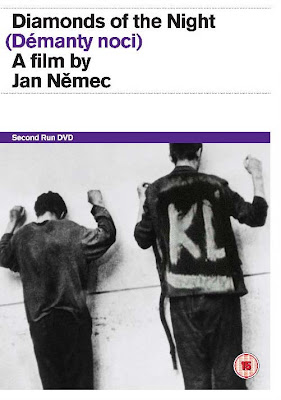 Film: Diamonds Of The Night
Release date: 26th April 2010
Certificate: 15
Running time: 68 mins
Director: Jan Němec
Starring: Ladislav Jánsky, Antonín Kumbera, Irma Bischofov
Genre: Drama/Thriller/War
Studio: Second Run
Format: DVD
Country: Czechoslovakia
Winner of the Grand Prize at the 1964 Mannheim-Heidelberg International Film Festival, many critics have hailed Jan Nemec’s Diamonds Of The Night (Demanty Noci) as a startling debut feature – integral to the then burgeoning Czech New Wave. A suggestion the film is deserved of this newly restored UK DVD release.
Film: Diamonds Of The Night
Release date: 26th April 2010
Certificate: 15
Running time: 68 mins
Director: Jan Němec
Starring: Ladislav Jánsky, Antonín Kumbera, Irma Bischofov
Genre: Drama/Thriller/War
Studio: Second Run
Format: DVD
Country: Czechoslovakia
Winner of the Grand Prize at the 1964 Mannheim-Heidelberg International Film Festival, many critics have hailed Jan Nemec’s Diamonds Of The Night (Demanty Noci) as a startling debut feature – integral to the then burgeoning Czech New Wave. A suggestion the film is deserved of this newly restored UK DVD release.
Two teenage boys escape from a train bound for a Nazi concentration camp during World War II.
With absolutely nothing, they have to contend with injury, hunger, thirst, the elements and the unkind woodland environment, as they run for their lives ahead of their pursuing captors, who will seemingly stop at nothing…
From the offset, director Nemec puts you in the mindset of the boys, capturing their emotional and physical anguish as he films through a shaky, jerky camera, which follows the boys up-close as they scramble through the unsympathetic terrain, their breathlessness clearly audible, with prominent unyielding shouts of “halt” and gunfire shots sending shudders – the impact heightened with the lack of a musical soundtrack, aggressive sounds used as an unexpected yet vital tool later on as dialogue is kept to a bare minimum, and always non-essential to the story’s telling.
We are not told why these boys are on the run, or from whom/where (although the sound of a steam train gives our first clue), left to ascertain for ourselves until the film’s near conclusion, as the director looks to increase our confusion with indiscriminate flashbacks and fantasy sequences that cut in abruptly, and on many occasions repeat. These eventually piece together events that brought these two boys to be on the run, but more importantly illustrate the psychological impact of their peril as thoughts become darker, and potentially murderous – when one of the boys enters a woman’s home to steal food, we are given a number of scenarios as to what happens next, privy to his now corrupt thoughts.
The stark black-and-white imagery augments the original storytelling: the boys muddy faces, grubby hands, and well-worn rags give a more obvious visual representation of their plight - the stolen boots that eventually cause injury to one of the boys, thus making the task that much more gruelling (especially for his companion who has to resort to dragging him).
There are some beautifully conceived, and lingering shots throughout, no more powerful than as we view these frail and battered youngsters looking out from their cover within the overgrowth to a farmer whose wife has brought him food - and the lips of one moves tentatively, clearly imagining how good it must taste. When they eventually do acquire bread, their mouths are so dry it becomes yet another heartbreaking difficulty that garners empathy as much as the freezing, wet nights where the anxious boys try to gain some rest. The director is also keen to cut in (the editing as brutal as the story) with harsh, bright light to dramatically offset the otherwise dull tone, and continue the viewer’s disillusion.
The enemy is always unrelenting. No matter how hard the boys run, and we follow them for significant periods, these darkly dressed old men, at times seemingly confused, slowly and methodically continue closely behind, firing their guns - other than threatening hollers, their speech mumbled and inaudible. They epitomise evil, especially when we are afforded greater time in their company; in contrast to the boys’ starvation, they have plenty, and are shown as gluttonous – their celebratory dancing and menacing laughter perhaps the most unsettling moments in a film that troubles throughout.
With limited dialogue, without the need for either to show any emotional shifts, and such unrelenting focus on channelling the viewers’ sympathies to the boys’ circumstance, the performances are somewhat secondary here, but the leads are suitably vague and solemn, and clearly praiseworthy given what both must have put themselves through to deliver on the director’s premise.
Undoubtedly an arduous watch, even at such a short running time, but a chillingly realistic account whose originality, heart and power demands you face this comparatively pale battle of nutrition. DH

Film: The Stranger
Release date: 15th February 2010
Certificate: PG
Running time: 100 mins
Director: Satyajit Ray
Starring: Dipankar Dey, Mamata Shankar, Utpal Dutt, Dhritiman Chatterjee, Robi Ghosh
Genre: Drama
Studio: Mr Bongo
Format: DVD
Country: India/France
The Stranger represents the final statement from acclaimed Indian filmmaker Satyajit Ray, who would pass away soon after due to heart complications.
Without any back-story, the film opens rather abruptly with Anila opening a letter from an uncle she had long thought had past. He disappeared some thirty-five years ago, but intends to return and stay with her as his only surviving family. The husband’s suspicions are instantly perked, but he bows to his wife’s desire – even if she’s not completely sure herself (hiding ornaments before her guest arrives).
When her uncle arrives, he does little to ease their concerns (openly stating that his passport could well have been faked), and though their son is pleased to have “a fake great uncle” to play with, and enthralled by his stories of travel and adventure, both Anila and her husband grow increasingly weary – enlisting the help of a friend to interrogate this ‘stranger’ – with their thoughts quickly turning to the financial repercussions of his return…
The key characteristics of any Satjajit Ray production are in place, with an orderly approach to filming that lends itself to long, drawn out scenes and verbose dialogue (at times making very little sense – particularly the scenes involving their inquisitive actor friend). And not forgetting the entertainingly bad acting from the supporting cast (stiff and expressionless), that serve to lift the efforts of the leads - Utpal Dutt is suitably questionable in his performance/appearance (a face that shouts villain).
As a story, the rational is weak. It’s more than questionable that any sensible person, especially a couple who are clearly so defensive of their material gains, would allow a complete stranger into their home - even if he is who he claims to be - and more so would then allow him to be alone with their child (soon after he arrives, their son sits alone with his new uncle on his bed). The father provides the only voice of reason (continuously griping and feeding his wife with doubts to his true identity and intentions), but given how it’s made very clear his standing (breadwinner and therefore waited on – even for the door to be opened for him), and where his wife’s place should be in the household, he would not have conceded to her wishes quite as easily.
There’s also a lack of tension and a number of possibilities instantly generated from this premise are ignored – whilst Utpal may be perfectly cast, his actions within the film rarely suggest foul play. Although he uses his intelligence to play a little on the father’s insecurities, it’s never worse than jovial, and he is kind and helpful (particularly with the son, who he gives a science lesson to, talks of explorations, and generously gifts coins collected from his travels – seemingly more attention and interaction than he gets from his own parents). Quickly warming to the suspected scoundrel of the piece renders the fears and doubts of his hosts irrelevant.
Ray does threaten to turn the story on its head, as the parents’ greed rises to the surface (visiting lawyers to find out if he can lay claim to inheritance behind the uncle’s back), but he seems to bottle out as we head to a gentle and almost sugary conclusion.
Although the meandering pace is representative of a Ray production, as if to allow time for you to digest any given point, the scenes here have been limited, which results in unnecessary scenes elongated even further (particularly where Anila sings and plays a sitar-type instrument for her guests). The director is also far less subtle in airing his opinions within the story – the questioning friend allows for a fairly unsubtle voice box rant on science, religion (something that creates barriers between people), mythology and westernisation (reference to junkies).
The film offers many interesting observations of India at the time: the characteristics/mannerisms adopted (bending to touch the feet when they greet someone); the wealthy; the treatment and expectancy of women (waiting on the men as they eat before eating themselves) and the underprivileged within their society; and how they, or more accurately Ray himself, viewed the outside world and how their country was changing (talk of how English was creeping into the vocabulary and the referral to the “white skinned”).
Commendably avoiding the obvious to take this story down a thrilling psychological route, Ray unfortunately uses the premise as a thin veil to air his own philosophical views. A tame conclusion to a career that would see Ray awarded an Oscar just months before his death. DH


