skip to main |
skip to sidebar
Film: Returner
Release date: 19th January 2004
Certificate: 15
Running time: 112 mins
Director: Takashi Yamazaki
Starring: Takeshi Kaneshiro, Anne Suzuki, Gorô Kishitani, Kirin Kiki, Yukiko Okamoto
Genre: Action/Adventure/Sci-Fi
Studio: Sony
Format: DVD
Country: Japan
When a term such as “summer blockbuster” is used, audiences are usually aware what they are in for: a lot of action, an over-reliance on CGI, and a dose of humour thrown in for good measure. Unfortunately, these elements can come at the expense of the writing and the plot, but if handled in the right way, these movies can be enjoyable and, most importantly, fun. Takashi Yamazaki's ambitious movie shows us it's not just Hollywood that appreciates the value of these movies.
The year is 2084, the human race has been brought to the edge of extinction by an alien race known as the Daggra. The humans have holed up in Tibet and their last hope rests with Milly, a young girl driven by the loss of her brother, who must travel back in time to the three days before the war started. Her orders are to kill the first Daggra, who faked a crash landing on Earth as a prelude to their invasion. Things don't go as planned, as her trip back in time places her squarely in the cross hairs of Miyamoto, a gunman who, after taking out a child smuggling ring, has finally caught up with his best friend's murderer, Mizoguchi .
After shooting Milly, Miyamoto takes her home to help her recover. When she reveals her true purpose to him, his reaction is one of derision and mirth at her obvious insanity, until she attaches an explosive device to his neck ensuring his co-operation. Together, with the aid of Miyamoto's sage-like handler, the two set out to stop the Daggra and save the future.
Meanwhile, Mizoguchi has his own plans for the alien and the ship. Hoping to use the technology for himself, he will go to any length to stop anyone from gaining the power he feels he rightly deserves.
As the two groups race to find the Daggra, Milly and Miyamoto slowly start to realise that all may not what it seems as they learn what really happened on the fateful day that the Daggra began their invasion…
This movie feels like a live action anime, with a super-cool anti-hero, a cute female side-kick, mechs and set pieces that take ‘over the top’ to the next level. This is a hard task for any director to get right, yet Takashi Yamazaki manages to pull it off. This aesthetic choice on his part is easier to understand now that he has gone on to direct live action versions of popular animes such as Space Battleship Yamato.
The action set-pieces are explosive and satisfying. The addition of a wrist device that can speed up the wearer adds to this greatly. Although it is a cheap ploy to fit in some Matrix-lite slow motion, it is nevertheless used in some original and inventive ways, while also giving characters a reason for being able to pull off some superhuman feats featured in the film.
The CGI and special effects are well done. The scenes set in a future overrun by the Daggra are the best example of this, from their ability to disguise their ships as normal planes to the scenes of the mech-encased invaders laying waste to all around them. It falls down slightly when the real actors and the Daggra are shown together on-screen as the limitations of the special effects become obvious.
With his shades, long hair and trench coat, Takeshi Kaneshiro oozes cool as Miyamoto. He switches between a revenge driven killing machine to reluctant hero effortlessly. His character isn't given much to do beyond this, but scenes showing his reaction and internal struggle with the loss of his best friend, and the scenes where he and Milly start to bond show a depth to his character which gives the film a much needed touch of heart.
Anne Suzuki is a delight to watch as Milly. Her fish out of water reaction to things we take for granted makes for an amusing contrast to her original introduction as the battle hardened savour of humanity, whilst a back-story involving losing her brother to the Daggra gives her an opportunity to show an emotional side, which helps fuels the story and her friendship with Miyamoto.
The relationship is well written and thankfully the bond that develops is similar to a bickering brother/sister combination rather than used as an excuse to fit a romantic sub-plot into an already convoluted story.
Undeniably, it is Goro Kishitani who steals the show here. With a hairstyle that even a manga star would envy, he lets rip as the villain. His introduction sees him execute one of the children he is transporting in order to subdue the rest. From here, he only gets worse, as his quest to use the power he feels he can gain from the Daggra leads him to more outrageous acts of violence and deception. In essence, he is the pantomime villain of the piece, though he goes about his acts of lunacy with such darkly comic glee that it is impossible not to look forward to his scenes.
This is a movie that is literally bursting with ideas, perhaps too many. An alien race, time-travel, gang warfare, a childhood vendetta and a clunky “humans are the real enemy” message all feature. Despite this, the plot is easy to follow, though scratch beneath the surface and things to start to unravel. Miyamoto's character has no obvious motivation (his encounter with Mizoguchi being as much a surprise to him as anyone). The Daggra are extremely powerful but haven't managed to wipe out humanity in eighty years. Why would Mizoguchi be firing a rocket launcher on an oil rig? The usual problems with time travel paradoxes, an issue that plagues the Terminator series, rears its head here also, and threatens to ruin one of the movie's most touching scenes. These are elements that could easily deter the more serious movie watcher, but it is a testament to the direction, action and acting that while watching the film, these niggling issues will fade into the background.
This is a divisive movie. It is a great action/ comedy movie with some decent CGI that will please fans of anime and action cinema in general. However, gaping plot holes, limited character development, and having heroes who take time out of saving the world to get makeovers may be a step too far for some people as the suspension of disbelief can only be pushed so far. DM

Film: K-20: The Legend Of The Black Mask
Release date: 10th January 2011
Certificate: 12
Running time: 137 mins
Director: Shimako Sato
Starring: Takeshi Kaneshiro, Takako Matsu, Tôru Nakamura, Kanata Hongô, Yuki Imai
Genre: Action/Adventure/Crime/Drama
Studio: Manga
Format: DVD & Blu-ray
Country: Japan
Japanese cinema is known for producing many things from classic monster movies (Godzilla; 1954) to even more classic samurai epics – Kurosawa’s Seven Samurai (1954), Throne Of Blood (1957) and Yojimbo (1961), to name just three – and most recently, supernatural J-Horror such as The Ring (1998), The Grudge (2002) and Dark Water (2002). However, Shimako Sato’s latest feature (her first in over ten years) is none of these, and offers a very different vantage on an increasingly popular national cinema.
In an alternate 1940s, where the Second World War never happened, the fictional Japanese capital of Teito revels in a prolonged aristocracy that sees the rich owning the majority of the wealth and the poor living in shantytowns on the fringes of the city. However, there is a proverbial thorn in the side of their tranquility; a mysterious masked villain known as K-20 – the phantom thief with twenty faces – wrecks havoc all over the city, stealing priceless objects from the elite.
Meanwhile, a talented circus acrobat Endo Heikichi (Takeshi Kaneshiro) is hired for a bogus job that results in him being framed and arrested as K-20. With the help of some professional thieves – among them is Genji (Jun Kunimura) – Endo escapes custody and tries to convince the city’s celebrity police inspector (Toru Nakamura) of his innocence by using his acrobatic skill to challenge and apprehend the real K-20…
K-20: The Legend Of The Black Mask arrives as a rather unorthodox breath of fresh air from an industry whose current fad seems to be churning out a high volume of low-budget, splatter-infused exploitation flicks. The film is a lighthearted swashbuckler-cum-superhero fantasy reminiscent of old, adventure-filled matinees of yesteryear, assisted with some 21st century filmmaking knowhow.
Performances are good all round, if perhaps a little straightforward and without much subtlety; this isn’t much of problem considering the lighthearted subject matter. Kaneshiro makes for a great lead whilst the older and wiser Kunimura serves well as mentor – it’s an engaging double act. Nakamura positively enjoys every second of screen time as the hotshot inspector, whilst the rest of the cast also appears to have a lot of fun, promoting a vibrant and uncharacteristic optimistic chemistry. As a result, Teito is quite possibly one of the happiest dystopias ever committed to film; even the orphaned children living in alleyways and boxes seem strangely content with their squalor.
This overall sense of colour and cheer is supported wonderfully by slick and professional cinematography that exudes the kind of old-school glamour that’s akin to a golden-age Hollywood picture. The film’s production design follows a similar modus operandi; reveling in modernist, art-deco architecture that lends the film a certain magical quality. It’s not perfect. There are a couple of moments where the film loses its period essence; the scenes that see Endo carry out his training by free running across the roofs of Teito’s skyline don’t exactly feel like that they’re taking part in late-1940s Japan for, example.
However, this is an alternate timeline, as indicated by the opening narration in an almost trailer-like manner (the modern day infomercial?) as well as the steampunk-esque flying machines that breeze past in the film’s first extreme wide shot. The inclusion of a Tesla inspired contraction – the MacGuffin that K-20 wishes to steal – that can inevitably be programmed for evil not only suggests that we are firmly in fantasy/comic book territory but raises the stakes to tantalizingly old-fashioned world-domination levels for the hero to overcome.
Part of K-20’s overall enjoyment lies in its rather deft ability to riff off many varying genre conventions and iconographies. Part super-hero movie, part steampunk fantasy, part detective movie, part heist movie, part period adventure, part romance, part comedy – the list goes on. The K-20 thief is a compound caricature made from elements of Spider-Man, Robin Hood, The Shadow and Zorro. Naturally, this does mean that the film is not particularly original, a mere recycled mishmash of various genre elements. However, its combination of said elements and its execution keeps things fairly unique and fresh, if only from a visual standpoint.
The set pieces themselves are very entertaining and make one pine for the days when these kinds of action scenes were the norm instead of computer-generated monstrosities duking it out for as long as the budget can last. Do you remember a time when computers and wires were only used to enhance a fight scene? K-20 remembers, and it makes for a refreshing change of pace. Implausibility is challenged but stays within the limits of the film’s logic. Endo and K-20’s showdowns are most enjoyable, partly through using the real actors for those scenes but also due to Sato’s decisions with regards to camera placement. Movements and stunts are given room to breath, and never come across as jumbled orgies of random angles, as is the case with a lot of contemporary action cinema. Other modern action movie gimmicks such as slow motion and fiddly camera-centric moves are used sparingly and effectively.
Another pleasant surprise is that the film’s inclusion of comedic relief, for the most part, works quite nicely and contains plenty of quirky Japanese humour - Akechi’s ridiculously young side-kick fantasizes about the Tesla device’s destructive power as, in his day-dream, it wipes out the city in a huge mushroom cloud. It then cuts back to the adolescent as he stares vacantly and longingly into the middle distance. Some of the heist elements of the film are also quite subversive; one sequence sees an entire section of a bridge get stolen by Genji’s group of thieves, seriously.
But the most amazing thing on display here is not the film’s ability to fathom a good balance between sincerity and tongue-in-cheek silliness – a sub-plot featuring Yoko, a politically ignorant heiress and love-interest, wanting to help feed the poverty stricken orphans is about as serious as it gets – but its overall execution. For a film that runs at a seemingly bloated two hours and twenty minutes, the pacing is incredibly brisk with very few dull moments. Also, for a film that was made for less than the average catering budget for a medium size Hollywood production, production values are extraordinarily high and offer plenty of bang for buck.
K-20: The Legend Of The Black Mask is ultimately a disposable, yet highly enjoyable romp: think Fritz Lang’s Metropolis (1927) made as a costumed action-adventure serial. Deep down, there’s nothing particularly new here but the film works on sheer bravado, nostalgia and entertainment value alone. Worth a look. MP

Check out the trailer below for K20: The Legend Of The Black Mask, which comes to DVD on 10th January 2011.
More information on the film can be found by searching this website.

Adapted by writer-director Shimako Sato (Tale Of A Vampire) from a novel by So Kitamura, the film stars Takeshi Kaneshiro (Red Cliff; The Warlords; House Of Flying Daggers), Takako Matsu (Confessions) and Toru Nakamura (Tokyo Raiders; Gen-X Cops) in a thrilling tale of an unlikely ‘superhero’ who is forced to pit his wits against the titular villain who has his sights set on world domination.
The year is 1949 in a slightly alternative reality to the one we know. In this version of history, World War II never happened, Teito is the Imperial Capital of Japan, inventor Nikola Tesla has just won a Nobel Prize, and Japanese society is divided between the extremely rich and the hopelessly poor.
Taking advantage of the situation is a mysterious thief and master of disguise known as K-20 – the Fiend with 20 Faces, a self-styled Robin Hood figure who steals from the rich and gives only to himself.
Having set his sights on a newly developed energy beam generator that could make him the ruler of the world, K-20 sets about achieving his deadly goal by framing a poor circus performer, Hekichi Endo (Takeshi Kaneshiro), for his previous crimes using the rehearsal of the high society marriage between heiress Yoko Hashiba (Takako Matsu) and Chief of Police, Kogoro Akechi (Toru Nakamura) as a backdrop.
Endo is arrested at the scene of the rehearsal and sentenced to death but manages to escape. On the run, Endo realizes the only way to prove his innocence and clear his name is to assume the identity of K-20 and take on the villain at his own game by finding and obtaining the energy generator first.
A cool, light-hearted caper packed with exceptional stunt work, thrilling set pieces and impressive action sequences (including some amazing free running), K-20: The Legend Of The Black Mask is a thoroughly enjoyable and uniquely Japanese take on the superhero movie.
Film: K-20: The Legend Of The Black Mask
Release date: 10th January 2011
Certificate: 12
Running time: 137 mins
Director: Shimako Sato
Starring: Takeshi Kaneshiro, Takako Matsu, Tôru Nakamura, Kanata Hongô, Yuki Imai
Genre: Action/Adventure/Crime/Drama
Studio: Manga
Format: DVD & Blu-ray
Country: Japan
After moving to Shanghai with his friend Tai Cheung (Yuen Wah), and finding work as a coolie, Ma Wing Jing (Takeshi Kaneshiro) saves the life of crime boss Tam See (Yuen Biao), earning the enmity of rival gangster Yang Shuang.
Ma becomes successful running an underworld club, but the cunning Yang has sworn revenge, and hatches a bloody plot against him.
Film: Hero
Release date: 8th November 2010
Certificate: 12
Running time: 90 mins
Director: Corey Yuen
Starring: Takeshi Kaneshiro, Yuen Biao, Yuen Wah, Yuen Tak, Valerie Chow
Genre: Action/Crime/Drama
Studio: Cornerstone
Format: DVD
Country: Hong Kong
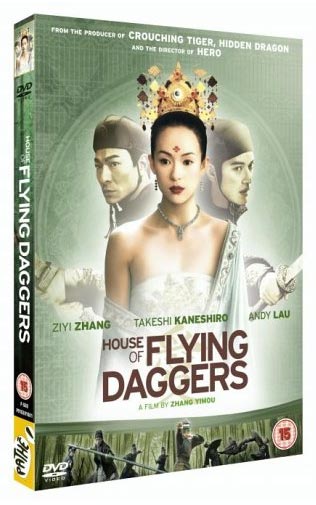
 Film: House Of Flying Daggers
Release date: 2nd May 2005
Certificate: 15
Running time: 114 mins
Director: Yimou Zhang
Starring: Ziyi Zhang, Andy Lau, Takeshi Kaneshiro, Dandan Song, Hongfei Zhao
Genre: Action/Adventure/Drama/Fantasy/Martial Arts/Romance
Studio: Pathe
Format: DVD
Country: China/Hong Kong
A triumphant work of artistic and directional genius, House Of Flying Daggers is an action romance that follows the tale of Mei, a suspected vigilante, and Jin, a governmental official, as they fight hidden enemies in search of the rebel group House of Flying Daggers. Having received international rave reviews, and an alleged 20 minute standing ovation at the Cannes Film Festival, it is no wonder that House Of Flying Daggers remains at the top of many a film lover’s list.
Film: House Of Flying Daggers
Release date: 2nd May 2005
Certificate: 15
Running time: 114 mins
Director: Yimou Zhang
Starring: Ziyi Zhang, Andy Lau, Takeshi Kaneshiro, Dandan Song, Hongfei Zhao
Genre: Action/Adventure/Drama/Fantasy/Martial Arts/Romance
Studio: Pathe
Format: DVD
Country: China/Hong Kong
A triumphant work of artistic and directional genius, House Of Flying Daggers is an action romance that follows the tale of Mei, a suspected vigilante, and Jin, a governmental official, as they fight hidden enemies in search of the rebel group House of Flying Daggers. Having received international rave reviews, and an alleged 20 minute standing ovation at the Cannes Film Festival, it is no wonder that House Of Flying Daggers remains at the top of many a film lover’s list.
Set during the decline of Tang Dynasty China, the government and its officials are riddled with corruption. Amongst civil unrest, an underground alliance named House of Flying Daggers emerges with the purpose of combating corruption, and fairly redistributing the country’s wealth among its people.
While respected and revered by the common mass, House of Flying Daggers is hated by the local deputies who have vowed to destroy the allegiance. Despite having recently murdered the old leader of the Flying Daggers, the rebel group only becomes stronger due to the presence of a mysterious new leader, whom Captain Jin (Takeshi Kaneshiro) and Captain Leo (Andy Lau) of the Chinese authority are given ten days to find and destroy.
Leo sends Jin, a flirtatious and unscrupulous playboy, to investigate claims that a Daggers affiliate is masquerading as a show girl at the Peony Pavilion. At the brothel, they find and arrest the beautiful blind artisan Xiao Mei (Zhang Ziyi), a dagger wielding martial arts master with a political agenda. Mei is incarcerated as rumours circulate that she is in fact the blind daughter of the late Daggers leader. In a cunning plot, Leo and Jin plan to trick Mei into leading them to the Daggers secret location.
Under the false pretence of being an admirer of the Daggers, Jin springs Mei from prison and leads her away from the governmental officials - or so she thinks. The two are followed closely by Leo and the local militia, who fake an ambush to convince Mei of Jin’s sincerity. Apparently blissfully unaware of the scheme, Mei begins to trust Jin, and an unlikely romance blossoms, as Jin’s game of trickery and deceit escalates into a real life and death drama, where the two find themselves battling unseen foes in their quest for safety and to find the concealed Daggers…
House Of Flying Daggers is an undisputable triumph of both acting and direction. Zhang Yimou’s signatory use of riotous colour makes the film an opulent reflection of the Tang dynasty, whose art work is typified by the type of grandeur that Zhang Yimou infuses this film with. The visuals themselves are so spectacular that they move as a piece of artwork, and continue to transcend the usual role of scenery in film. In this case, Zhang Yimou has achieved a remarkable harmony between scenery and plot, where the background becomes as important, if not more, than the story line itself.
Unlike previous martial arts films, House Of Flying Daggers provides the perfect melange of nail biting romance and heart stopping action. The kung fu throughout is gorgeously choreographed, and acts to enrich both the plot and setting. Moving effortlessly through the air, these blood-splattering, action packed encounters add to the sense of mystery and drama, as well as providing a visual thrill for the audience.
The use of sound throughout is extremely important, and masterfully heightens and intensifies the film experientially. Musical whiz kid Umebayashi is behind the score for House Of Flying Daggers. This sensitive soundtrack amalgamates eastern and western influences to provide a contemporary, yet in keeping take on traditional Chinese music.
The storyline is a little wanting, and the characters are superficial without much depth or development. The script is clichéd and a little predictable throughout the middle section, however, the final scenes make up for the lacklustre build up. Despite all this, the plot is not disappointing, as the main emphasis in the film is that of the visual and audio sensationalism, which more than compensates for any storyline flaws. The story, like that in an opera, is not crucial to the overall experience but merely provides a spider web framework in which Zhang Yimou weaves his phantasmagorical action-romance.
Interestingly, the foundation of a weak script does not equate to poor performances from any of the actors. Before taking on the role of Mei, Zhang Ziyi is rumoured to have spent two months preparation time with a young blind girl, in order to perfect and authenticate her performance. This would indeed be no surprise as her portrayal of the blind Mei is flawless. Zhang Ziyi brings an exciting dimension to the character of this gritty and determined young girl, by ensuring that Mei’s hard façade is penetrated by moments of endearing vulnerability and displays of passionate love, anger and hatred.
Zhang Ziyi’s ephemeral beauty juxtaposed with Xiao Mei’s serious martial arts skills makes this no-nonsense vigilante the deserved heroine of the film. Takeshi Kaneshiro’s performance of Jin brings this cheeky chappy to life. The womanizing Jin, however, is no match for Xiao Mei, and it must be said that despite his characteristically good acting, Takeshi Kaneshiro could not hold a torch next to Ziyi’s. Andy Lau proves himself to be a likely contender for the title of Daggers Heart throb, as he plays his role of the focused Captain Leo credibly, and adds a certain mysterious je ne sais quoi to the character.
This gripping love story, laced with espionage and betrayal, is a sure hit. Zhang Yimou’s glorious utilisation of colour, coupled with his ingenious take on audio sound effects, acts to showcase this directors true talent. The thoroughly convincing performances by the entire cast, especially Zhang Ziyi, will embroil you in this twisting tale, filled with double bluffs and surprising turns. House Of Flying Daggers is an absolute must see, that will act to either inspire or feed your kung fu film addiction, and is guaranteed to leave you gasping for more. HRP
 Film: The Warlords
Release date: 2nd March 2009
Certificate: 15
Running time: 108 mins
Director: Peter Ho-Sun Chan
Starring: Jet Li, Andy Lau, Takeshi Kaneshiro, Xu Jinglei
Genre: Action/Drama/War/History
Studio: Metrodome
Format: DVD
Country: China/Hong Kong
Director Peter Ho-Sun Chan unites three of Asian cinema’s most prolific and charismatic leading men for an epic of war, morality and betrayal loosely based on one of “the great unsolved mysteries” of China in the Qing Dynasty.
Film: The Warlords
Release date: 2nd March 2009
Certificate: 15
Running time: 108 mins
Director: Peter Ho-Sun Chan
Starring: Jet Li, Andy Lau, Takeshi Kaneshiro, Xu Jinglei
Genre: Action/Drama/War/History
Studio: Metrodome
Format: DVD
Country: China/Hong Kong
Director Peter Ho-Sun Chan unites three of Asian cinema’s most prolific and charismatic leading men for an epic of war, morality and betrayal loosely based on one of “the great unsolved mysteries” of China in the Qing Dynasty.
1865. China has been ravaged by a decade-long civil war that is eroding the will of the nation. Destiny brings together three men, soldiers all, whose decisions and actions may yet decide the fate of the country. Brothers Er-Hu (Lau) and Wu-Yang (Kaneshiro) are joined by General Pang (Li), an unpredictable warrior haunted by a moment of rare cowardice, and driven mad by his need to atone for it.
With Pang uniting and organising their ragged army, Er-Hu and Wu-Yang soon become major players in the war for China. But, as their army marches across the land, each man’s moral code is tested by difficult and potentially soul-shattering decisions. Can they make free their country before destroying each other?
It is strange to consider that Jet Li, like Jackie Chan, is now very much an elder statesman of Chinese martial arts/action cinema. After twenty-plus years of working mostly within his righteous hero persona, Jet Li takes his longest stride away from his comfort zone with The Warlords, a grim, brutal historical epic. General Pang may share martial proficiency with Li’s back catalogue of heroic figures, but where he differs is in his tenuous grip on his own sanity, and an agenda that seems anything other than honourable. Like Jackie Chan’s recent attempt to exercise his acting muscles with The Shinjuku Incident, Li seeks to subvert his cinematic persona - his performance distorting his usually impassive features with tinges of bloodlust and a megalomaniacal frenzy. While the end result is a slightly over-cooked turn that ultimately does not match the sheer perfection of his necessarily blank performance in Zhang Yimou’s Hero, Li’s acting is nevertheless a notch above what his star vehicles usually permit him to do, his unhinged delivery extremely effective within the parameters of a war fable.
He is ably supported by his two co-stars. Andy Lau’s Er-Hu, the most honourable and conflicted of the trio, is an over-stuffed box of pent-up frustration surely destined to explode. Lau plays him with a measured stillness that is slowly, hauntingly, inevitably undone, and his performance here is arguably his best since 2002’s Infernal Affairs. But the star turn, almost predictably, is from Takeshi Kaneshiro, who makes believable the about-faces and suddenly redefined motivations the script thrusts upon Wu-Yang. Together, the three leading men form three pillars of a morality tale which, though fairly simplistic in its examination of necessity-during-war, is far more compelling than its occasionally pedestrian and predictable narrative.
The film itself is a stirring, searing war epic that owes as much to Greek, Shakespearean and operatic tragedy traditions as it does to Asian action cinema. Its battle sequences, directed by Ching Siu-tung, are visually stunning slices of pure excitement, even if they lack the crisp clarity of Ching’s work in the aforementioned Hero, and the screenwriter’s decision to gradually narrow the focus of the film to the characters and their emotional motives is a welcome change from war films that walk blindly into a chaotic final battle sequence. Both action and drama are shot with the lush, meticulous hand of the venerable Arthur Wong, whose cinematography conjures up some truly memorable images, not least the sight of a horrified Andy Lau standing in a sea of dead soldiers after a mass execution.
But, as stellar as The Warlords is on a technical level, there remain persistent niggles with a slightly underdeveloped script that is oddly elliptical, suggesting a film that’s received the kind of savaging in the editing room that its principal characters inflict upon each other on-screen. Whole scenes and sequences seem to be missing (for example, a siege of Nanking - presented as a bone of contention between the three conflicted lead heroes - is strangely skipped over), leaving viewers scrabbling to connect the dots. Likewise, a pseudo love triangle involving Jet Li, Andy Lau and Xu Jinglei’s Lian is hinted at, but never fully explored or committed to, and is eventually utilised purely as a device through which the script can swiftly put its main characters at-odds going into its third act, which unfolds with the inevitability of Shakespeare and the carnage of John Woo. In addition, any allegorical contemporary relevance to which the film might aspire is buried too deep beneath the violent, visceral aesthetic to truly resonate. While it may play very well for local audiences, The Warlords is likely to at least mildly alienate overseas viewers. That should not, however, detract from an often-exhilarating cinematic experience.
Subtlety is not on the menu for this feast of blood and carnage, but The Warlords is an effective historical epic with more than enough well-staged action to recommend it. The action is complimented by fine work from the cast, and Arthur Wong’s visuals are stunning. JN