skip to main |
skip to sidebar
Film: Little Big Soldier
Release date: 8th November 2010
Certificate: 15
Running time: 96 mins
Director: Sheng Ding
Starring: Jackie Chan, Leehom Wang, Yoo Seung-yun, Lin Peng, Xiao Dong Mei
Genre: Action/Adventure/Comedy
Studio: Cine Asia
Format: DVD & Blu-ray
Country: China/Hong Kong
The talented and nimble Jackie Chan gives a commemorative performance in this martial arts comedy caper set in China during the Warring States period, just before the country was unified. Directed by the relatively unknown Ding Sheng, Little Big Soldier sees the kung fu icon return to form, even if it’s the younger members of the cast – including pop star Leehom Wang – who ultimately steal the show.
Much blood has been spilt between two opposing armies, the Liang’s and the Wei’s, and thousands of casualties lay motionless among the battlefield. However, the conflict has spared the lives of two men, Old Soldier (Chan) from the Liang Army, who shamelessly played dead, and a prince (Wang), from the Wei Army.
Unscathed, Old Soldier takes the wounded prince as his captive in the hope of handing him over to his superiors for a reward. But the journey to the state of Liang proves a long and treacherous one with many bandits and barbarians waiting in the wings. The unfortunate twosome also has to deal with the aggressive pursuit of prince’s brother Wen (Steve Yoo) and his entourage, who seek to kill him and take his place as the future ruler of Wei.
Through the formidable circumstances that start to emerge, the pair help one another during the many sticky situations, and come to rely on each other to survive. A tolerance and understanding between the two soldiers emerges, each finding a new respect for the other and a dignity within themselves...
The main script, written by Chan, is relatively straightforward. But beneath the simplistic plot lays a moralistic tale of honour, loyalty and brotherhood. Whatever the film lacks in plot, it more than makes up for in the fine acting capabilities of the cast, especially that of Chan. His portrayal of the seemingly gutless scallywag showcases his brilliance at comedy timing - his acting ability has vastly matured, and takes preference over his skill as a martial artist. Chan and Wang play-off each other very well and make a very convincing pair whose characters are inevitably bound together. Through the events that take shape, Chan’s character, Big Soldier, who is referred to as Small Potato by his hostage, proves to have admirable qualities he never thought he had - supposedly a coward at the start of the film by playing dead on the battlefield to avoid being killed.
The film is laced with subtle metaphors such as the poignant performance on a mountain top by the girl singer (Peng). Dressed in a white rope with long flowing sleeves, she moves swiftly like a bird, possibly signifying a dove of peace flying over the zenith. Although she plays a minor role, Peng’s delicate deliverance as the singer has a beauty that is most welcome, and doesn’t feel out of place or contrived. Even in this small part, Peng shows she has a graceful quality that could potentially take her to the heights of Zhang Ziyi (House Of Flying Daggers) or Xun Zhou (The Banquet). Overall, the film has a great supporting cast, even minor characters like the scholar and his students stand out. In fact, it’s a shame they didn’t have more screen time as they worked really well.
Director Ding Sheng presents us with the vastness of a dry wasteland, incorporating stunning panoramic views of jagged mountains that are used as a backdrop to the narrative; the camera sweeping over the summit giving scope to the terrain, and the environment showcasing the harsh conditions of the journey in which the foot soldier undertakes with his captive in tow. The costumes depicting ancient armour and the rugged look of Old Soldier and that of the barbarians blend in with the scenery, making the overall look of the film a character in itself. Vibrant colours are used sparingly throughout the film but are put to good effect during a dream sequence that has Old Soldier blissfully running through a field of yellow canola flowers.
The soundtrack is also underplayed, not being excessive for the sake of it, or for needless sentimental reasons. Often the score goes unnoticed, but that’s a good thing as it blends in with the whole presentation, never being unnecessarily dominant or distracting.
Chan bounces back from a string of uninspiring Hollywood films with Little Big Soldier in which he brilliantly demonstrates his acting ability that has improved immensely over the years. Although his action sequences emphasise his expertise in acrobatic manoeuvres rather than his proficiency in the art of kung fu, Chan fans won’t be disappointed. Strong performances from a competent supporting cast and genuinely funny successions of comedic moments, as well as striking visuals, makes this a must see film. SLP

Film: The Karate Kid
Release date: 15th November 2010
Certificate: 12A
Running time: 130 mins
Director: Harald Zwart
Starring: Jaden Smith, Jackie Chan, Taraji P. Henson, Wenwen Han, Rongguang Yu
Genre: Action/Drama/Family/Martial Arts
Studio: Sony
Format: DVD & Blu-ray
Country: USA/China
This is an English-Language release.
It may now be set in China, with an Afro-American child lead, but there are plenty of similarities for nostalgic fans of the original, as The Karate Kid becomes the latest ‘victim’ of the Hollywood reboot.
Dre Parker’s mother shows zero responsibility and care for her child by uprooting him from his home and friends in Detroit, USA and taking him across to Beijing, China, with minimal notice or preparation, for a standard employment opportunity.
Now alone and feeling lost in a foreign land, Dre takes a shine to young Chinese musician Mei Ying, but this does not impress the local kung fu kid, who, displaying superman-esque strength, gives Dre a thorough ass whooping.
With even less friends now, and a mother too busy to spend any time with him let alone address his ill-manners properly, Dre becomes increasingly isolated and depressed, as the bullying continues.
Looking to get his own back on these young brutes only lands Dre in even hotter water, and it’s left to handyman Mr. Han to save him from a precarious situation - by beating up a group of children.
This angers the children’s sensei, and the only way Mr. Han can think of avoiding more blood spill on the streets of Beijing is to enter Dre into an upcoming martial arts competition. Mr. Han will train him, but he has some unusual methods that will test the patience of the already testy Dre…
Of course, a remake, where so much of the original’s story has been retained (bar a completely new country), of such an iconic 80s children’s favourite will struggle for much goodwill amongst fans of the original, but, given its PG-certificate, this is being targeted at a whole new generation, who have likely never seen the original, and will no doubt relate to the petulant Dre character, and be thoroughly engrossed by its flashy, over-the-top fight scenes and loud soundtrack – they don’t need any emotional weight, moral aspect, or character relation. In fact, had they seen the original they’d no doubt find it tame in comparison, where Ralph Macchio in the role of Daniel Larusso was asked to get off his butt and do a bit of work (we’ll get to this later), whilst holding an elderly fellow in reverence as he passed on words of wisdom.
Unfortunately, for an adult viewing, The Karate Kid raises some serious questions mostly about the desensitisation of children today, who are growing up with intense, and at times fairly violent and aggressive video games and television – and nothing else. Here, in one of the film’s earliest scenes, where Dre is first confronted by his nemesis, we have a character presented as demonic, with power and strength well beyond his years, beating seven bells out of a small child with the slightest frame in a fairly graphic and bone crunching manner – this should be terrifying viewing for any child. For any adult, it makes for uncomfortable viewing, because it’s outright wrong (let’s forget all the racial stereotyping in this critique).
We’ll overlook the fact that the film is called Karate Kid, even though nobody is trained in that discipline, and that they’ve set the film in China, when, had they lived up to the film’s billing, Karate originates from Japan. This is being pedantic, and, of course, makes very little difference to the ‘boy trains to beat up bully’ premise. The biggest question has to be why they opted for such a young lead (perhaps not such a big question when you consider his father’s clout within the industry – Will Smith has a production credit here), which not only raises the aforementioned concerns, but takes the film into the realms of extreme fantasy – how does this compute in a child’s mind. In the original, Ralph was a twenty-something playing the role of a 16-year-old. He was at an age where hormones are raging and romantic interests and conflicts are commonplace; he was fighting against fellow older actors of a sizeable stature, in realistic scenarios; and everything was grounded in moral messages that ultimately fighting is wrong. Here we are expected to believe that someone who looks barely 10 is really going to be all that concerned with the fairer sex – let alone displaying the depth of emotional understanding we are shown during many of the film’s laborious moments – and that the bullies of the piece can fly around the screen with the strength to give Jackie Chan of all actors – still in decent shape - a tough time. The only message coming across is violence is good, and forget respecting anyone else – let alone an elder – unless you quite fancy them.
In fairness, Jackie Chan puts in a solid performance – a far better dramatic display than his much-hyped role in The Shinjuku Incident. But again, all the fun has been taken away. Part of the joy of the original was seeing the podgy, diminutive, elder Mr. Miyagi turning out to be an agile martial arts expert, and alongside his principles that vitally grounded the film’s events, he brought a humour to the part that was so enjoyable for a child viewer (he also disposed of these older, larger adversaries quickly – it wouldn’t have been half as cool if he spent half-an-hour knocking about infants). In this film, we have a dark, breakdown scene where Jackie completely loses it and bears his soul. Apparently, we are now expecting children to take on board such heavy issues - and amongst the fierce carnage that would leave any fully developed mind a little rattled.
As mentioned at the start of this review, fans of the original are going to pick holes, particularly in the initial training, where instead of the pupil being asked to clean and polish his trainer’s car (the infamous wax on, wax off scenes) and paint his fence - and the subsequent joyful enlightenment for both the viewer and the character when the big reveal shows all these menial tasks were actually grounding him in the basics of good karate skills - here the writers thought it would be enough to have him just hang his coat up, put it down, drop it on the floor, on repeat, for what seemed like an eternity. This is before it goes completely over-the-top as he quickly becomes the new Bruce Lee, if compensated for by some spectacular scenery.
That brings us to the running time. Unfortunately, the filmmakers got sidetracked with an unnecessaryily long romantic sub plot, which adds nothing – it certainly won’t impress child viewers where the thought of making out repulses, and who are waiting for their next fix of CGI enhanced kick ass, and neither Jaden Smith in the role of Dre or Wenwen Han in the role of Mei Ying have the acting chops to pull it off. In fact, the only commendable aspect of Jaden’s performance is in his physicality, although it’s uneasy that a child actor so young would be expected to develop in such a way – yet another unhealthy message for its target audience. Also clocking up the minutes is the big ‘visit China’ sell – all the key visitor attractions are enhanced and displayed on the grandest of scales. Whilst it may have helped with the production costs, and no doubt younger viewers will be in awe, it hampers progress of what, ignoring the moral concerns any right minded adult would have watching, is a decent, standard, big budget Hollywood action flick.
There’s nothing here for adults, the characters are too young for older teenagers, who have progressed to blowing people up on X-Box for their amusement, so this is definitely targeted at young children. Given its PG-rating, the choice should (although probably not) be with the parents as to whether they feel their child is ready to be exposed to such levels of emotional and physical distress – if they haven’t been already.
Kids today will lap it up. Fresh from smashing someone through a wall on their latest video game, they can now watch an actual person do it. For fans of the original, all the basic story elements are in place, it just lacks any of that film’s warmth, humour or soul. However, the biggest crime is the complete lack of responsibility Hollywood has again shown as those involved focus solely on boosting their bank balances. DH

After moving to Shanghai with his friend Tai Cheung (Yuen Wah), and finding work as a coolie, Ma Wing Jing (Takeshi Kaneshiro) saves the life of crime boss Tam See (Yuen Biao), earning the enmity of rival gangster Yang Shuang.
Ma becomes successful running an underworld club, but the cunning Yang has sworn revenge, and hatches a bloody plot against him.
Film: Hero
Release date: 8th November 2010
Certificate: 12
Running time: 90 mins
Director: Corey Yuen
Starring: Takeshi Kaneshiro, Yuen Biao, Yuen Wah, Yuen Tak, Valerie Chow
Genre: Action/Crime/Drama
Studio: Cornerstone
Format: DVD
Country: Hong Kong
 Set in the war period in China between 476 BC – 221 BC, Little Big Soldier tells the story of a soldier (Jackie Chan) and a general (Wang Leehom) from opposing states (Liang and Wei), who have very much opposing views on the war and world.
Jackie Chan - in one of his finest performances - plays the soldier from Liang, who survives the war which had left most men killed, by playing dead until the war was over. Lee Hom Wang, who plays the general from Wei, survives the war, but would rather be dead after the bloodshed.
A painful yet comical journey commences when the soldier decides to abduct the downtrodden general and bring him back to his state in the high hopes of collecting a reward. Taking the general home was not as easy as expected, however, as the general attempts suicide many a time, but the soldier insists on saving him for his huge reward - even if that means endangering his own life.
A bonus digital copy of the film will be packaged with the DVD as a special gift from Cine Asia. The disc comes with a specially formatted standard definition digital version of the full-length movie so that you can fully enjoy the possibilities of watching the action-packed Little Big Soldier on your PC!
Film: Little Big Soldier
Release date: 8th November 2010
Certificate: 15
Running time: 96 mins
Director: Sheng Ding
Starring: Jackie Chan, Wang Lee-hom, Yoo Seung-yun, Lin Peng, Xiao Dong Mei
Genre: Action/Adventure/Comedy
Studio: Cine Asia
Format: DVD & Blu-ray
Country: China/Hong Kong
DVD Special Features:
•
Audio commentary by Hong Kong Cinema Expert Bey Logan
•
Trailer gallery – Including first look at Ip Man 2, starring Donnie Yen!
•
Interview gallery
•
‘Making of’ gallery
•
‘On set report’ gallery
•
Behind the scenes
•
Jackie Chan music video
Film: Versus
Release date: 30th June 2003
Certificate: 18
Running time: 120 mins
Director: Ryûhei Kitamura
Starring: Tak Sakaguchi, Hideo Sakaki, Chieko Misaka, Kenji Matsuda, Yuichiro Arai
Genre: Action/Comedy/Fantasy/Horror
Studio: Tartan
Format: DVD
Country: USA/Japan
Versus was the film that made the world sit up and take a serious look at Japanese director Ryuhei Kitamura. Now over ten years later, having had several re-releases with extra footage and even a US remake supposedly due for a 2010 release, is Versus still the internationally acclaimed gem that it would appear to be?
The opening scrawl explains that there are 666 portals on earth leading to the afterlife, one of which is found in Japan, and is called the ‘forest of resurrection’. The film then jumps to the present day, where Prisoner KSC2–303 and a fellow prisoner meet with a gang of Yakuza mobsters in the forest, after escaping police custody.
Following a disagreement, KSC2-303 flees the Yakuza with a mysterious woman that the mobsters had kidnapped. The gangsters run deep into the forest after the two of them but discover that the dead bodies of people they have killed and buried in the forest are coming back to life as zombies. The gang then furiously fight off the zombified hordes approaching them; losing most of their numbers in the onslaught.
KSC2-303 meanwhile has started to forget details of his life, and begins to experience flashbacks of events he hasn’t knowingly experienced. Matters become clear as he meets face to face with a mysterious man. This man turns out to be an arch rival of KSC2-303 from a past reincarnation, and seeks to use the woman to open the gates of hell and acquire a great power.
Now knowing that his destiny is to stop his nemesis, KSC2-303 vows to protect the girl and settle the age old rivalry once and for all…
Whilst Versus is primarily an action horror flick, there are also occasional comedic turns. These are relatively outrageous and self-conscious scenes that juxtapose the heavy premise and the gory aesthetic. Moreover, these don’t necessarily undermine the flow of the film. Much of the comedy is self-referential and parodying of generic elements in Far Eastern action films.
The gore used by Kitamura for many of the action and zombie scenes go to show he is a man who doesn’t wish to hold back on visceral horror and instead gives the audience the blunt imagery. As a result, there are people having huge holes blown through their body, bits of limbs being cut up, and guts flying ad nausea. Indeed, it is true to say that those who do not like blood will be looking through their fingers for much of the film. It is splatter core at its most visual.
What is probably the most enjoyable factor about Versus is that the plot is simple, but without lacking any narrative depth. The story of resurrection, reincarnation, sibling rivalry and love across spiritual worlds manages to squeeze its way in amongst the gun and swordplay, and this somehow feels right. Not many films manage to strike this balance successfully, however for Versus it just about works. This is also despite the movie being quite minimalist when it comes to dialogue, as, in most cases, actions speak louder than words. Occasionally this makes some scenes more interesting and poignant - this is beautifully displayed during a particular flashback sequence where emotion is created simply by facial expressions.
If there is one thing that comes across most with Versus, it is the overt stylistic comparison with the Matrix. This is probably no accident as the Matrix smashed box office records the year before Versus was released, and that in itself borrowed stylistic elements very heavily from Far Eastern cinema. However, in this case, the Matrix style effects are somewhat sent up. In one particular case, a man attempting to dodge a bullet in the style of Neo fails spectacularly and is blown to smithereens. It is also worth noting how many times KSC2-303 is referred to as ‘the one’ and, most notably, how he wears a very similar jacket to Neo’s.
Despite the fact that he is clearly modelled on Neo, Tak Sakaguichi manages to put in a fine performance as KSC2-303; portraying a character that is not as clear cut a hero as it would seem. Sakaguichi succeeds, despite the character being somewhat of an undesirable, in making the audience root for him and gives KSC2-303 an ice cool edge, as well as a fiery ruthlessness.
Versus is a film with many hidden depths, and is not simply the big loud action film it would appear to be on the surface. The somewhat deep story of rivalry and conflict crossing over many reincarnations successfully compliments the zombie splatter core, and makes for an engaging and entertaining two hours. Versus has ultimately stood the test of time, but it seems hard to imagine what could be improved upon should the US release actually happen. DJ

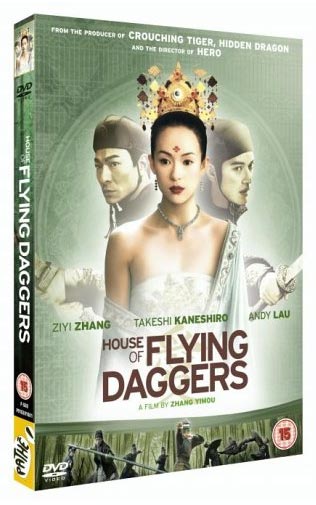
 Film: House Of Flying Daggers
Release date: 2nd May 2005
Certificate: 15
Running time: 114 mins
Director: Yimou Zhang
Starring: Ziyi Zhang, Andy Lau, Takeshi Kaneshiro, Dandan Song, Hongfei Zhao
Genre: Action/Adventure/Drama/Fantasy/Martial Arts/Romance
Studio: Pathe
Format: DVD
Country: China/Hong Kong
A triumphant work of artistic and directional genius, House Of Flying Daggers is an action romance that follows the tale of Mei, a suspected vigilante, and Jin, a governmental official, as they fight hidden enemies in search of the rebel group House of Flying Daggers. Having received international rave reviews, and an alleged 20 minute standing ovation at the Cannes Film Festival, it is no wonder that House Of Flying Daggers remains at the top of many a film lover’s list.
Film: House Of Flying Daggers
Release date: 2nd May 2005
Certificate: 15
Running time: 114 mins
Director: Yimou Zhang
Starring: Ziyi Zhang, Andy Lau, Takeshi Kaneshiro, Dandan Song, Hongfei Zhao
Genre: Action/Adventure/Drama/Fantasy/Martial Arts/Romance
Studio: Pathe
Format: DVD
Country: China/Hong Kong
A triumphant work of artistic and directional genius, House Of Flying Daggers is an action romance that follows the tale of Mei, a suspected vigilante, and Jin, a governmental official, as they fight hidden enemies in search of the rebel group House of Flying Daggers. Having received international rave reviews, and an alleged 20 minute standing ovation at the Cannes Film Festival, it is no wonder that House Of Flying Daggers remains at the top of many a film lover’s list.
Set during the decline of Tang Dynasty China, the government and its officials are riddled with corruption. Amongst civil unrest, an underground alliance named House of Flying Daggers emerges with the purpose of combating corruption, and fairly redistributing the country’s wealth among its people.
While respected and revered by the common mass, House of Flying Daggers is hated by the local deputies who have vowed to destroy the allegiance. Despite having recently murdered the old leader of the Flying Daggers, the rebel group only becomes stronger due to the presence of a mysterious new leader, whom Captain Jin (Takeshi Kaneshiro) and Captain Leo (Andy Lau) of the Chinese authority are given ten days to find and destroy.
Leo sends Jin, a flirtatious and unscrupulous playboy, to investigate claims that a Daggers affiliate is masquerading as a show girl at the Peony Pavilion. At the brothel, they find and arrest the beautiful blind artisan Xiao Mei (Zhang Ziyi), a dagger wielding martial arts master with a political agenda. Mei is incarcerated as rumours circulate that she is in fact the blind daughter of the late Daggers leader. In a cunning plot, Leo and Jin plan to trick Mei into leading them to the Daggers secret location.
Under the false pretence of being an admirer of the Daggers, Jin springs Mei from prison and leads her away from the governmental officials - or so she thinks. The two are followed closely by Leo and the local militia, who fake an ambush to convince Mei of Jin’s sincerity. Apparently blissfully unaware of the scheme, Mei begins to trust Jin, and an unlikely romance blossoms, as Jin’s game of trickery and deceit escalates into a real life and death drama, where the two find themselves battling unseen foes in their quest for safety and to find the concealed Daggers…
House Of Flying Daggers is an undisputable triumph of both acting and direction. Zhang Yimou’s signatory use of riotous colour makes the film an opulent reflection of the Tang dynasty, whose art work is typified by the type of grandeur that Zhang Yimou infuses this film with. The visuals themselves are so spectacular that they move as a piece of artwork, and continue to transcend the usual role of scenery in film. In this case, Zhang Yimou has achieved a remarkable harmony between scenery and plot, where the background becomes as important, if not more, than the story line itself.
Unlike previous martial arts films, House Of Flying Daggers provides the perfect melange of nail biting romance and heart stopping action. The kung fu throughout is gorgeously choreographed, and acts to enrich both the plot and setting. Moving effortlessly through the air, these blood-splattering, action packed encounters add to the sense of mystery and drama, as well as providing a visual thrill for the audience.
The use of sound throughout is extremely important, and masterfully heightens and intensifies the film experientially. Musical whiz kid Umebayashi is behind the score for House Of Flying Daggers. This sensitive soundtrack amalgamates eastern and western influences to provide a contemporary, yet in keeping take on traditional Chinese music.
The storyline is a little wanting, and the characters are superficial without much depth or development. The script is clichéd and a little predictable throughout the middle section, however, the final scenes make up for the lacklustre build up. Despite all this, the plot is not disappointing, as the main emphasis in the film is that of the visual and audio sensationalism, which more than compensates for any storyline flaws. The story, like that in an opera, is not crucial to the overall experience but merely provides a spider web framework in which Zhang Yimou weaves his phantasmagorical action-romance.
Interestingly, the foundation of a weak script does not equate to poor performances from any of the actors. Before taking on the role of Mei, Zhang Ziyi is rumoured to have spent two months preparation time with a young blind girl, in order to perfect and authenticate her performance. This would indeed be no surprise as her portrayal of the blind Mei is flawless. Zhang Ziyi brings an exciting dimension to the character of this gritty and determined young girl, by ensuring that Mei’s hard façade is penetrated by moments of endearing vulnerability and displays of passionate love, anger and hatred.
Zhang Ziyi’s ephemeral beauty juxtaposed with Xiao Mei’s serious martial arts skills makes this no-nonsense vigilante the deserved heroine of the film. Takeshi Kaneshiro’s performance of Jin brings this cheeky chappy to life. The womanizing Jin, however, is no match for Xiao Mei, and it must be said that despite his characteristically good acting, Takeshi Kaneshiro could not hold a torch next to Ziyi’s. Andy Lau proves himself to be a likely contender for the title of Daggers Heart throb, as he plays his role of the focused Captain Leo credibly, and adds a certain mysterious je ne sais quoi to the character.
This gripping love story, laced with espionage and betrayal, is a sure hit. Zhang Yimou’s glorious utilisation of colour, coupled with his ingenious take on audio sound effects, acts to showcase this directors true talent. The thoroughly convincing performances by the entire cast, especially Zhang Ziyi, will embroil you in this twisting tale, filled with double bluffs and surprising turns. House Of Flying Daggers is an absolute must see, that will act to either inspire or feed your kung fu film addiction, and is guaranteed to leave you gasping for more. HRP
 Film: Bang Rajan
Release date: 28th February 2005
Certificate: 15
Running time: 114 mins
Director: Tanit Jitnukul
Starring: Jaran Ngamdee, Winai Kraibutr, Theerayut Pratyabamrung, Bin Bunluerit, Bongkoj Khongmalai
Genre: Action/Drama/History/War
Studio: E1
Format: DVD
Country: Thailand
Historical epics could be considered the respectable face of action movies. The deeper the roots in historical events, the less they can be dismissed as just another excuse for bloody fight scenes. Bang Rajan boasts a budget four times that of the average Thai film, but when that figure still compares unfavourably to Hollywood’s more modest output, it begs the question: can this little epic mirror its David and Goliath subject matter?
Film: Bang Rajan
Release date: 28th February 2005
Certificate: 15
Running time: 114 mins
Director: Tanit Jitnukul
Starring: Jaran Ngamdee, Winai Kraibutr, Theerayut Pratyabamrung, Bin Bunluerit, Bongkoj Khongmalai
Genre: Action/Drama/History/War
Studio: E1
Format: DVD
Country: Thailand
Historical epics could be considered the respectable face of action movies. The deeper the roots in historical events, the less they can be dismissed as just another excuse for bloody fight scenes. Bang Rajan boasts a budget four times that of the average Thai film, but when that figure still compares unfavourably to Hollywood’s more modest output, it begs the question: can this little epic mirror its David and Goliath subject matter?
In 18th century Siam, the mighty Burmese army marches on the country’s capital of Ayutthaya. Only the small village of Bang Rajan stands between them and complete military victory, and yet the indomitable villagers of this small hamlet defy the odds by rising up to stop the invaders in their tracks.
Aided by the forces of a mysterious moustachioed veteran, the town drunk and his enlisted water buffalo, the locals make a valiant final stand for their country in this historically-based war epic…
Tribal warriors running around speaking in a foreign-language and participating in gritty fight sequences are a staple of the Hollywood epic diet. The Last Of The Mohicans and Apocalypto are two notable standards of this particular sub-genre – but these are films represented by Western stars, either in-front or behind the camera, telling the story of someone else’s ancestors. Bang Rajan’s greatest appeal is in the authenticity of its mission statement. Sure, the writing and acting compete furiously to be the weakest element, but, rather than undermining the film, they stand as a testament to the genuine grass-roots level of the production. This is a film from a country with less than prolific cinematic output attempting to tell a story so grand that by rights they have no place taking on - just like the film’s heroes, they seem unable to recognise a losing battle when they see it.
To its credit, the action is impressively proficient, and the bloody battles are spectacularly visceral in their execution. Even when the numbers begin to swell, the direction remains sharp and controlled, and there is some ingenious camerawork, in what could easily have descended into just another jungle brawl. While violent, there is also an element of humour injected into the proceedings, and not only in unintentional doses of overacting from some of the supporting roles. When the hero, Nai Chan Nuad Kheo, and his fantastic facial hair make an appearance, the film really hits a peak, and it’s so endearing given the film’s unassuming development.
That said, Bang Rajan struggles to find a clear balance between its lofty historical aspirations and the lowest common-denominator combination of aggression and comedy. The plot never rises above the obvious and the film treads a confused ground between being too standard in its production for the art house audience, yet with too many idiosyncrasies to appeal on popular release – no doubt the success of Eastern epics such as Hero, alongside those aforementioned blockbusters, has allowed this one to sneak through into the UK marketplace.
The underdog, rag-tag band of peasant warriors is a story well-trodden both in the East and the West, and having been served in every flavour from 300 to Seven Samurai (then re-served as The Magnificent Seven), it’s quite refreshing to see the story being retold not so much from a new approach but rather from an old one, re-imagined through fresh-eyes too inexperienced to feel the need to include any twist or irony to the proceedings. The result is naively sincere, and all the more enjoyable for it.
Be aware, there is nothing new to see here. But if you’re open to watching a film that seems to discover every classic cliché as if for the first time, the experience is gleefully rewarding. JB

 Film: Taxi
Release date: 14th October 2002
Certificate: 15
Running time: 86 mins
Director: Gérard Pirès
Starring: Samy Naceri, Frédéric Diefenthal, Marion Cotillard, Manuela Gourary, Emma Sjöberg
Genre: Action/Comedy/Crime
Studio: Prism Leisure
Format: DVD
Country: France
As the ‘80s passed us by and the ‘90s emerged, we entered a new age in cinema. The postmodern slowly developed into the post-postmodern, an age of remakes and intertextuality. The old adage that, “Anything that can be invented, has already been invented” now seems to have been accepted as an unwritten rule of cinema. Taxi is a perfect example of intertextual postmodern film, and was written and produced by one of the finest exponents of the art: Luc Besson.
Film: Taxi
Release date: 14th October 2002
Certificate: 15
Running time: 86 mins
Director: Gérard Pirès
Starring: Samy Naceri, Frédéric Diefenthal, Marion Cotillard, Manuela Gourary, Emma Sjöberg
Genre: Action/Comedy/Crime
Studio: Prism Leisure
Format: DVD
Country: France
As the ‘80s passed us by and the ‘90s emerged, we entered a new age in cinema. The postmodern slowly developed into the post-postmodern, an age of remakes and intertextuality. The old adage that, “Anything that can be invented, has already been invented” now seems to have been accepted as an unwritten rule of cinema. Taxi is a perfect example of intertextual postmodern film, and was written and produced by one of the finest exponents of the art: Luc Besson.
Daniel is a taxi driver who drives a super-taxi at the highest speeds possible. He drives so fast, in fact, that his car is a blur when captured on any speed cameras. One day he is caught by Emilien, a very unlucky policeman, and Daniel is faced with having his license taken away.
The Mercedes Gang, from Germany, are so good at robbing banks that they always announce where and when they plan to strike next. So far the gang have eluded capture and now they are targeting Marseilles. Desperate for a lucky break, Emilien offers Daniel a chance to keep his taxi license. Daniel, who despises the police, reluctantly agrees to help Emilien catch the Mercedes Gang…
This crime/comedy was an instant classic upon its release in 1997 and has since been remade by Hollywood, with Queen Latifa taking over the lead role. However, Taxi takes more from Hollywood than it does from its apparent French influences and perspectives.
On the surface, Taxi presents the viewer with a distinct homage to Hollywood crime movies. In fact, the music in the opening titles is the song Mirsolu from Pulp Fiction (the rest of the soundtrack is mostly French hip-hop). Mirsolu has become so iconic that it tells the audience exactly what to expect from the rest of the film. There are also numerous references to Tarantino and other big budget crime movies throughout Taxi, such as the Reservoir Dogs style bank robbery scenes, and the ending, which is visually reminiscent of Heat.
However, this relationship with Hollywood goes even deeper than its face value. When watching Taxi there is a strong sense of hyper-masculinity, which triggers memories of Alain Delon and French crime thrillers of the ‘50s and ‘60s, such as Le Samourai, Borsalino and A Bout de Souffle. Daniel is not just a taxi driver; he is the greatest driver alive. The Mercedes Gang are not simply bank robbers; they are super bank robbers. Even the cars they drive are fantastical and encased in their own folklore. It is also worth noting that the quintessentially French city of Marseilles is the typical setting of any French heist movie or gangster film.
The most striking aspect of this movie is the way the stunts and driving scenes are shot. Many of the action sequences act as set pieces to the plot, driving (no pun intended) it forward to the spectacular finale. The story begins with Daniel being ‘saluted’ by a troop of pizza delivery bikes, who put on an impressive display of tricks and stunts. This is then taken to new heights when Daniel unleashes his modified taxi. The way in which the cars are shot makes them look incredibly fast, but without any CGI glossiness. The cinematography and soundtrack build upon the visual style to further enhance the ever present coolness to great effect.
Despite the driving and stunts being central to the plot, these set pieces are interspersed with cleverly constructed comedy, which is best enjoyed with subtitles, as jokes sound very corny in the London gangster-style dubbing. Many of the characters come across as being caricatures of themselves, particularly when coupled with their exaggerated hyper-masculine abilities and traits. Daniel is a cool, suave diamond in the rough. Emilien is the accident prone, pathetic nice guy who brings the bulk of the comic relief.
This odd combination of prodigy and spoof adds further charm and complexity to the double act without infringing on either the action or the humour. There is also the sense that Daniel is the hero and Emelien is a sidekick who is there to bring credibility to Daniel’s prowess, as with most action films. So, the duo act as both a Laurel And Hardy-style comedy act and the Leathal Weapon-style buddy team.
Luc Besson supposedly wrote the script for Taxi in just thirty days, which is particularly impressive given the film’s success and popularity. The acting is capably portrayed, with Samy Naceri playing a laid-back, yet smooth lead, indicative of a modern Jean-Paul Belmondo in A Bout de Souffle crossed with a French version of Sean Connery’s Bond (complete with a gadget packed Peugeot!).
Taxi has much to offer the discerning viewer with its unique mix of action and comedy. It embroiders a textured intertextual tapestry and, at the same time, carves its own niche far beyond these roots. It’s easy to see how this endearing film has spawned a further three sequels and a US remake in little over a decade. DOB

 Film: By The Will Of Genghis Khan
Release date: 27th September 2010
Certificate: 15
Running time: 122 mins
Director: Andrei Borissov
Starring: Stepanida Borissova, Sergei Egorov, Gernot Grimm, Orgil Makhaan, Eduard Ondar
Genre: Action/History/War
Studio: Manga
Format: DVD & Blu-ray
Country: Mongolia/Russia/USA
There have many films about the life of Genghis Khan, the founder of the Mongol Empire and notoriously ruthless warlord of the late 12th and early 13th centuries, and director Andrei Borrisov’s By The Will Of Genghis Khan (2009) followed hot on the heels of Mongol: The Rise To Power Of Genghis Khan (2007), the first of a proposed three-part trilogy directed by Sergey Bodrov. Both films focus on the earlier years of Genghis Khan, but By The Will Of Genghis Khan was made for an estimated $10 million, roughly half the budget of Mongol: The Rise To Power Of Genghis Khan.
Film: By The Will Of Genghis Khan
Release date: 27th September 2010
Certificate: 15
Running time: 122 mins
Director: Andrei Borissov
Starring: Stepanida Borissova, Sergei Egorov, Gernot Grimm, Orgil Makhaan, Eduard Ondar
Genre: Action/History/War
Studio: Manga
Format: DVD & Blu-ray
Country: Mongolia/Russia/USA
There have many films about the life of Genghis Khan, the founder of the Mongol Empire and notoriously ruthless warlord of the late 12th and early 13th centuries, and director Andrei Borrisov’s By The Will Of Genghis Khan (2009) followed hot on the heels of Mongol: The Rise To Power Of Genghis Khan (2007), the first of a proposed three-part trilogy directed by Sergey Bodrov. Both films focus on the earlier years of Genghis Khan, but By The Will Of Genghis Khan was made for an estimated $10 million, roughly half the budget of Mongol: The Rise To Power Of Genghis Khan.
By The Will Of Genghis Khan adopts a straightforward, linear approach to its subject, charting Genghis Khan’s life from birth to the point at which he began to build a vast empire that would eventually cover most of Asia and large parts of the Middle East and eastern Europe.
Named Temujin at birth, the boy who would eventually become Genghis Khan endures a difficult childhood, but his early experiences give him a strength and determination that distinguish him in later life.
Temujin’s father, the leader of a minor nomadic Mongolian clan, dies after being poisoned by a rival clan when Temujin is still a young boy. In response, his own clan exile Temujin and his remaining family, regarding him as too young to take over his father’s leadership role. Later still, he is kidnapped and tortured, but eventually he manages to escape and, with guidance from his mother, Hoelun, begins to form important alliances with other clans…
Central to Temujin’s development, and the film’s narrative, are his relationships with the people closest to him: his long-suffering mother, childhood friend and blood brother turned rival Jamuka, and first wife, Borte, who at one point he has to rescue after she too is kidnapped by a rival clan. There is also plenty of action in the form of protracted battle scenes, but By The Will Of Genghis Khan attempts to show something of the man behind the warrior; a man who exercised what, at the time, was a remarkable tolerance for different religions, and a willingness to engage in negotiations before putting his enemies to the sword.
Largely shot on location in Russia and Mongolia, By The Will Of Genghis Khan should be much better to look at than it is. Unfortunately, much of the film appears to have been shot on less than premium quality digital cameras, giving the film a flat, at times almost amateurish quality that negates the effect of some stunning scenery.
It may seem unfair to criticise a film for limitations that are probably due to a restricted budget, but given the ambitious nature of the film, and the director’s obvious desire to shoot an historical epic, there are clearly elements of the film that were compromised by a lack of funds. Some of the battle scenes, for example, come close to looking like the weekend antics of an historical re-enactment society, with just not enough men or horses to do the job. Apparently, the Mongolian army were on hand to help with certain scenes, but it doesn’t really show.
Perhaps even more problematic is the overblown dialogue, overflowing as it is with laboured, quasi-poetic lines that are meant to be profound but border on parody. Some of the performances don’t help either, with too many of the cast engaging in hammy, melodramatic overacting.
On the plus side, By The Will Of Genghis Khan at least attempts to show what motivated Genghis Khan in his conquests, and presents a reasonably balanced view of the effects of his empire building. Eduard Ondar is, for the most part, convincingly stoic as Genghis Khan, and has to be commended for faring so well with a script that doesn’t do him any favours.
There may be a lot wrong with By The Will Of Genghis Khan, but it’s certainly nothing like as bad as The Conqueror, the 1956 turkey starring John Wayne as Genghis Khan, and it’s unlikely to be bettered by an upcoming Hollywood biopic of Genghis Khan with Mickey Rourke in the title role. According to recent reports, Rourke claimed the new film will be directed by John Milius, the Hollywood screenwriter and director who is perhaps best known for writing Apocalypse Now - and for directing Conan The Barbarian. By The Will Of Genghis Khan may be a little flat visually, and curiously dull given the overblown dialogue and acting, but at least its central character doesn’t resemble a punch-drunk plastic surgery victim, and it doesn’t have the overall feel of an extended heavy metal video as filmed by a swords-and-sandals fantasy fanatic.
By The Will Of Genghis Khan fails to really engage, but it’s not without its merits, if you’re prepared to overlook certain shortcomings. With a bigger budget and better writing it could have been so much more impressive, but it’s a flawed historical epic that doesn’t quite achieve what it sets out to do. JG

 Film: Connected
Release date: 20th September 2010
Certificate: 15
Running time: 110 mins
Director: Benny Chan
Starring: Louis Koo, Barbie Hsu, Nick Cheung, Ye Liu, Fan Siu-Wong
Genre: Action/Crime/Thriller
Studio: Cine Asia
Format: DVD
Country: China/Hong Kong
Connected is the latest film from Director Benny Chan - and evidence that, while the American’s may enjoy cherry picking the finest Asian movies for remake, it’s not all one way traffic.
Film: Connected
Release date: 20th September 2010
Certificate: 15
Running time: 110 mins
Director: Benny Chan
Starring: Louis Koo, Barbie Hsu, Nick Cheung, Ye Liu, Fan Siu-Wong
Genre: Action/Crime/Thriller
Studio: Cine Asia
Format: DVD
Country: China/Hong Kong
Connected is the latest film from Director Benny Chan - and evidence that, while the American’s may enjoy cherry picking the finest Asian movies for remake, it’s not all one way traffic.
Bob’s simply isn‘t happy with his life. He’s an amicable, friendly sort, trapped in the decidedly unfriendly occupation of debt collector. He’s also a single father whose sister is immigrating to Australia with his son, thinking him unfit.
Faced with immense pressure to be a better dad, a better brother, a better worker and an all round better person, Bob’s life seems empty and purposeless. That is until his phone rings unexpectedly. On the line is a woman, Grace, who claims that she and her daughter are the victims of a kidnapping. Is it a poor practical joke, or is Bob genuinely her only lifeline?
With the police quickly dismissing the claims as a joke in bad taste, Bob’s instincts tell him otherwise. He realises he may just be the only one who can prevent the victims suffering a painful and undeserved death. The question is, with the weight of the world on his shoulders, and the problems he already faces, will Bob put his own welfare aside and risk everything, including his son, for two people who may not even exist...
Connected is a rare beast indeed. One of the tiny minority of remakes that are better than the original source material on which they’re based. That being said, the American original - Cellular - was no masterpiece. It was a mildly diverting show with an interesting, original central idea - two strangers linked only by a phone call which, for one, presents a disturbing distraction from life, and, for the other, a last chance at survival.
Benny Chan’s has airlifted the concept and transported it to the bustling metropolis of Hong Kong. The change of location is only the beginning as Chan also opts to change the central characters, as well as trying to provide a more realistic story arc. In Connected, Cellular’s Ryan (a beach bum slacker type) is replaced by Bob (played by Louis Koo), who, to all intents and purposes, comes across as your average working adult.
Bob’s employment as a debt collector serves as an easily accessible insight into the world he inhabits. In one early scene, smartly dressed in his shirt and tie, we see Bob watching as a gang of hired thugs threaten a mother and her two young children over an unpaid family debt. As he helplessly clutches his briefcase while his ‘colleagues’ proceed, it is obvious that here is a man with a conscience - a man who is ill suited not only to his job, but to the world he lives in.
As mentioned, he is also a single father, and Bob is struggling to do right by his son almost as badly as he is in his own life. The day Bob gets the phone call from Grace Wong, claiming that she has been kidnapped and needs his help desperately, is the same day his son is due to move to Australia and disappear from his life altogether. The central character’s readiness to ignore his own problems and set out to be a hero was definitely one of the major weaknesses of Cellular. But Benny Chan, who also co-wrote this adaptation, has obviously considered this in his version. Why would anyone believe this stranger and risk his own life to save her? Chan answers this question: skilfully setting Bob up early on as the sort of person who couldn’t ignore Grace, while, at the same time, showing us a chain of events that explain why he’d reject the notion that she’s an impostor.
Connected also represents a slight change of pace for a director whose name is synonymous with big-budget action movies. For one thing, there are fewer action set-pieces here than in the likes of New Police Story. Well aware that Bob is not an action hero, Chan instead opts to crank up the tension, as well as adding some fairly dark humour, as time ticks away for both Grace and Bob.
Mr. Chan has also toned down the emotional histrionics which were arguably the most cringe worthy aspects of more recent movies like Robin B. Hood. While the single father aspect of Bob’s life is inevitably touched on, it is never excessively mined, so, for precisely this reason, it is all the more affecting.
Most of the credit for this audience engagement must go to charismatic star Louis Koo. He turns in a fine performance as the ordinary man thrust into an extraordinary situation that calls on every ounce of his courageous instincts. The knowledge that Koo performed many of his own stunts lends his portrayal of Bob an even greater level of credibility and honesty.
Connected is probably the first major Chinese remake of a Hollywood movie. As such, it ticks all the boxes a remake should. While fairly faithful to the source, it recognises and addresses the weaknesses the original displayed. While some would say it’s no great achievement to improve Cellular, Connected is an engaging and enjoyable thriller that does just that. Besides, isn’t it refreshing to learn that the Asia to Hollywood gravy train makes the occasional return trip? PD

 Set in the war period in China between 476 BC – 221 BC, Little Big Soldier tells the story of a soldier (Jackie Chan) and a general (Wang Leehom) from opposing states (Liang and Wei), who have very much opposing views on the war and world.
Jackie Chan - in one of his finest performances - plays the soldier from Liang, who survives the war which had left most men killed, by playing dead until the war was over. Lee Hom Wang, who plays the general from Wei, survives the war, but would rather be dead after the bloodshed.
A painful yet comical journey commences when the soldier decides to abduct the downtrodden general and bring him back to his state in the high hopes of collecting a reward. Taking the general home was not as easy as expected, however, as the general attempts suicide many a time, but the soldier insists on saving him for his huge reward - even if that means endangering his own life.
Film: Little Big Soldier
Release date: 1st October 2010
Certificate: 15
Running time: 96 mins
Director: Sheng Ding
Starring: Jackie Chan, Wang Lee-hom, Yoo Seung-yun, Lin Peng, Xiao Dong Mei
Genre: Action/Adventure/Comedy
Studio: Cine Asia
Format: Cinema
Country: China/Hong Kong
Film: The Sword With No Name
Release date: 20th September 2010
Certificate: 15
Running time: 120 mins
Director: Kim Yong-gyun
Starring: Baek Jae-jin, Choi Jae-woong, Cho Seung-woo, Heo In-gu, Go Su-hee
Genre: Action/Drama/Martial Arts/Romance
Studio: Cine Asia
Format: DVD & Blu-ray
Country: South Korea
A sumptuous, epic tale of forbidden love, social uprising, royal intrigue and betrayal - where tensions are settled with deadly duels. Yong-gyun Kim follows up The Red Shoes with decidedly more traditional fair - but does he bring the same verve and style?
Set in 19th century Korea, The Sword With No Name tells the story of star-crossed lovers Moo-myoung and Ja-young, the latter destined to become the Empress Myeongseong. Haunted by a love that can never cross the class divide in a Korea depicted as rife with social and religious upheaval, the two are torn apart by fate.
Until the determined Moo-myoung schemes his way into the Royal Palace, becoming a guard in order to stay close to her. But the Empress is bound by her courtly duty, and can never reciprocate his feelings. But, when the royal family’s enemies mount an assault on the throne, will fate bring the two soul mates back together? Or will it finally tear them apart for good?
To begin this review with a summary, The Sword With No Name has all the essential ingredients for an engrossing film, but none of them are mixed quite right. A visually pleasing historical epic, its arresting action sequences don’t grip as much as they should, thanks to some crippling narrative flaws, and a schizophrenic tone.
The inconsistency of tone is best exemplified within the character arc of Moo-myoung (Cho) - the protagonist goes from hapless, pratfalling goof into a cocksure, steely-eyed young man confident enough to walk into a royal household with - apparently - the eviscerated corpse of the tiger he killed for reasons that are never quite clear. Showing an emotional trauma from the events on the film’s opening only when the filmmakers deem it appropriate, his character seems more inconsistent than complex and contradictory and, as such, the film demands a lot of its audience to invest in him during an opening act that is at best sluggish, at worst downright dull.
His - and the script’s - inconsistency is displayed clearest in an early turning point that sees him attempt to rescue the woman he loves in a very sombre scene, only to be followed with a light-hearted, comical depiction of how she dominates his thoughts, the image of her turning up in river water to annoy him. Against the backdrop of religious conflict and serious emotional stakes, scenes like this prevent an audience from fully engaging in the story.
And a curious story it is. Opening with a genuinely unsettling execution of Korean Christians, serving as a social backdrop, as well as prologue for Moo-myoung, the film stakes its claim to the tag of ‘worthy epic’. But all too soon, this dark and harrowing tone is thrown off as the film’s main plot picks up at a gentler pace, as it moves into a somewhat charming courtship sequence between a grown Moo-myoung, now working as a boatman, and a noble girl, Ja-young (Su-Ae). But as the film takes its time setting up its characters and conflict, it is unable to decide what type of film it wants to be - serious historical epic, or heart-rending romance. It succeeds at neither, and coats everything in the grandest melodrama.
Characters profess and act on grand, epic emotions in a story that whips through its developments very quickly. With everything feeling underdeveloped, the film alienates its audience right when it needs them to care.
For a plot that’s relatively simple and straightforward, the first half narrative is oddly confusing, with apparently nameless characters making plot-altering decisions for reasons that are not always entirely clear. For example, a sequence that sees Moo-myoung venture to the royal household to challenge a presumably nefarious elite soldier to a duel somehow results in him wilfully testing a bullet-proof vest, with nary a mention of why. The two sequences play as though the film has been hastily reedited, out of order, and serves to further disengage the viewer.
Furthermore, as the film builds to the end of its second act, the audience is left pondering some perplexing questions: why has the king set Moo-myoung the challenge that he has? Why is Moo-myoung suddenly fighting an army all by himself? Whose side is everyone on? What is the ‘bigger picture’ conflict really about? The latter may be clear to those who know their Korean history; but the uninitiated may scratch holes in their heads.
And this is a real shame, because it takes the shine off where the film does succeed - visually. The Sword With No Name is stunningly designed, and gorgeously shot, with some of the better-looking CGI-aided fight sequences in Asian cinema for some time. Though not always convincing in terms of realism, Yong-gyun Kim fuses anime, video game and wuxia visual influences into one unique, satisfyingly impressionistic and dream-like style all of his own. It is the film’s major strength, and ensures that it is always easy on the eye. This film packs a potent, but ultimately wayward, punch.
It’s romance isn’t especially romantic, and its political intrigue is not particularly interesting, but The Sword With No Name is a classy production, rescued by some nifty dust-ups. JN

 Film: The Banquet
Release date: 2nd August 2010
Certificate: 15
Running time: 126 mins
Director: Xiaogang Feng
Starring: Ziyi Zhang, Daniel Wu, Sun Zhou, You Ge, Jingwu Ma
Genre: Action/Drama/History/War
Studio: Metrodome
Format: Blu-ray
Country: China
Loosely based on Shakespeare’s Hamlet The Banquet, directed by Feng Xiaogang, is a lavishly produced tale of incest, corruption and revenge during the fall of the Tang Dynasty, a period known as the 'Five Dynasties of Ten Kingdoms'. A web of intrigue has been woven within the walls of the Imperial Palace that ultimately leads to tragedy and bloodshed.
Film: The Banquet
Release date: 2nd August 2010
Certificate: 15
Running time: 126 mins
Director: Xiaogang Feng
Starring: Ziyi Zhang, Daniel Wu, Sun Zhou, You Ge, Jingwu Ma
Genre: Action/Drama/History/War
Studio: Metrodome
Format: Blu-ray
Country: China
Loosely based on Shakespeare’s Hamlet The Banquet, directed by Feng Xiaogang, is a lavishly produced tale of incest, corruption and revenge during the fall of the Tang Dynasty, a period known as the 'Five Dynasties of Ten Kingdoms'. A web of intrigue has been woven within the walls of the Imperial Palace that ultimately leads to tragedy and bloodshed.
China 907 BC: Prince Wuluan (Daniel Wu) has decided to study the performing arts in remote woodlands away from the Imperial Palace after his sweetheart, Little Wan, (Ziyi Zhang), marries his father the Emperor, and thus becoming Empress.
She sends word to Wuluan that his father has been killed, presumably by a black scorpion, and his Uncle Li (You Gi) has now taken the throne, taking her as his own Empress.
Unbeknown to Wan, Li orders a secret onslaught on Wuluan, but despite the slaughter of all Wuluan’s fellow performers, whose faces are hidden behind white impassive masks - making it difficult to know which one is the Prince - Wuluan makes a narrow escape. Convinced they have killed Wuluan, the steel-welding Imperial Guards return to notify the Emperor of their “success”.
Believing Wan to be responsible for his father’s death, Wuluan returns to the palace to confront her, but Wan reassures Wuluan that it was Emperor Li who killed his father.
Once the Emperor learns that Wuluan is still alive, another attempt on the young Prince’s life is made, only to be saved yet again by the Empress’ intervention.
The Emperor decides to hold a lavish banquet and orders all those that don’t attend to be put to death. The Empress sees the event of grandeur as the perfect opportunity to rid the world of the Emperor. But as with all Shakespearean tragedies, all does not end well…
The Banquet is a visually spectacular costume drama, which incorporates balletic fight scenes with lashings of blood and grandiose set pieces, as well as impressive crane shots used to good effect during scenes within the walls of the Imperial Palace.
The central figure in the story is the multi-faceted Empress Wan, played to great effect by the talented international superstar Ziyi Zhang. The Empress is a complex character with a multiple persona, which is subtly revealed by the adornment of her vibrant extravagant costumes that she wears at specific moments. Colours divulge her characteristics: gowns of reddish-purple are worn as she demonstrates her powerful malicious side; whilst yellow, her chosen colour of attire during intimate moments with the Prince, is worn at times when she can be gentle and most true to herself. The role of the Empress was originally intended for a more developed actress, someone of Gong Li’s calibre, for example. But once Zhang agreed to come on board, Xiaogang was enthusiastic towards her suggestions on how she should approach the role, which led to major changes in the script to suit her specifications.
Because of this alteration with the leading actress, the film has come under fire from some critics who deem the role of the Empress too demanding for someone, at that time, not yet fully developed. If Gong Li or even Maggie Cheung did fill the Empress’ shoes, this would indeed command an amendment with the other major players. Although this could have given the film more substance, Zhang’s portrayal of the Empress, as well as the visuals, is the film’s saving grace; being that the decision to make the Empress only four years younger than the Prince actually works, it’s just a shame that Wu couldn’t have played the Prince with a little more ardour.
High praise must also go to actress/singer Xun Zhou for her portrayal of the virtuous Qing, who is deeply in love with Wuluan, and is the only character we can warm to. She is the innocent one within this tragic entanglement of love and rivalry, and receives our full sympathy – a well-deserved winner of the Hong Kong Film Award for Best Supporting Actress for her role. She also sang the closing theme tune, which was nominated for a Golden Horse Award for Best Original Film Song.
The overall intellect and style of The Banquet is very theatrical, and is relatively in keeping with Shakespeare’s original vision. On the downside, the western-influenced soundtrack falls short of being appealing, and is quite unforgettable, only managing to be commanding on occasion.
There is also an over use of slow motion filming. This technique works well with certain scenes, such as those of galloping horses and the wirework fight sequences, but is over-applied at other times, especially during the torture and slaughter scene of General Yin Sun (Xiaoming Huang). What should have been a brutal and unsettling sight for us to witness, consequently became an exaggeratedly dramatic stage show, which diminished the overall effect.
The Banquet is by no means a masterpiece, but it is a gloriously spectacular work of visual art with some fine performances, mainly from two of China’s brightest stars - Zhang Ziyi and Xun Zhou. Sadly, it’s hard to feel any compassion for the three main characters, as they are often cold and callous, putting a distance between them and the viewer. SLP