skip to main |
skip to sidebar
Film: Uncle Boonmee Who Can Recall His Past Lives
Release date: 28th March 2011
Certificate: 12
Running time: 113 mins
Director: Apichatpong Weerasethakul
Starring: Thanapat Saisaymar, Jenjira Pongpas, Sakda Kaewbuadee, Natthakarn Aphaiwonk, Geerasak Kulhong
Genre: Comedy/Drama/Fantasy
Studio: New Wave
Format: DVD & Blu-ray
Country: Thailand/UK/France/Germany/Spain
In 1983, Phra Sripariyattiweti, the abbot of a Buddhist monastery in Thailand, published a book telling the story of a man called Boonmee who had told him he could clearly remember his own past lives while meditating, “playing behind his closed eyes like a movie.” By the time Thai director Apichatpong Weerasethakul had heard the story, Boonmee had died, so rather than attempt a straightforward biopic, he decided to use the idea and structure to make a far more personal film, reminiscent of the Thai horror films of his youth. Uncle Boonmee Who Can Recall His Past Lives was released in early 2010 to critical acclaim, winning the Palme d'Or at the Cannes Film Festival, and boosting the profile of its director to worldwide recognition.
Set in a remote village in Thailand, the film tells the story of an elderly man called Boonmee who lives with his wife, son, and carer – an illegal immigrant from over the border in Laos. Boonmee is suffering from acute kidney failure, and is struggling through the last days of his life.
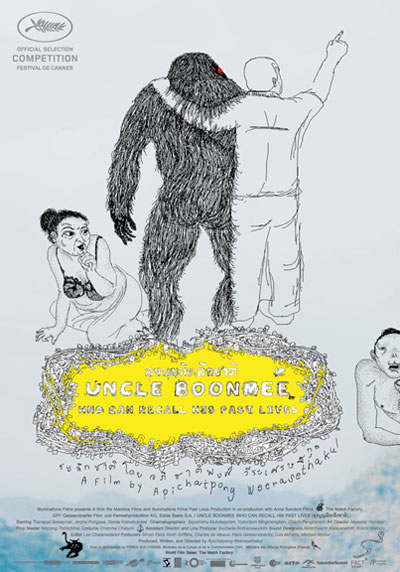
As he comes closer to death, Boonmee is approached by visions of ghosts from his life, including his long dead first wife, and his missing son who returns in the form of a half-monkey with glowing red eyes. Through these spirits he experiences visions of his past and future lives, and ponders on possible reasons for his illness…
From the outset it is clear we are in for something very different from Weerasethakul. Shots linger eternally on the banal, asking us to examine and re-examine the seemingly mundane of everyday life until, before our eyes, it actually becomes interesting. He purposefully does not focus on the action, does not edit for convenience, and allows his camera to drift around and away from (and then back to) the focus of the story. Whoever said that drama is life with the boring bits taken out forgot to tell Weerasethakul.
Like many other examples of Asian cinema (notably the Studio Gibli animations), in Uncle Boonmee, we are asked to accept along with the characters the existence of ghosts and spirits as a completely normal, conventional part of everyday life - and death. It is with little more than mild alarm that the characters react when Boonmee’s long dead ex-wife materialises at the dinner table, followed by his missing son who has transformed into a bi-pedal, red-eyed monkey. It’s a peculiar concept to adjust to, one which would maybe benefit from repeat viewings, but undoubtedly this technique helps immerse us in the director’s world, far more than an Alice Through The Looking Glass conceit ever would.
The film frequently drifts from scene to often unrelated scene with no real purpose or flow, yet somehow these changes of tone are never jarring, instead allowing Uncle Boonmee to play out like a long, lazy dream. A significant example is where, for apparently no reason in the middle of the film, the story changes unannounced to the short story of a disfigured princess who has a conversation – and much, much more – with a talking catfish. Unexplained, the film then returns to the story of Boonmee, exactly where we left off. It feels like rather than being told a story, we are taking a trip through the director’s mind, and that he has put his thoughts directly on screen exactly as it came to him.
Even with repeat viewings, huge chunks of Uncle Boonmee are forever going to remain unexplained, other than perhaps only in the director’s mind. It is this wanton disregard for traditional narrative and stubborn refusal to explain itself that will be the greatest barrier to most audiences. This is not something however that concerns Weerasethakul. On the contrary, he welcomes the thought of his film’s potential unpopularity, saying: “I always say a film should have a personality. And like a person, if he or she is very popular, I would feel very suspicious.” In a world of audience-pleasing self-promoters, it is a refreshing attitude.
It seems that while narrative is nothing to Weerasethakul, tone is everything, and through some truly striking imagery, he captures a beautiful otherworldly quality to Thailand that we haven’t encountered before. The mountains and forests hang with a dark, ominous foreboding that make the line between life and death, and between the real and the spirit world thinly defined. Indeed, this creepy, darkly lit ambience makes Uncle Boonmee play out at times like a horror film, and the image of many sets of glowing red eyes staring out from a silhouetted forest will keep many awake at night.
The acting is largely subdued and wooden, but this cannot really be blamed on the actors, as Weerasethakul has commented that this was an intentional homage to an acting style of the past - from low-budget Thai horror films - where actors were whispered their lines from off camera and would then woodenly repeat them aloud. It’s another indication that he is really not interested in the conventional techniques of storytelling, but rather has his own very particular ideas about what does and does not make a good film.
A bold, dream-like piece; confusing, befuddling, but often stunningly beautiful. It definitely won’t be for everyone, many will find it confusing and impenetrable, but Uncle Boonmee could well mark an eye-opening new direction for film, with Weerasethakul’s direction treading a unique new path for other filmmakers to follow. LOZ

Apichatpong Weerasethakul directs this Thai fantasy.
The film portrays the final days in the life of Boonmee (Thanapat Saisaymar), a middle-aged man with failing kidneys who recalls his various past lives from his deathbed.
Along with a nurse Jaai (Samud Kugasang), his sister-in-law Jen (Jenjira Pongpas) and his young cousin Tong (Sakda Kaewbuadee), Boonmee has come to a remote forest cabin to end his days, as he believes it to be the place where his former existences took place.
As he revisits his many reincarnations and is reunited with the ghosts of his dead wife and lost son, Boonmee becomes immersed in memories and undergoes intense personal transformation as he surrenders to the inevitability of death.
The film won the Palme d'Or at the 2010 Cannes Film Festival.
Film: Uncle Boonmee Who Can Recall His Past Lives
Release date: 28th March 2011
Certificate: 12
Running time: 113 mins
Director: Apichatpong Weerasethakul
Starring: Thanapat Saisaymar, Jenjira Pongpas, Sakda Kaewbuadee, Natthakarn Aphaiwonk, Geerasak Kulhong
Genre: Comedy/Drama/Fantasy
Studio: New Wave
Format: DVD & Blu-ray
Country: Thailand/UK/France/Germany/Spain
When I first encountered the work of director Apichatpong Weerasethakul, it was in a university lecture. The lecturer of the class placed a bet; he wagered that none of us in the twenty-strong group of students could pronounce his name properly. He was right. With a name like Apichatpong Weerasethakul, there is a guaranteed certainty that comes from possessing such a tongue twister of a name; once a person pronounces it correctly, they won’t forget the name.
Although it is probably not the first name that comes to a person’s mind when images of Asian cinema are evoked, Apichatpong’s career has evolved outside the parameters and regulations of the Thai film system. From taking this decision, his life’s work has received recognition from prestigious awards bodies such as the Vancouver, Berlin and Cannes film festivals, along with creating short films in partnership with companies like Dior and Louis Vuitton. With his work regularly being acknowledged by an increasingly wider audience of big names, there is a growing feeling of inevitability that the name that was so hard to pronounce between twenty people will become synonymous to the production of Asian films.
Beginnings
Born in Bangkok, Thailand on 16th July 1970 to a family of physicians, Apichatpong originally gained qualifications to be an architect from a Taiwanese university. In 1997, he attended the School of the Art Institute of Chicago, where other film luminaries such as Hong Sang-Soo, Orson Welles and Walt Disney have studied. Two years later, he set up his collective/production company called Kick The Machine, so people like Suchada Sirithanawuddhi and Sompot Chidgasornpongse, his assistant directors, could work outside the stringent measures of the Taiwanese film industry and the levels of censorship.
His first feature length film, Dokfa nai meuman (Mysterious Object at Noon) from 2000 details several unconnected lives across Thailand; the Kick The Machine website describes it as “part fiction, part documentary, and part pseudodocumentary... It was shot without a conventional script and relies on the subjects being filmed... The film emphasizes a documentary approach that presents people with different professions rather than looking for a perfect and
unbroken narrative.”
This unconventional example of film, not only in its practical construction but in its aesthetics, was warmly received by reviewers and boards of judges from all across the globe, winning the special mention prize at the Vancouver International FF and the Grand Prix, and the Jeonju International FF in Korea.
Romance... and Exploitation
Between 2002 and 2004, Apichatpong directed two films exploring different themes of love and relationships with very contrasting results and reception by their wider public. The two films also set precedents for Apichatpong’s directorial style and cinematic trademark stamps.
The first of these two films, Sud Sanaeha (Blissfully Yours), from 2002, details two stories of partnerships at different stages in their lifespan, loosely connected by their locale and the professions of the people in the relationships. The second film, Sud Pralad (Tropical Malady), from 2004, tells the story of a homosexual relationship between a young soldier and a farm boy in the town that the solider is assigned to on a mission. A second story in Sud Pralad portrays the relationship between a young soldier lost in a forest and the spirit of a shaman.
Both Sud Pralad and Sud Sanaeha possess hallmarks of Apichatpong Weerasethakul beginning to develop a style towards a claim as an auteur; the juxtaposed composition of the dual narratives, the title credits of the film occurring midway through the narrative, and using the same actors from the first story as character roles in the second.
Both films received limited appraisal from their audiences because of their obvious nonconformist edit and narrative structures. Sud Sanaeha won the Un Certain Regard prize at Cannes 2002 and Sun Pralad won the Jury Prize at Cannes 2004. However, Timothy Pfaff writes of Sud Pralad in the San Francisco Chronicle: “Tropical Malady infects you in stages. Few people get Thai independent filmmaker Apichatpong Weerasethakul's greatest film on a single exposure. Like other great art works, it requires - and rewards - repeat contacts.”
Much like the narrative qualities of Dokfa nai meuman, Sud Pralad and Sud Sanaeha possess, as Pfaff describes, the desire to return to the films to watch again. Much like great storytellers, Apichatpong Weerasethakul obviously possesses a natural talent for encapsulating audiences with the simplest stories.
Between these two films of romance came a film of stark contrast. Acting as co-director alongside Michael Shawonasai, they directed The Adventure Of Iron Pussy (Shawonasai) in 2003, a film made as a parody towards the action/cop films made within the Thai film system. Shot on an incredibly low budget and on digital video, the film furthered Apichatpong’s status amongst the disenfranchised clusters of alternative cinema audiences as a cult director working against the traditions of the time.
David vs. Goliath
In 2006, Apichatpong Weerasethakul directed the film that was to launch his name to a larger audience; but unfortunately it was not for the right reasons. Following the trademark points from previous productions, Apichatpong Weerasethakul released Sang Sattawat (Syndromes Of A Century) in 2006, a film made in tribute to his parents; the first half of the film set in a rural hospital and the second half set in a medical centre in Bangkok.
The film faced a frosty reception from the Taiwanese censorship board over some of the scenes portraying doctors and monks behaving out of character to what is expected within Taiwanese culture. Although seemingly innocuous in western culture, the scenes of monks playing with a remote control spaceship and a doctor kissing his girlfriend at work were flagged by the then active Thai Film Act of 1930 that Weerasethakul himself describes as “a vague statute that forbids the promotion of bad morals. In practice, that means films dealing with sex, religion and politics are taboo.”
In his refusal to edit the film to the rules of the censorship board, Apichatpong Weerasethakul pulled the film from general release and emailed the Bangkok post, as Kong Rithdee (Bangkok Express) re-tells: “I, as a filmmaker, treat my works as I do my own sons or daughters... I don't care if people are fond of them or despise them... If these offspring of mine cannot live in their own country for whatever reason, let them be free. There is no reason to mutilate them in fear of the system. Otherwise there is no reason for one to continue making art.”
Eventually, Sang Sattawat was released for a short time in Thailand in a censored form. However, in a mark of protest, the scenes in question that were censored were purposely replaced with black filler, so audiences were aware of the edit.
Despite all of its problems and controversy that faced it, Sang Sattawat’s world premiere was at the 2006 Venice Film Festival, and also showed at festivals in New York, Toronto and Melbourne.
His greatest reward
After all the controversies and opposition from governmental bodies and critics, Apichatpong Weerasethakul released Loong Boonmee raleuk Chat (Uncle Boonmee Who Can Recall His Past Lives) in 2010. The film focuses around the eponymous character on his death-bed, and recounting his lives with people in various contorted forms. The film premiered at the 2010 Cannes Film Festival, and against films such as the hugely popular film Another Year (Leigh, 2010) won the highly coveted Palme D’Or. The film also was listed for an Academy Award in the Best Foreign Language Film category but didn’t make the shortlist.
Throughout his career, it is clear to see from the narrative and aesthetic compositions that Apichatpong Weerasethakul has always aimed to create against convention. An artist in his own right, he has slowly garnered a collective of likeminded people, an audience from all over the world that shares a love and craving for alternative cinema. He has won many prestigious awards, presented to him by revered people in the film industry. TJB
Film: Uncle Boonmee Who Can Recall His Past Lives
Release date: 19th November 2010
Certificate: 12A
Running time: 113 mins
Director: Apichatpong Weerasethakul
Starring: Thanapat Saisaymar, Jenjira Pongpas, Sakda Kaewbuadee, Natthakarn Aphaiwonk, Geerasak Kulhong
Genre: Comedy/Drama/Fantasy
Studio: New Wave
Format: Cinema
Country: Thailand/UK/France/Germany/Spain
In 1983, Phra Sripariyattiweti, the abbot of a Buddhist monastery in Thailand, published a book telling the story of a man called Boonmee who had told him he could clearly remember his own past lives while meditating, “playing behind his closed eyes like a movie.” By the time Thai director Apichatpong Weerasethakul had heard the story, Boonmee had died, so rather than attempt a straightforward biopic, he decided to use the idea and structure to make a far more personal film, reminiscent of the Thai horror films of his youth. Uncle Boonmee Who Can Recall His Past Lives was released in early 2010 to critical acclaim, winning the Palme d'Or at the Cannes Film Festival, and boosting the profile of its director to worldwide recognition.
Set in a remote village in Thailand, the film tells the story of an elderly man called Boonmee who lives with his wife, son, and carer – an illegal immigrant from over the border in Laos. Boonmee is suffering from acute kidney failure, and is struggling through the last days of his life.
As he comes closer to death, Boonmee is approached by visions of ghosts from his life, including his long dead first wife, and his missing son who returns in the form of a half-monkey with glowing red eyes. Through these spirits he experiences visions of his past and future lives, and ponders on possible reasons for his illness…
From the outset it is clear we are in for something very different from Weerasethakul. Shots linger eternally on the banal, asking us to examine and re-examine the seemingly mundane of everyday life until, before our eyes, it actually becomes interesting. He purposefully does not focus on the action, does not edit for convenience, and allows his camera to drift around and away from (and then back to) the focus of the story. Whoever said that drama is life with the boring bits taken out forgot to tell Weerasethakul.
Like many other examples of Asian cinema (notably the Studio Gibli animations), in Uncle Boonmee, we are asked to accept along with the characters the existence of ghosts and spirits as a completely normal, conventional part of everyday life - and death. It is with little more than mild alarm that the characters react when Boonmee’s long dead ex-wife materialises at the dinner table, followed by his missing son who has transformed into a bi-pedal, red-eyed monkey. It’s a peculiar concept to adjust to, one which would maybe benefit from repeat viewings, but undoubtedly this technique helps immerse us in the director’s world, far more than an Alice Through The Looking Glass conceit ever would.
The film frequently drifts from scene to often unrelated scene with no real purpose or flow, yet somehow these changes of tone are never jarring, instead allowing Uncle Boonmee to play out like a long, lazy dream. A significant example is where, for apparently no reason in the middle of the film, the story changes unannounced to the short story of a disfigured princess who has a conversation – and much, much more – with a talking catfish. Unexplained, the film then returns to the story of Boonmee, exactly where we left off. It feels like rather than being told a story, we are taking a trip through the director’s mind, and that he has put his thoughts directly on screen exactly as it came to him.
Even with repeat viewings, huge chunks of Uncle Boonmee are forever going to remain unexplained, other than perhaps only in the director’s mind. It is this wanton disregard for traditional narrative and stubborn refusal to explain itself that will be the greatest barrier to most audiences. This is not something however that concerns Weerasethakul. On the contrary, he welcomes the thought of his film’s potential unpopularity, saying: “I always say a film should have a personality. And like a person, if he or she is very popular, I would feel very suspicious.” In a world of audience-pleasing self-promoters, it is a refreshing attitude.
It seems that while narrative is nothing to Weerasethakul, tone is everything, and through some truly striking imagery, he captures a beautiful otherworldly quality to Thailand that we haven’t encountered before. The mountains and forests hang with a dark, ominous foreboding that make the line between life and death, and between the real and the spirit world thinly defined. Indeed, this creepy, darkly lit ambience makes Uncle Boonmee play out at times like a horror film, and the image of many sets of glowing red eyes staring out from a silhouetted forest will keep many awake at night.
The acting is largely subdued and wooden, but this cannot really be blamed on the actors, as Weerasethakul has commented that this was an intentional homage to an acting style of the past - from low-budget Thai horror films - where actors were whispered their lines from off camera and would then woodenly repeat them aloud. It’s another indication that he is really not interested in the conventional techniques of storytelling, but rather has his own very particular ideas about what does and does not make a good film.
A bold, dream-like piece; confusing, befuddling, but often stunningly beautiful. It definitely won’t be for everyone, many will find it confusing and impenetrable, but Uncle Boonmee could well mark an eye-opening new direction for film, with Weerasethakul’s direction treading a unique new path for other filmmakers to follow. LOZ
A special thanks to the Watershed in Bristol who allowed us to attend a screening of this film. Please check out their website here.

Interview courtesy of New Wave Films.
Apichatpong Weerasethakul was born in Bangkok (1970) and grew up in Khon Kaen, north‐eastern Thailand. He graduated from Khon Kaen University and holds a Bachelor’s degree in Architecture, then a Master of Fine Arts in Filmmaking from The Art Institute of Chicago.
Apichatpong started making films and video shorts in 1994, and completed his first feature in 2000. Often non‐linear, his works link with memory, invoked in subtle ways personal politics and social issues. Working independently of the Thai commercial film industry, he devotes himself to promoting experimental and independent filmmaking through his company Kick The Machine Films, founded in 1999. Kick the Machine has produced all his feature films.
In 2008, he embarked on the Primitive Project, a multi‐platform work of which Uncle Boonmee Who Can Recall his Past Lives is part. The film won the Palme d’Or in 2010 (not the first time the director has received award recognition).
With the film now on general release in cinemas across the UK (click here for more details), the director shares his thoughts on the project with subtitledonline.com…
What is so special about the north‐east of Thailand to you? And what inspired you to make the film?
A few years ago, when I was living in the north‐east, I came across Uncle Boonmee. An abbot at a monastery near my house told me that there was an old man who had arrived at the temple to help out with the temple’s activities and to learn meditation. One day this man, Boonmee, came to an abbot and told him that while he was deep in meditation, he could see his past lives playing behind his closed eyes like a movie. He saw and felt himself to be a buffalo, a cow, even a body‐less spirit that roamed around the north‐eastern plains.
The abbot was impressed but not surprised, because Boonmee was not the first person to tell him about such experiences. From near and far, he had collected stories from villagers who shared their past lives with him. Later, he published a little book. On its cover one could read: A Man Who Can Recall His Past Lives. Unfortunately, by the time I got a hold of the book, Boonmee had passed away several years earlier.
All your films have incorporated strongly autobiographical elements. That seems to be much less the case with Uncle Boonmee…?
Compared to that original Boonmee book, this film has a lot of me in it. The process of making this film made me realise that I am incapable of being faithful to any original source! Besides altering the past lives, I pushed Boonmee into the background and foregrounded my regular actors, Jenjira and Tong, who act as witnesses to this anonymous guy’s passing. The film is not about Boonmee, but about my take on the idea of reincarnation.
The film naturally developed into an homage to the cinema I grew up with. A cinema that’s also dying or dead. And once again, my father slipped into the film. He succumbed to kidney failure. All those pieces of equipment in Boonmee’s bedroom are a simulation of those in my dad’s.
Once again you have chosen to work with your regular actors and then with two primarily amateur performers (Uncle Boonmee and Huay). How did you cast the film? Are they all from the north‐east?
Only Tong is not. So he’s the only one who’s not speaking north‐eastern dialect. To me, Boonmee is anonymous. So I could not use professional actors who have many public identities.
I think the amateurishness is precious when you are aiming for early cinema’s acting style. So I cast people from all walks of life. We ended up having a roof welder and a singer to play Boonmee and Huay.
Although the title of the film refers to Uncle Boonmee’s past lives, he never explains them or describes what they are…
Originally, the script was more explicit in explaining which were the past lives, which were not. But, in the film, I decided to respect the audience’s imagination.
Of course, after watching it, you can tell that he could be a buffalo or a princess. But for me, he could be every living thing in the film, the bugs, the bees, the soldier, the catfish and so on. He could even be his Monkey Ghost son and his ghost wife. In this way, the film reinforces a special association between cinema and reincarnation. Cinema is man’s way to create alternate universes, other lives.
You have spoken of the film being an homage to a certain kind of cinema - the cinema of your youth. What sort of cinema did you have in mind? Thai cinema?
I was old enough to catch the television shows that used to be shot on 16mm film. They were done in studios with strong, direct lighting. The lines were whispered to the actors, who mechanically repeated them. The monsters were always in the dark, in order to hide the cheaply made costumes. Their eyes were red lights, so that the audience could spot them. I only got the chance to see old horror films later, when I was already making films.
I also think that the Thai comic books influenced me. The plots were not complicated ‐ the ghosts were always part of the landscape. It’s still like that today.
The film has distinctive shifts of tone and style; sometimes it is almost comic and ironic, at other times very serious and moving…
I love my movies to operate like a stream of consciousness, drifting from one remembrance to another. I think it is important to accentuate this drifting when the root of the film is about reincarnation, about wandering spirits.
You have spoken of your interest in the ‘transmigration of souls’. This comes to mind particularly in the closing scenes of the film. Is that what is taking place to Jen and Tong?
The scene (gently) attacks the movie’s time and reference points. I hope that in the end, the audiences are the ones who are transported.
Ghosts and fantastic beings have appeared in your earlier films like Tropical Malady. But in Uncle Boonmee… they have taken centre stage. Could you comment on this?
The film focuses on the beliefs in otherworldly elements that are actually parts of our lives. I am captivated by the fact that as we age, our childhood has become more vivid. I think the curiosity (and perhaps the fear) of ghosts and of other worlds arises when we are young, and when we are dying.
Your recent work seems to have taken on a more political direction. The still photo sequence would seem to highlight this. That sequence is so different from everything else in the film…
I wanted to introduce my memory of making this project into the film as well. The film is part of the Primitive Project in which I tried to capture some memories of the north‐east. I ended up working with the teens in a village that had a violent political history. We built a spaceship and made up scenarios. We also made a short film, A Letter To Uncle Boonmee, in which we scanned the village in order to find a suitable house for the feature.
For me, the experience in this village was always related to Boonmee’s existence. It is a place where memories are repressed. I want to link it with the guy who remembers everything. With that photo scene in the film, Boonmee’s and my memories merge. NW
Suffering from acute kidney failure, Uncle Boonmee has chosen to spend his final days surrounded by his loved ones in the countryside. Surprisingly, the ghost of his deceased wife appears to care for him, and his long lost son returns home in a non‐human form.
Contemplating the reasons for his illness, Boonmee treks through the jungle with his family to a mysterious hilltop cave – the birthplace of his first life.
Film: Uncle Boonmee Who Can Recall His Past Lives
Release date: 19th November 2010
Certificate: 12A
Running time: 113 mins
Director: Apichatpong Weerasethakul
Starring: Thanapat Saisaymar, Jenjira Pongpas, Sakda Kaewbuadee, Natthakarn Aphaiwonk, Geerasak Kulhong
Genre: Comedy/Drama/Fantasy
Studio: New Wave
Format: Cinema
Country: Thailand/UK/France/Germany/Spain