skip to main |
skip to sidebar
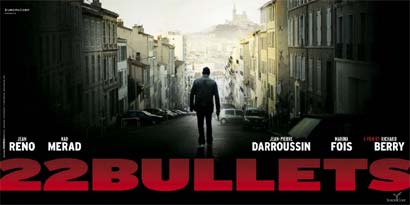
Film: 22 Bullets
Release date: 31st January 2011
Certificate: 18
Running time: 115 mins
Director: Richard Berry
Starring: Jean Reno, Kad Merad, Jean-Pierre Darroussin, Marina Fois, Gabriella Wright
Genre: Action/Crime/Thriller
Studio: Anchor Bay
Format: DVD & Blu-ray
Country: France
Jean Reno returns to the kind of sensitive tough guy role which gained him worldwide fame in Leon in the early-90s. Franz-Olivier Giesbert’s novel based on real life crime in the Marseille underworld, L’Immortel, inspired the character of Charly Matteï - a one-time gangster who reforms for the sake of a quiet life with his wife and family.
Three years into his retirement from crime, and seemingly safely cocooned in the peace of family life, Charly Matteï is ambushed and gunned down in an underground car park in Marseille’s old port by masked gunmen, his body ravaged by the 22 bullets of the title. Remarkably, he survives to take revenge upon his would-be killers.
The briefly explicated back-story reveals that Charly Matteï had fallen in love with someone equally entangled in the Marseille underworld, a woman under the control of both a violent pimp and her own drug addiction. Extricating her from both, he turned his back on crime’s empty rewards of power and money in order to create a safe and peaceful way of life for his new family. But retirement from the fragile hierarchy, and secret loyalties of the city’s criminal society was clearly never to be as simple as he had hoped.
Charly’s resolution to remove himself and his family from the perils of the underworld inevitably gives way to his instinct to take revenge upon those who have betrayed him, his blood drenched vendetta destined to stain the sun bleached streets of Marseille…
The character of Charly Matteï was apparently inspired by a real life Marseille crime lord Jacques Imbert, who suffered a similarly vicious attack yet lived to tell the tale, earning himself the nickname of The Immortal. The film’s writer and director used this incident and other material from Franz-Olivier Giesbert’s novel as his initial inspiration, augmenting this with his own research carried out in the Marseille underworld. It is a pity, then, that so little of anything distinctive or remarkable survives in either the script or the plot. The film is full of generic and predictable motifs from the mafia film genre – from a lame interrogation scene culminating in the victim’s body falling to the floor in slow motion, to the uneasy bonhomie of a birthday celebration for one of the gangsters - the excess of drugs and drink finding its inevitable ending in a bloodbath.
The actors deserve better than this script. Reno’s irrefutable charisma is given few chances to shine, but takes flight in a handful of scenes where his understated menace puts the thrill into the thriller. A rare humorous scene, Matteï in monologue with a cat, allows Reno to show the character’s humane side in a more original context than the rather schmaltzy scenes of family togetherness.
Marina Foïs provides the other standout performance as the police investigator attempting to break the code of silence surrounding the criminal fraternity, and facing apathetic and political opposition from her own police chief. Her finely understated and, in the main, unsentimental performance is undermined by the banality of the script. When Matteï proposes that she let him walk in order to set a trap for his would-be killer, she counters with the lame line: “I have a tough job to do” – as an exposition of the shadowy moral complexities faced by an investigator implicated by her association with a known criminal, it’s hardly thought provoking.
There are other potentially strong performances that are undermined by the blandness of the script and the predictability of the plot. Kad Merad as the current Mafia boss, a close ally of Mattei since childhood; or Jean-Pierre Darroussin, playing the inevitably morally compromised role of lawyer to organised crime lords. As for Matteï’s current wife, and indeed his first wife who also makes a number of very brief appearances, these are cardboard cut-out parts. Considering that Matteï is supposed to have turned his back on the brotherly bonds of his crime family in order to be with his wife, her part is horribly underwritten.
The other great omission of the film is the underuse of Marseille as a distinctive location. There is the odd shot which gives a sense of the place – the bare bones bleached-ness of a hillside graveyard, the exotically striped facade of the cathedral reflected in the windows of a passing car, or the medieval squalor of rubbish bags piled up in a market place. These intermittently appealing scenes only emphasise the film’s general lack of visual impact. A director of such a film might argue that pretty-pretty aesthetics are not appropriate to the subject – but higher quality cinematography could legitimately be used here to heighten dramatic effect. One scene takes as its setting the industrial backdrop of an oil refinery; the sense of horror of the torture and murder that take place here could have been heightened by better use of the starkly lit alienation of the refinery’s towers lit up against the night sky, but poor cinematography reduces the impact of the scene.
The underwhelming sense of menace is in part due to the cartoonish characterisation of the evil henchmen – again, an inevitable result of predictable plotting and woefully underwritten dialogue. As the villains drive past Matteï following a further failed attempt on his life, there is the merest suggestion of a phantom fist shaking and the words, “I’ll get you, Penelope Pitstop”. Considering how certain actions in the film are – the peppering of Matteï’s body with bullets, boiling water being poured over his face, someone’s head being repeatedly slammed with a car door – the violence appears curiously bloodless and insipid, reflecting the blinkered morality of the reformed Matteï. The hypocrisy of his personal ethics is challenged towards the end of the film, but the challenge lacks the subtlety that could have made this a disturbing and thought provoking examination of a troubled conscience.
22 Bullets has a fine premise – the moral consequences inherent in a reformed criminal trying to turn his back upon the violence and degradation of his former life, and whether such a way of life can be consigned to the past. The calibre of the acting talent is underused by the script and plot, while the setting of Marseille could have been used to much stronger effect to reflect the harshness and beauty of the film’s feudal moral code. Given the promise of its concept and cast, the film disappoints. KR

22 Bullets, starring Jean Reno (Leon) and directed by Richard Berry (The Black Box), is a thriller inspired by the real-life events in the world of the Marseille Mafia. Sharing writing duties with Berry is Irène writer Eric Assous.
Charly Matteï has turned his back on his life as an outlaw. For the last three years, he's led a peaceful life devoting himself to his wife and two children. Then, one winter morning, he's left for dead in the parking garage in Marseille's Old Port, with 22 bullets in his body.
Against all the odds, he doesn't die...
Film: 22 Bullets
Release date: 31st January 2011
Certificate: 18
Running time: 113 mins
Director: Richard Berry
Starring: Jean Reno, Kad Merad, Marina Pois, Jean-Pierre Darroussin
Genre: Action/Crime/Thriller
Studio: Anchor Bay
Format: DVD & Blu-ray
Country: France
Special Features:
•
Interviews
•
22 Bullets in Marseille
•
Making of
•
Original French trailer
•
Theatrical trailer
Interview courtesy of Anchor Bay/Organic.
An actor since the ‘70s, Richard Berry has established himself as one of France’s most promising writer/directors during the noughties with films such as The Black Box.
His new film, 22 Bullets, which is released in cinema’s this week, follows Charly Mattei, a gangster who tries to turn his back on a life of crime…
What made you want to adapt Franz-Olivier Giesbert's book?
In the same way that comedy is an incredible vehicle for certain ideas, thrillers can also give you pause to reflect on certain issues. In the story of a guy, who was allegedly a mafia godfather in Marseille, who was left for dead in 1977 in a parking lot in Cassis, but who survived the shooting earning himself the nickname ‘The Immortal’, I saw an incredibly strong subject and an amazing adventure. Going from gangster to immortal is a pretty astounding feat.
I situated the film beyond the anecdote. It gave me a chance to talk about identity, the central theme of most of my films. You can never shake off your culture, origins and history... To other people, you'll always be the Breton, the Jew, the Arab, the Chinaman, or whatever. And between the desire to integrate, and our ability to accept people, there's often a huge gulf.
In 22 Bullets, we're dealing with a gangster who has retired from the life, and who is redeeming himself by living a quiet life with his wife and children, while accepting that he'll never be as rich that way. Eventually, his past catches up with him in the shape of Zacchia, his childhood friend. They'd sworn to stick together in life and in death, but Zacchia is motivated by a theory that is no less true and totally rational: "When you have blood on your hands, it never washes off. Evil is evil. It's within us. You have to accept it." Their completely contrasting approaches made me want to make a movie based on their story, but not in a didactic way, telling audiences who's right and who's wrong. In the underworld, like in the police department, there are good guys and morons. They're human beings first and foremost, before they're cops or hoodlums. So Marina Foïs's character, the female cop, is still looking for closure after her husband's death because the investigation never found any proof against the gangsters who did it. They are untouchable. And, of course, her personal perspective is completely different than her professional one. It's that human reality, those paradoxes, that I wanted to see on the screen. Similarly, I wanted each hoodlum who dies to be a man with a story, a family. These are contradictions that shine true humanity on the film.
How did you set about achieving that aim?
I bought the rights to Franz-Olivier Giesbert's book, but I only used part of the novel in the end. Some people will find the movie very true to the reality of the underworld. I conducted my own investigation, which I can't talk about in great detail because I met a lot of people in total secrecy. I spent weeks on end in Marseille and gradually, I met a woman who knew a man and so on... Discreet meetings in cafés, where I heard stories that fleshed out the story or certain characters.
What happened when you met ‘The Immortal’, the notorious Jacky Imbert?
Franz was the go-between. Jacky was obviously the first person I wanted to meet. The movie isn't the story of his life. I take one event and build a fictional life around it. That fiction is based on the reality of life in the underworld, but it isn't the reality of Jacky's or anybody else's daily life. It's fiction based on fact.
Our first meeting took place one summer's evening nearly three years ago. I found myself in the company of a very funny, quite mysterious and very tight-lipped character. He saw what he'd been through from a very human perspective - friendships, backstabbing. He said, "That attempt on my life destroyed me when I was only 47 years old. Now, I'm an invalid. I've lost the use of my right hand and my body is racked with pain." But the worst thing for him, his biggest wound, was the betrayal. I soon understood that, as he did for Franz's book, Jacky wanted to stay well out of the story I wanted to tell.
But you asked to see him again...Yes, that didn't stop me meeting with him during his trial for racketeering, a charge that went back
Fifteen years. He'd already spent eighteen months in custody. So, six months after our first meeting, I turned up at the courthouse and was astonished by the number of photographers and TV crews. Actually, I was struck by the charisma of this guy, whose hair is completely white and who dresses all in black. As I followed the trial, I discovered an intelligent man who defended himself and explained things with a lot of humour. I also began to understand the situation he was in, prey to so many rumours. He's a victim of his reputation as a "dangerous" man.
After the trial, we had dinner together and met up often. He's as silent as the grave - never gives a name or even a nickname, and says things that found their way into the movie, such as, “Heavenly justice works faster than justice on earth," or "The hitmen were wearing hoods. That's murder. You settle your scores with your face unmasked," or "The cops took me in for jobs I didn't do. For the jobs I did, they never came near me." Today, he's a guy who just wants to live the rest of his life quietly.
He trusted you right away?
Yes, because, without asking anything, he knows it's not the story of his life. But I hope the movie rings true overall. It's not an Italian or American mafia movie transposed to Marseille. I root the film in the reality of the French mafia, the Marseille mafia, which is a distinct part of local culture.
There's a line in the movie telling the story of how, in the 18th century, Louis XIV turned the canons of two forts onto the city of Marseille. On set, the mayor of Marseille, Jean-Claude Gaudin, kept saying that he didn't want another movie showing Marseille as a mafia hub. But the fact is, I spent over a year in Marseille and, in that time, there were an amazing number of gangland killings. Every time I recced a location, there was a bunch of flowers "In memoriam..." That doesn't stop the city developing, and it will be European Capital of Culture in 2012, but the reality is there and has been a long time. I wanted that to appear on screen. That's why all the supporting actors I cast are local actors who speak with a genuine Marseille accent.
But you don't emphasize the links between politicians and the mafia. Why?Until the late-80s, those links existed between local politics and the underworld. My film's set in the present day, so I only allude to them in the scene at the wedding of Zacchia's "spiritual son". The audience sees that all these guys were in contact with very senior politicians. I had other more explicit scenes, but they hark back to bygone times and that wasn't my angle, especially as relationships between politicians and gangsters are not what they were. As I explain in the movie, today, drugs are where it's all at, and drugs are available to small-time crooks as well as major-league gangsters. You never see the kingpins because they have representatives who have representatives who have representatives... all the way down the economic ladder to the street-corner dealers who sell a couple of kilos and are ready to kill for no good reason at all, whoever it is they're facing.
The mafia's pyramid hierarchy no longer exists, so having links with politicians has become redundant.
Tell us how you set about writing with Mathieu Delaporte and Alexandre de la Patellière once you'd done your research and chosen your angle on the story…
As usual, I wrote a first draft on my own to give it the tint I wanted. With several writers, the script can go off in different directions, and I'm scared the film will slip through my fingers. Once I've laid down the main themes, I can start the technical job of structuring the story with Mathieu and Alexandre, two remarkable and smart writers. But I don't let them near the keyboard! (Laughs) What's on screen is what's on the page, so it has to come from me and nobody else. I'm very demanding in this phase, a pain in the butt, you could say. I like to keep the story bubbling under, so it's told by juxtapositions as much as by what's in the scene. For me, the end of one scene and start of the next have real meaning, so I work very hard on the transitions. I also like writing dialogue.
At the same time, Mathieu and Alexandre kept coming up with ideas and I used their suggestions to polish the script. They were easy to work with, passionate and perspicacious. At the end, I went over the dialogue one last time with Eric Assous.
How did you choose the leads?Just as I try to write real characters in real situations, I cast the film so that it will be credible. For the three main male characters, who are three childhood friends, I needed two ‘old-timers’ and a younger guy. Jean Reno and Kad Merad on the one hand, and Jean-Pierre Darroussin on the other, were just the obvious choices.
Why Jean Reno to play ‘The Immortal’?
Jean was there at the beginning of the project. We're good friends. he was one of the first actors to ask me to cast him in a movie. But I can't write for someone. The story that I have in mind has to be the right fit. But I had nothing in mind that fitted with Jean.
I started working on an adaptation of Philippe Claudel's La petite fille de Mr Linh, which unfortunately didn't get off the ground. Then the story of ‘The Immortal’ came along, and I immediately thought it was a role for Jean. He has the humanity of a guy who's looking for redemption, but looks like he could once have been a major gangster. Jean has the depth of someone with a past, and strength that could potentially be very dangerous for someone. The quiet man. Also, as he confirms in the movie, he's a wonderful actor. In 22 Bullets, his performance is quite extraordinary.
Why Kad Merad to play Zacchia, who sends his hit men after ‘The Immortal’?
Zacchia is a multi-faceted character. He is, in turn or even simultaneously, charismatic, likable, temperamental and nuts. He can go off the wall at any moment.
Once again, I immediately thought of Kad because he has one of the character's vital traits, genuine kindness, and because, although he's given acclaimed performances in movies like Don't Worry, I'm Fine, he's never played a character who scares people. I wanted to light the fuse and see what happened.
I chose to take a likable actor and push him towards craziness, rather than an actor who looks like a nutcase and give him a veneer of humanity. It's fascinating to show those facets of one character. For a moment, you think you can be pals with the guy, and then he turns totally scary. Kad was the right person to capture that range of feelings.
And, to complete the trio, Jean-Pierre Darroussin…
Jean-Pierre and I have known each other ages, we've made three or four movies together, and I get on really well with him. He's the ultimate nice guy, honest, loyal, trustworthy—a Robert Duvall without the hint of danger—precisely like the last member of the trio, more withdrawn and cowardly than Jean's very calm character and Kad's on-edge character. We show those traits in the flashbacks to their younger days.
Amidst all these men, you cast Marina Foïs to play the cop leading the investigation...Marina is an actress I've adored for a long time, and I wanted to see her in a more realistic setting. 22 Bullets proves that she's a great actress with incredible range. Her character isn't as crazy as in
Darling, nor as offbeat as in Les Robins des Bois. She's incredible in an extremely grounded role, she likes to take direction and she responds immediately, so I could push her really far in certain scenes.
That's an enormous pleasure for a director… You and rapper Joey Starr also make brief appearances. Why?In the movie, there's a mystery surrounding the eighth man in the group that shot Jacky. The idea was that the audience shouldn't immediately guess his identity. I fought to have well-known faces in minor roles to increase the possibilities. That explains my role and that of Joey Starr as Pistachio. Of course, the actors had to be credible in the roles they play, and I think Joey is a wonderful actor. He was astonishingly true to life in Le bal des actrices. Also, we've known each other a long time. I met him before he even became Joey Starr, and I like him a lot. On top of that, the camera loves him.
How do you work with your actors?
Before the shoot, I do read-throughs with the whole cast, and, on set, I take the time to rehearse the scene with them while the crew sets up the shot. I always prepare a very detailed shot breakdown, so the technicians know exactly what I want, leaving me to focus on the actors. Most often, I stand right behind the camera, in range of my actors. They know I expect them to know their lines perfectly. I don't want any hesitations because they don't know what they're supposed to be doing. I give a lot of direction, driving them hard to get the best out of them.
For the scene where Jean begs Marina to help him, I'd been on Jean's case for weeks beforehand, focusing on him so he'd be like a diamond that we'd cut to its purest state with each take. I kept asking him to go even further, to deactivate the automatic pilot. It was easy for me because we go back 35 years and I know what he can do, and he wanted to do it. I asked him to learn his lines and work out for the physical scenes where there wouldn't be a stunt-double. And he got there. He got into shape and reached the truth in its purest form.
What are your major considerations when you're directing?This movie had to be both truthful and slick, which may seem like a contradiction in terms, but that's what I was after. To see how we did it, we have to go back to The Black Box, my previous film, which wasn't at all rooted in reality, because we were in the head of a coma victim. To capture that effect, I used short lenses and extreme composition to achieve shots that looked almost like paintings. I visited all my fantasies and obsessions.
In 22 Bullets, without neglecting aesthetic considerations, I worked with longer lenses to increase the realism, and used a handheld camera with the shutter at 45°, which is tighter than usual, as in the kidnapping scene in the street, to give a sense of snatched, true-to-life images impregnated with a sense of panic. I had to be careful not to go too far the other way - I don't like the jerky look of so many movies today, it's facile and pointless. My only aim was to tell each scene as it should be, not to use spectacular effects for the sake of it. The camera is almost never still, we're always moving, even if only slightly - a sideways tracking shot, push-in or crane movement.
Did the movie change a lot in editing?No. I didn't cut any scenes, just shaved a little off here and there. The first rough cut was 125 minutes and we're now down to 114 minutes, including the end credits. All my movies have been like that. To use the diamond metaphor again, the more you polish them, the better they look. Less is more!
I talked about this with Luc (Besson) and he said, "I never wondered why I cut something out of one of my movies, but I often regretted not cutting something else."
Why did you choose Klaus Badelt to compose the score?
I worked with the music of James Newton Howard in mind. I admire his work greatly. That set the standard very high because he's a composer who switches between genres with astonishing ease. He and Alexandre Desplat were the first people I contacted - I was lucky that my producers gave me a free hand - but neither of them were free. Then I turned to Howard Shore, who's worked with Scorsese, Cronenberg and on Lord of the Rings. He agreed to do it after reading the script but, oddly, when we tried to put some of his music to the scenes in the editing suite, it didn't work. I tried again and again, in vain. Then I realized Howard Shore's music competes with the opera music. He works mainly with strings using very classical foundations, so it couldn't work with this movie. I had two options left: Harry Gregson-Williams and Klaus Badelt, whose work on Premonition and Constantine I really liked, and who reminds me musically of James Newton Howard. Somebody recommended that I listen to his score for Pour elle. It was very minimalist, but beautiful and pure. I also like when he's more flamboyant, like on Pirates Of The Caribbean 3. Then I heard he was on a rare trip to Paris, so I met him and showed him the movie. I had the intense joy and shock of hearing him say, "I'm asking you to let me work on your movie. I love it!" When such a talented person sends you emails and calls to say he's sure he could do a wonderful job on the picture, it becomes a no-brainer. He wasn't lying - he's done a wonderful job. We recorded at Abbey Road with a marvellous string section. It was an amazing moment. That's when I realised why he insisted on doing 22 Bullets. It gave him the chance to compose flamboyantly, like on Pirates Of The Caribbean, while creating real emotion with simple, pure feelings, and so work with a range of tones, which doesn't happen very often.
How do you feel ahead of the film's release?
Obviously, I'm very attentive to how the film will be received because it's very dear to my heart, and I'd like Jacky Imbert to be touched when he sees it, and for audiences to be moved, to be able to relate to something, even if the story is far removed from their own experience. It's about the way people look at you and accept you, or not. And the way you look at other people. The way they can feel excluded from microcosms of society that they want to belong to.
More personally, with this movie, I feel I've pushed on both as a writer and director. Although my films have always had a good press, this time I'll be even more attentive to it than usual. AB