Showing posts with label Claude Chabrol. Show all posts

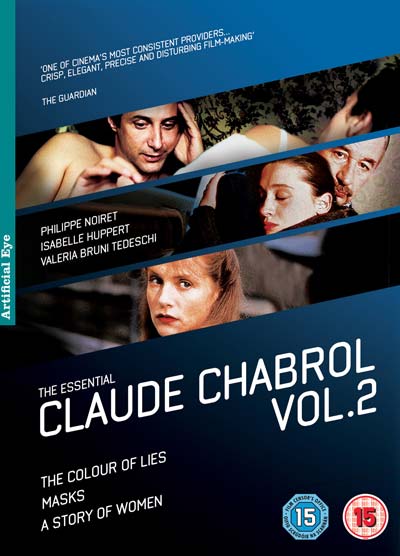
REVIEW: DVD Release: The Essential Claude Chabrol Vol.2


Film: The Essential Claude Chabrol Vol.2
Release date: 7th June 2010
Certificate: 15
Running time: 325 mins
Director: Claude Chabrol
Starring: Isabelle Huppert, Jean Poiret, Marie Trintignant
Genre: Drama/Crime/Thriller
Studio: Artificial Eye
Format: DVD
Country: France

An icon of French cinema and pioneer of nouvelle vogue, writer/director Claude Chabrol's work has to a large extent defined a niche of the French cinematic vanguard, spreading the seeds of vision from a once peripheral garden to what many would now regard as mainstream. Often regarded as the French response to Alfred Hitchcock, the second volume of The Essential Claude Chabrol offers three distinct films from the director’s body of work representing two decades in Chabrol's now half century career as a filmmaker. With a wide variety of nuanced tales of intrigue and wealth of cinematic style, the dark comedy and sultry drama of this collection serves an expansive feast certain to appeal to all refined cinematic tastes.


Masks (Masques)
First released in 1987, Masks serves as a portrait of deception within duplicity. Given a distinctly comedic tone, aspiring biographer Roland Wolf (Robin Renucci) is invited to popular game-show host Christian Legagneur's (Phillip Noiret) estate for a series of exclusive interviews. Much to Wolf's chagrin, Lagagneur is constantly being called away for reasons more and more suspect, and further and further delaying the promised interviews. Unbeknownst to Lagagneur, Wolf has an ulterior agenda of his own for which he has brought a gun and an interest in the disappearance of recent guest to the television personality's home. To this is added the presence of Lagagneur’s godchild, Catherine, whom he shadows and obviously has more to reveal than she is at liberty to divulge under her custodian’s watchful gaze.

The strength of Masks lies greatly in the metered quality with which the events unfurl - an earmark of Chabrol’s work. At its onset, the circumstances of the film seem benign, and, to some extent, rather blasé. Set as it is on the estate of an obviously wealthy man, the aesthetic seems far more Merchant Ivory than film noir. To the credit of its cast, however, though not revealed explicitly, there is a nearly subliminal sense of unease communicated through unprovoked glances and awkward chuckles. This escalates to a point wherein an audience has unwittingly strayed so far from the comfort of first introduction, though paced such that they don’t register how far they have drifted.


The Colour Of Lies (Au Coeur Du Mensonge)

From 1999, the most recent film in the collection's three-disc set depicts the consequence of implication and speculation in a murder investigation set against the paranoid tensions of a rural French village.

When the body of a young girl is discovered in the town where all are familiars and local gossip is exchanged at the Bar de Amis, leery eyes fall upon René (Jacques Gamblin), the girl's art teacher and last person to have seen her before her fateful death. Though there is no evidence of René's guilt, the local inspector’s constant interrogations and the court of public opinion quickly make the once beloved teacher a prisoner among former friends.

In a similar fashion to the metronomic timing of Masks, The Colour of Lies offers a far more overt depiction of obscured truth revealed in meticulous degrees. René’s apparent guilt seems initially to a viewer an obvious case of misdirection; the more apparent his guilt the less likely he is the murderer. However, as the film progresses, there is neither any suggestion of his innocence, which stirs doubt in a viewer who is left with no clear sense of the character with whom they should sympathize. The presence of René’s wife, Vivianne (Sandrine Bonnaire), and her unerring devotion to her husband likewise leaves more doubt than assurance and delivers one of the films most compelling performances.


A Story Of Women (Une Affaire De Femmes)
1988’s A Story Of Women features the internationally acclaimed Isabelle Huppert in an adaptation of the Francis Szpiner novel of the same name.

As Marie-Louise Giraud, the last victim of Madame Guillotine, executed in 1943 for having performed twenty-seven documented abortions during the Nazi occupation of France Huppert delivers a performance that garnered significant attention and several awards.

Though certainly not to deny credit to its director, A Story of Women owes a great deal of its mystique to the mesmerising performance of Huppert, whom the audience watches develop from unassuming domestic to radical abortionist over the course of the film. It is a fascinating transformation to observe in both a cinematic and historical context. Huppert, it seems, found a remarkable approach to Giraud that allowed her to travel a considerable arc without its seeming in the least contrived. The conviction she discovers throughout the film is one that occurs as a matter of course, an extreme response to extreme circumstances that while ultimately resulting in her death also gives meaning to her life. Scenes between Giraud and her husband Paul (Francois Cluzet), develop stunningly from her introduction as demure wife to furious arguments as Giraud defies her husband as she does the state.


The allure of Chabrol's films is unmistakable and demonstrated masterfully in this set. There is an obvious sensibility to his work that results in a maddening suspense for which no talent for deduction will give relief. One is left riveted to each scene certain that it will provide some resolution to its increasingly intricate plot, only to be left with still more questions. Unexpected twists and vertiginous turns drive towards climactic finales, the culmination of which leaves a viewer slack jawed and reeling


The second volume of this anthology is (as the title implies) an essential addition to the library for all enthusiasts of Chabrol, or more generally of French New Wave cinema, and a suitable primer for those unfamiliar with the style. BAM


REVIEW: DVD Release: The Essential Claude Chabrol Vol.1


Film: The Essential Claude Chabrol Vol.1
Release date: 26th April 2010
Certificate: 15
Running time: 302 mins
Director: Claude Chabrol
Starring: Isabelle Huppert, Jean Poiret, Marie Trintignant
Genre: Thriller/Crime/Drama
Studio: Artificial Eye
Format: DVD
Country: France

One of the founders of filmmaking in the French New Wave eram, Claude Chabrol has been active since the late-50s, winning the Golden Bear at the Berlin Film Festival with just his second feature film, Les Cousins. His career has been a lengthy and prolific one, leading to his reputation as one of the greatest French film directors there has ever been. Artificial Eye’s recent release of The Essential Claude Chabrol Vol.1 marked the 80th birthday of the man, encompassing three films: the murder-mystery Inspecteur Lavardin (1986); the bleak character study Betty (1992); and the blackly comic Merci Pour Le Chocolat (2000), starring one of Chabrol’s favourite actors, Cesar-winner Isabelle Huppert.

The lesser-known Inspecteur Lavardin begins with the sinister discovery of a man’s slain corpse on the beach of a French coastal village, and the arrival of the Inspector assigned to the murder case.

Lavardin is in the Hercule Poirot mould of sleuth; arrogant, self-satisfied, and facetious in his methods, but nonetheless effective, uncovering a web of deceit and intrigue. Jean Poiret, previously Oscar-nominated for his writing work on musical La Cage Aux Folles, plays the titular officer, and is clearly revelling in the outspoken nature of his authoritarian figure.

What develops is a solidly watchable mystery, the aftermath of the murder of Raoul casting into doubt the legitimacy of his marriage to Hélène (Bernadette Lafont), as well as suggesting her possible motives for killing him. Also suspected is Helene’s gay brother Claude, who admittedly thought Raoul contemptuous of him, his sexuality, and his involvement with amateur dramatics.

By contrast, Betty never quite attains as light a tone as Inspecteur Lavardin, since it essentially focuses on the mystery surrounding one woman and her ambivalence towards commitment.

It is a tragedy of sorts, charting the descent of bourgeois housewife and mother Betty Etamble into alcoholism and depression following her failed marriage to husband Guy.

A chance encounter in a bar leads her into a friendship with Laure (Chabrol’s ex-wife Stéphane Audran), who gets Betty a room in her hotel and attempts to guide her back onto the straight-and-narrow.

The film flits back and forth in time, between Betty as a singleton, an adulteress, and finally as a divorcée. The late Marie Trintingnant gives a devastating performance as the troubled woman, offering multiple facets of her character’s unnervingly self-destructive lack of worth. A tour-de-force for the ages.

Certainly, at least, of more recent times, Merci Pour Le Chocolat is one of Chabrol’s most famous works - a frothy tale of family secrets, child complexes, and jealous chocolatiers.

Famous pianist André Polonski (Jacques Dutronc) is taken aback when approached by a young woman named Jeanne, who is told by her mother that when she was born the hospital first identified her as the daughter of the Polonski family. The fact that Jeanne is an aspiring pianist also lays claim to the possibility of her as a relative, a suggestion not entirely welcomed by Andre’s new wife Mika (Isabelle Huppert), who herself comes from a family famous for its confectionery.

What ensues is a slow-burning chronicle of a family harbouring deep resentment, inevitably culminating in dramatic revelations…


Chabrol’s upfront style, while brave and novel, can often translate as disingenuous. Inspecteur Lavardin and its wry tone, perhaps most blatantly, demonstrates Chabrol’s tendency to deal with serious issues matter-of-factly - the camp interplay the Inspector engages in with various characters far too distracting, and heavily indulgent of the film’s whimsical tone. One often feels as if Chabrol is deliberately alienating his characters to illicit moral guffaw, deriving comedy from injustice, the absence of serious conflict where many would think there should be.

In Merci Pour Le Chocolat, the early confession by Jeanne’s mother that they might not actually be related is divulged over a lunch the pair have with friends, and there is no attempt to address the pain both would feel if this turned out to be true. Chabrol generates comedy from melodrama without really attuning his characters to this style, or suggesting why Jeanne has her head in the clouds, completely unfazed by this early setback that she marches up to Polonski’s door with not a moment’s consideration.

Both Merci and Inspecteur Lavardin feel particularly contrived to deliver plot mechanics, allowing the actors in them to be engulfed but never really part of that mystery, to the extent where you guage their self-conscious bemusement with the attention-sought - harsh realities of Chabrol’s approach to themes of family, trust, and guilt.

Betty is all the more successful because Chabrol affords Trintingnant more of an opportunity to work with Betty, to characterise and humanise, than he does with his other leads.

As a character, Betty isn’t essentially dissimilar in her apparent self-awareness, but Trintingnant is able to allude to this as a fixture of the woman’s inherent sexualisation, disguising the true intent of Betty’s confessional monologues as a flimsy way of developing the character. Still, Chabrol has enough of a handle on the film as a tragedy, and produces a woman’s picture the likes recently seen in the Italian I Am Love, where he expresses that guilt can go both punished and unpunished.


The three films share common themes and traits which make the decision to collate them into a trio comprehensible. However, the decision to band together tarter, more cynical works that represent neither the nature nor the quality of his career is in danger of doing the man a grave disservice. CR